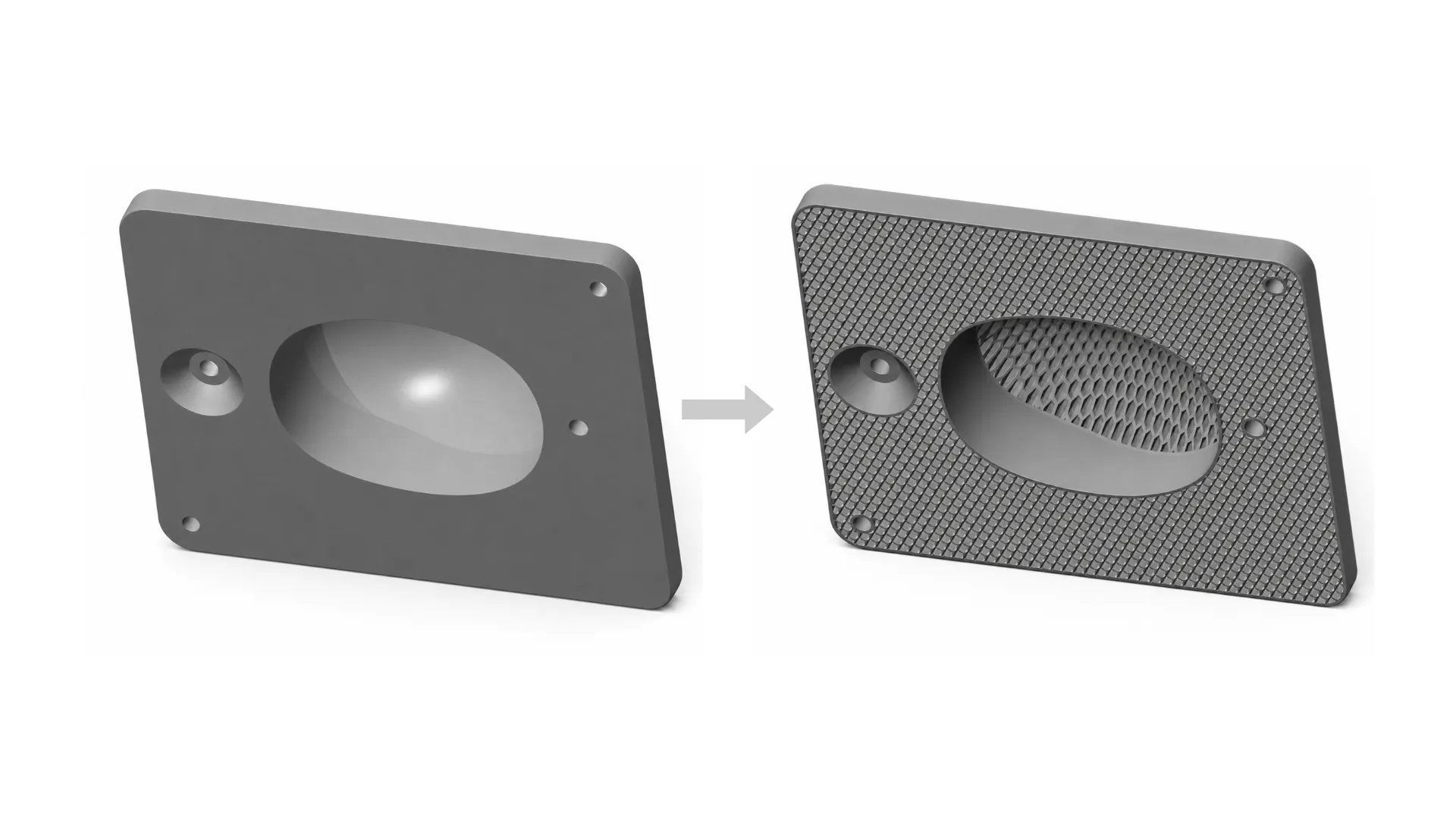

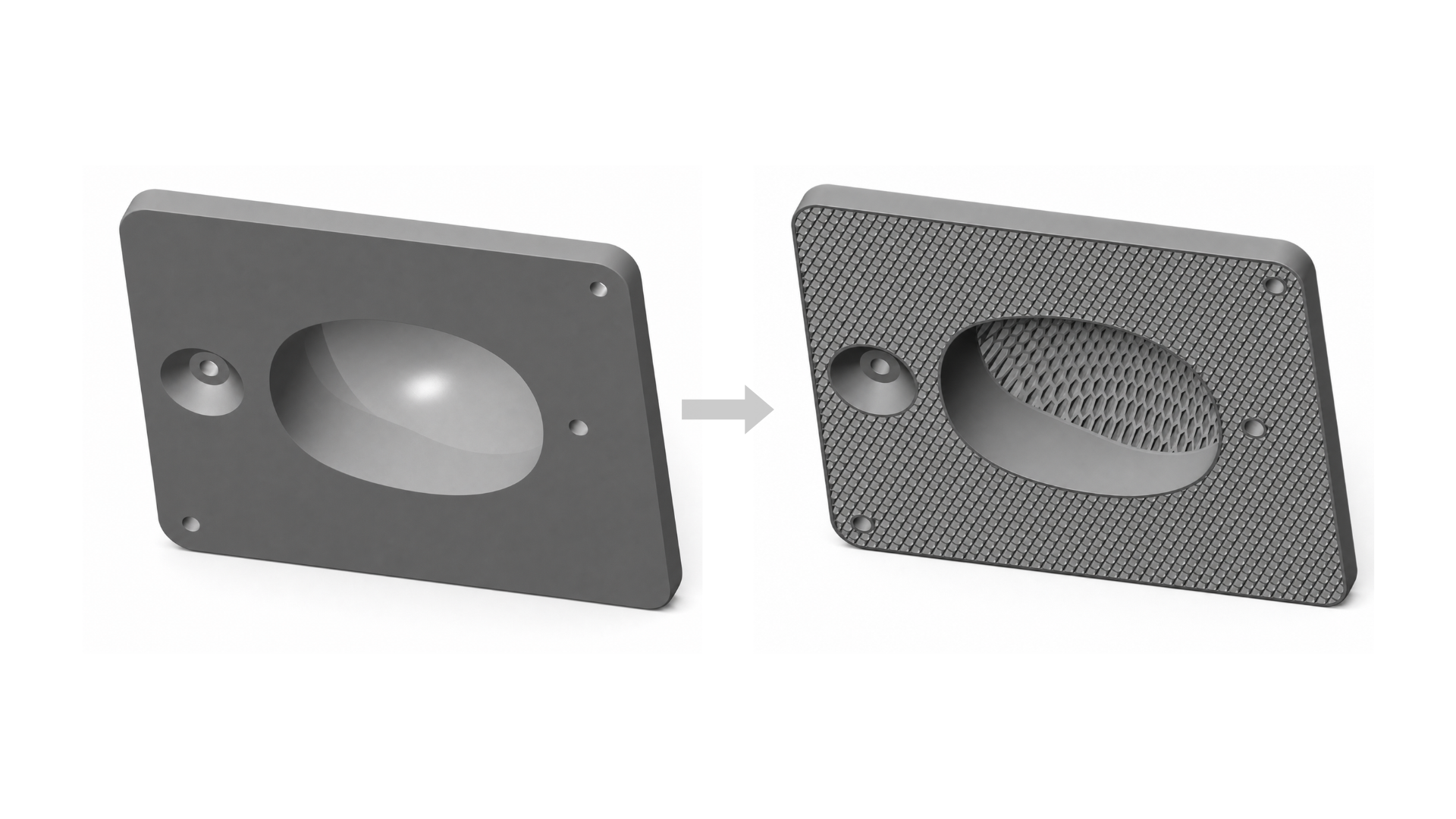
See how a DFAM redesign turned a solid mold's non-working structure into a honeycomb lattice, cutting weight by 50% while preserving its full functional geometry.
Introduction
Hot-press molds are built to survive repeated cycles of clamping force and elevated temperature, and that's exactly why most hot-press tooling defaults to solid, heavy construction.
But that's not really a design choice. Under conventional subtractive manufacturing, a solid non-working surface is simply the default output: material starts as a solid block, and anything left uncut stays solid.
Cutting a complex lattice into that same block would mean more roughing, more corner-clearing, and more setup changes, so manufacturers rarely have a reason to depart from that default. That pattern only began to change once 3D printing made complex structures practical to produce in a single build.
This project applied that shift to a real hot-press mold, keeping every functional surface untouched while rebuilding the rest for weight, cost, speed, and thermal performance.
The Solution
This project focused on a single hot-press mold, with one condition set from the start: the working surface, locating holes, and assembly boundaries had to stay exactly as designed. Nothing about how the mold performs was open for change.
What was open for change was everything else. The non-working surface was redesigned with a honeycomb lattice structure, produced directly through metal 3D printing in a single build rather than multiple machining operations. That single design shift carried through to four measurable outcomes, all achieved without touching the mold's functional geometry:
A lighter mold
Lower material and manufacturing cost
A shorter build cycle
Faster heat dissipation during hot-press cycling
Before and After
The comparison between the two versions makes the redesign logic easy to follow at a glance.
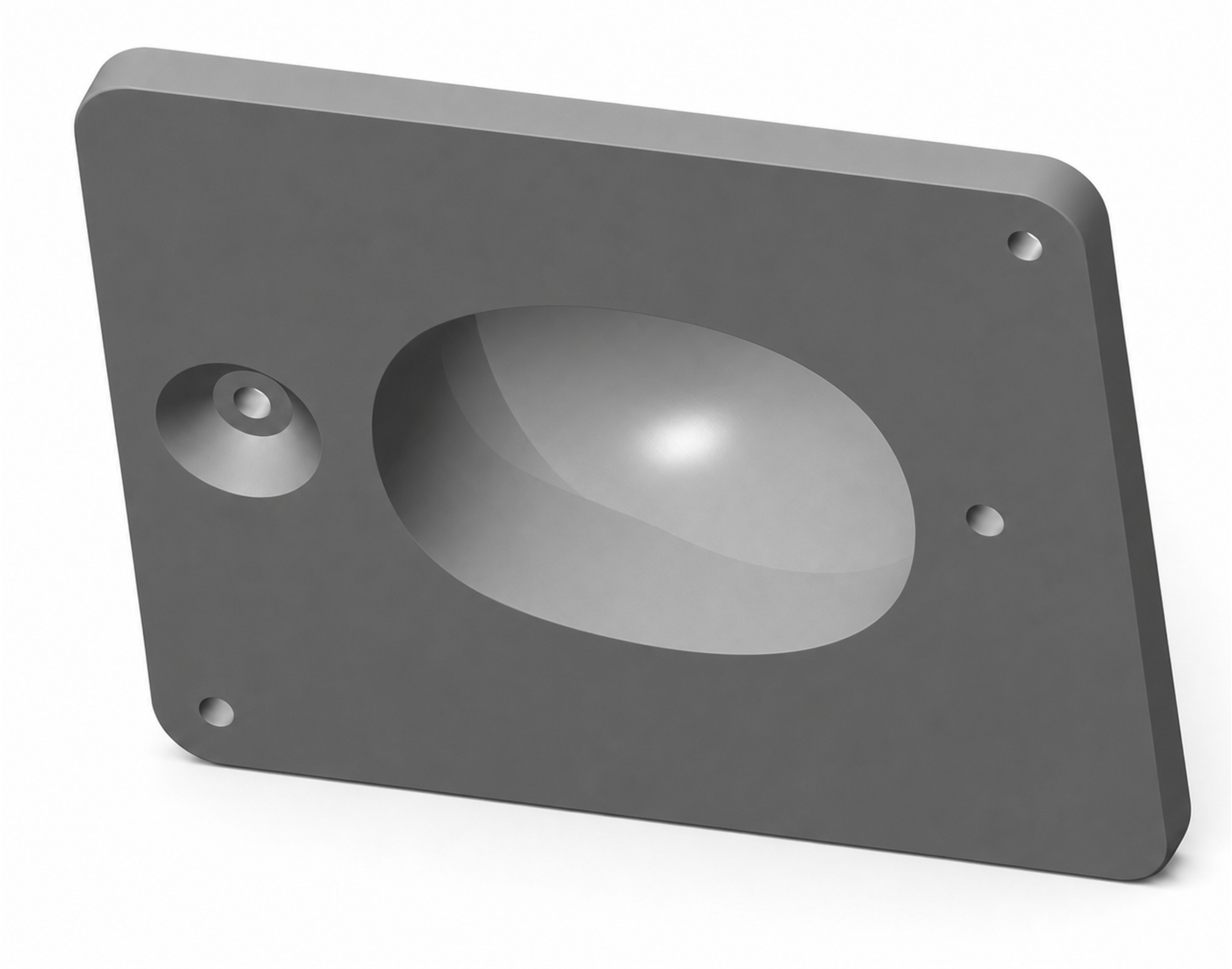
The original design used a fully solid non-working surface. It's a straightforward approach, but a large share of that mass sits in areas that never touch the part or contribute to the mold's functional accuracy.
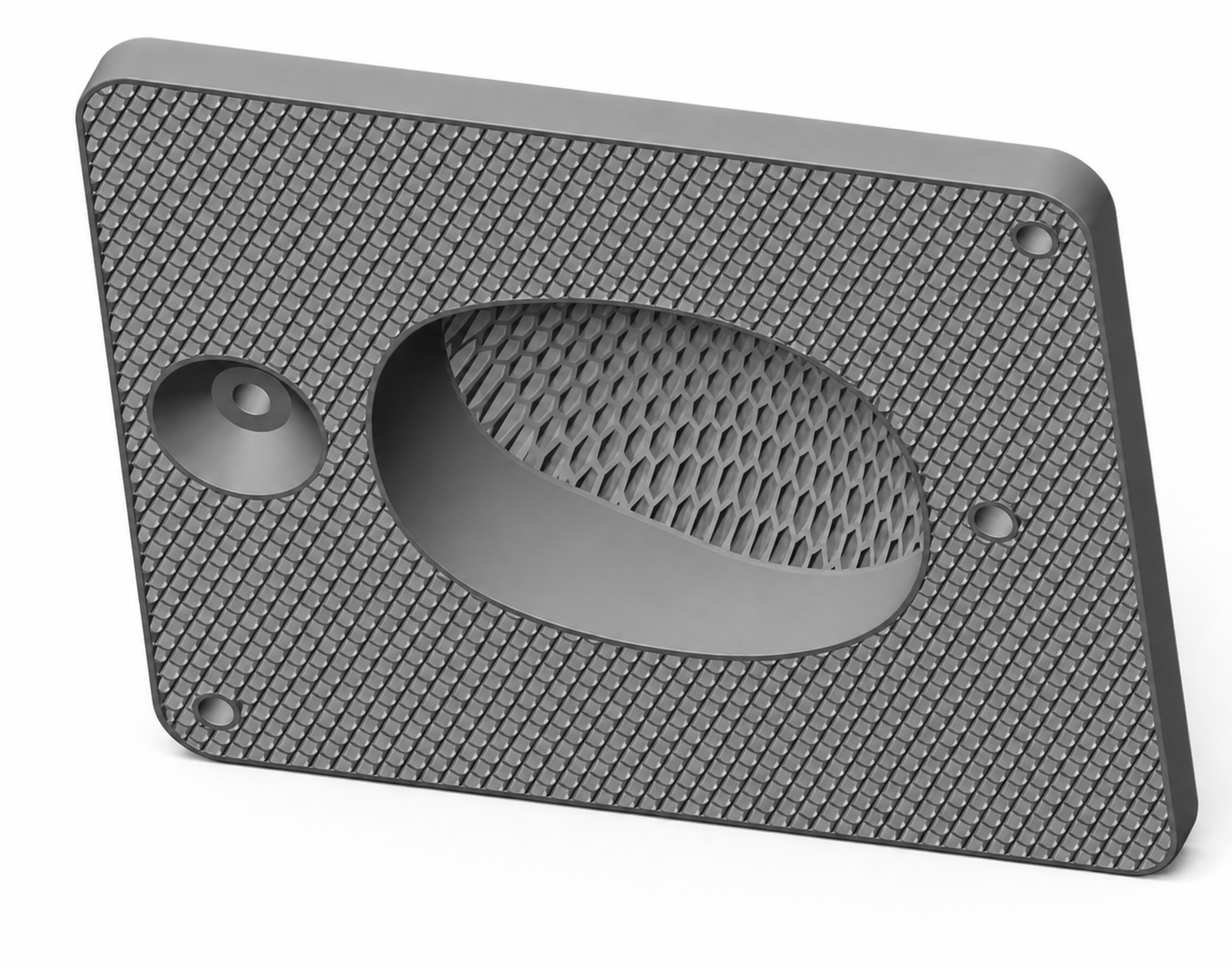
The optimized version replaces that solid backing with a regular honeycomb lattice, while the working cavity, locating holes, and mounting features remain untouched. The lattice pattern stops exactly where function begins. The transition is visible in the geometry itself, not just in the weight number.
Why the Honeycomb Design Works
The honeycomb redesign isn't a single trick that produces one benefit. It changes how the mold uses material, and that change carries through to a connected set of outcomes.
Dimension | What Changed | Why It Matters |
|---|---|---|
Strength & Thermal Performance | The lattice forms a continuous network of ribs that distributes load across the structure instead of relying on one solid mass. That same open geometry also exposes far more surface area than a solid block. | In 316L stainless steel, the rib network provides the strength and fatigue resistance needed for repeated clamping cycles, while the added surface area gives heat more paths to dissipate between hot-press cycles, supporting tighter, more consistent cycle times. |
Cost & Manufacturing Cycle | The mold is produced as a single 3D-printed build, with a smaller build volume than a solid equivalent and no separate roughing, corner-clearing, or setup changes. | Less material and fewer manufacturing steps translate directly into lower cost and a shorter path from design to finished mold, an advantage that would be difficult to replicate through conventional machining. |
Weight | Overall mold weight dropped from approximately 10 kg to approximately 5 kg. | A direct, measurable result of the structural and manufacturing changes above, roughly a 50% reduction with no change to functional geometry. |
Where This Applies
The same principle extends beyond this specific mold: keep the functional surface untouched and rebuild everything else. It applies to a broader set of tooling where weight, material cost, and cycle time all matter:
Metal additive manufacturing molds for other thermal or compression-based forming processes
Jigs and fixtures used in production and inspection workflows
Automation fixtures that are handled or repositioned frequently, where lower mass speeds up changeovers
Vacuum tooling and other function-driven industrial components that need to balance structural support with reduced weight
In each case, the redesign question is the same: which surfaces are doing functional work, and which ones are simply carrying mass because that's how they've always been built.
Conclusion
If you're working on a mold, fixture, or similar tooling component, our engineering team can review the design for manufacturability and identify where weight, cost, or cycle time could be improved without compromising functional geometry.
DFM feedback is free. Talk to Unionfab's engineering team about reviewing your mold or tooling design for manufacturability improvements.
Want to know what your part would cost? Upload your file and get an instant quote in minutes.