

Compare stainless steel vs titanium exhaust systems in weight, durability, sound, and cost. Learn which material suits your driving needs best.
Introduction
If you are upgrading or customizing your car’s exhaust system, one important question often arises — should you choose stainless steel or titanium?
The answer depends on how you balance performance, durability, weight, and cost. Both stainless steel and titanium are excellent choices for exhaust systems, but each offers unique benefits and trade-offs.
In this article, we take a closer look at stainless steel vs titanium exhaust, analyzing them from the perspectives of material properties, performance, longevity, cost-efficiency, installation, and maintenance.
By the end of this guide, you will clearly understand:
How stainless steel and titanium differ in structure and performance.
Which material fits your driving style and budget best.
What practical factors matter most in real-world use and maintenance.
Whether you are building a high-performance race car or upgrading a daily driver, this comparison will help you make a confident, informed decision.
Why Exhaust Material Matters
The Role of the Exhaust System
The exhaust system does far more than release gases — it directly shapes a vehicle’s power, balance, and driving feel. A well-engineered exhaust optimizes:
Back pressure, to maintain smooth exhaust flow and efficient engine performance.
Heat management, keeping components within safe operating temperatures.
Sound quality, influencing tone and resonance from subtle to aggressive.
Weight distribution, which affects handling and acceleration response.
In high-performance vehicles, even small design or material differences in the exhaust system can create noticeable effects on power delivery and sound signature.
Why Material Choice Is Crucial
The exhaust material defines how the system performs under stress, heat, and long-term use. Each property influences durability and efficiency:
Property | Material Impact | Result |
|---|---|---|
Wall thickness | Determines total system weight | Influences vehicle balance |
Thermal expansion | Affects structural stability | Prevents cracking and fatigue |
Corrosion resistance | Ensures longer service life | Reduces maintenance costs |
Heat tolerance | Controls performance at high RPM | Improves reliability |
Acoustic behavior | Shapes resonance and tone | Alters sound character |
For daily drivers, resistance to corrosion and ease of maintenance are top priorities;
For performance builds, lighter and more heat-resistant materials like titanium provide a distinct advantage in handling and throttle response.
Matching Material to Application
Every vehicle has a different purpose, and that purpose should guide your material choice:
Usage Scenario | Key Priorities | Recommended Material |
|---|---|---|
Daily commuting | Durability, affordability | Stainless steel |
Performance modification | Weight reduction, sound | *Titanium |
Track or racing | Heat endurance, precision | *Full titanium |
*Notes:
Titanium exhaust: Uses titanium for some or most parts, with certain sections still made of stainless steel.
Full titanium exhaust: made completely from titanium.
Selecting the right material can balance performance, longevity, and cost — ensuring your exhaust system performs exactly as intended.
Stainless Steel Exhaust Systems
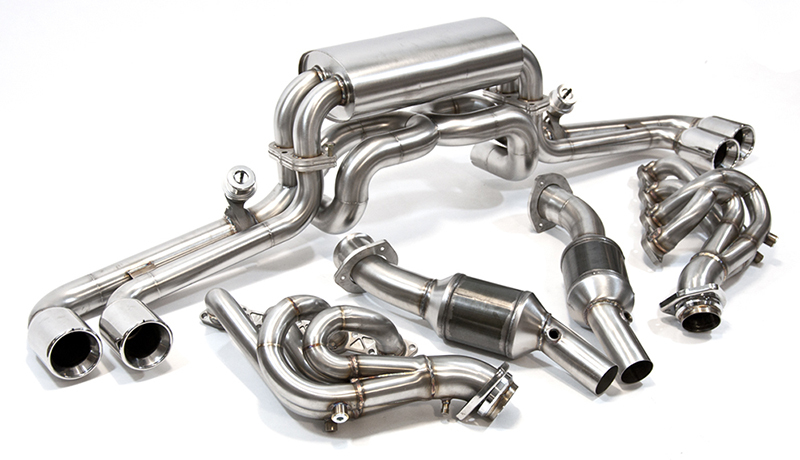
Source: Powerflow Exhausts
Stainless steel is an iron-based alloy that contains chromium and nickel, giving it excellent resistance to corrosion and oxidation. It’s one of the most widely used materials for exhaust systems due to its balance between cost, strength, and durability.
The most common stainless steel grades used in automotive exhaust manufacturing are:
Grade | Key Properties | Typical Application |
|---|---|---|
304 Stainless Steel | Excellent corrosion resistance and good formability | Performance and aftermarket exhausts |
409 Stainless Steel | More affordable, moderate corrosion resistance | OEM and cost-conscious builds |
316L Stainless Steel | Superior resistance to salt and chemicals | Marine or coastal environments |
Advantages of Stainless Steel Exhausts
Stainless steel remains the go-to material for most factory and aftermarket exhaust systems for several reasons:
Durability and longevity – it withstands high temperatures and daily wear extremely well.
Cost efficiency – significantly more affordable than titanium, making it suitable for large-scale production.
Ease of fabrication – it’s easier to bend, weld, and repair compared to titanium.
Corrosion resistance – performs well under rain, humidity, and mild salt exposure.
These traits make stainless steel a versatile and reliable choice for drivers who want long-term performance without overspending.
Limitations of Stainless Steel Exhausts
While stainless steel performs well in most environments, it does have a few limitations to consider:
Heavier weight – stainless steel systems are considerably heavier than titanium, which can slightly reduce acceleration and handling response.
Heat discoloration – over time, exposure to extreme temperatures can cause surface dulling or yellow tint.
Corrosion in harsh conditions – in salty or coastal regions, surface oxidation can occur, especially on lower-grade steel.
Sound characteristics – compared with titanium, stainless steel produces a deeper and smoother tone, rather than the sharp, metallic resonance associated with race systems (Urban Exhaust).
These factors make stainless steel better suited for durability and practicality, rather than ultra-lightweight or competition-level builds.
Ideal Applications
Usage Type | Description | Why It Fits |
|---|---|---|
Daily driving | Commuting, long-term use | Resistant, affordable, and low maintenance |
Mild modification | Street performance upgrades | Offers a balance between power and cost |
All-weather vehicles | SUVs, trucks, or city cars | Handles varying environments reliably |
If your main goal is dependable performance with reasonable cost and minimal upkeep, stainless steel is a smart and proven choice. It offers excellent value and durability for both stock and lightly modified vehicles.
Titanium Exhaust Systems
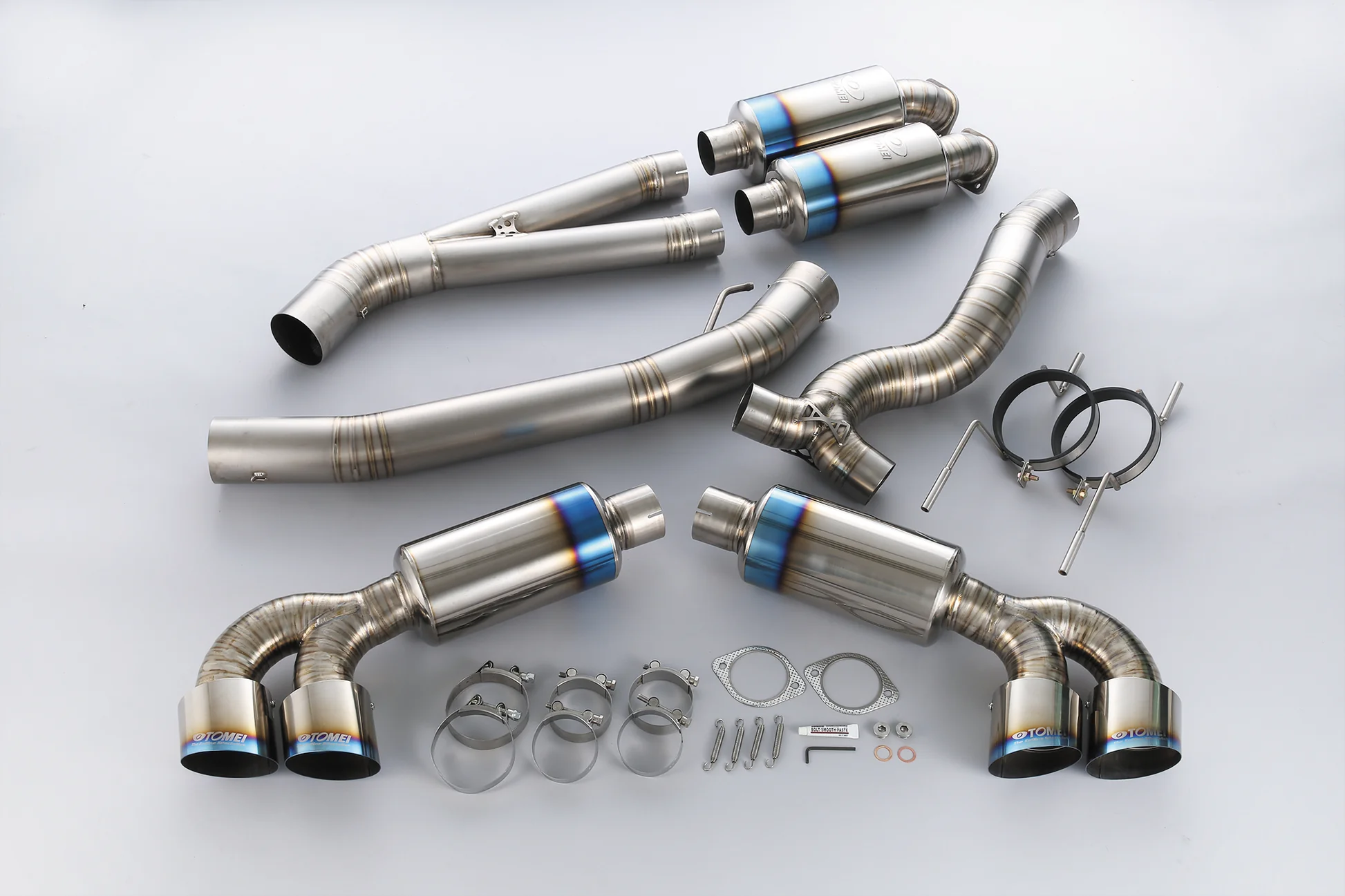
Source: TOMEI
Titanium is a lightweight, high-strength metal widely used in aerospace and motorsport applications. Compared with stainless steel, titanium has a much lower density — roughly 40–50% lighter. This weight reduction plays a major role in improving a vehicle’s agility and acceleration.
In addition to its low density, titanium maintains structural integrity under extreme heat and stress, making it ideal for exhaust systems that experience continuous high-temperature cycles.
Property | Titanium | Stainless Steel |
|---|---|---|
Density | ~4.5 g/cm³ | ~7.9 g/cm³ |
Weight Difference | 40–50% lighter | Heavier |
Melting Point | ~1668°C | ~1450°C |
Strength-to-Weight Ratio | Excellent | Moderate |
Titanium’s combination of lightness, heat resistance, and corrosion resistance explains why it’s favored in racing, supercars, and performance tuning applications.
Key Advantages of Titanium Exhausts
Titanium exhaust systems are known for their high-end performance characteristics and visual appeal.
Significant weight reduction – Up to 50% lighter than stainless steel, improving acceleration, braking, and cornering.
Exceptional heat and strength performance – Maintains strength under constant exhaust heat cycles and extreme operating conditions.
Unique appearance – When heated, titanium develops a signature blue-purple tint, often seen in high-end racing systems.
Distinct sound signature – Titanium produces a sharper, higher-frequency tone with more metallic resonance, delivering a race-inspired auditory experience.
These benefits make titanium the material of choice for performance enthusiasts who value both engineering precision and aesthetic impact.
Limitations of Titanium Exhausts
Despite its impressive performance, titanium also presents several practical drawbacks:
High cost – Titanium material and fabrication are considerably more expensive than stainless steel.
Complex manufacturing – Requires specialized TIG welding and precision control during forming.
Maintenance sensitivity – Prone to discoloration and oxidation if not properly cleaned or stored.
Durability concerns in certain environments – Salt spray, gravel impact, and moisture can gradually degrade surface finish if not protected.
Overkill for daily use – For drivers focused on cost-effectiveness and routine commuting, titanium may not justify the price.
These limitations don’t reduce titanium’s engineering value but highlight the importance of application-based selection.
Ideal Applications
Titanium exhaust systems are built for performance-oriented scenarios where every gram and degree matters.
Vehicle Type | Recommended Reason | User Profile |
|---|---|---|
High-performance sports cars | Maximum weight savings and superior heat control | Track or supercar owners |
Modified or tuned cars | Sharp sound and aesthetic value | Enthusiasts upgrading for performance and design |
Racing vehicles | Ultimate thermal efficiency and durability | Competitive drivers or professional teams |
If your project involves high horsepower, frequent track use, or you simply appreciate premium craftsmanship and visual impact, titanium exhaust systems are the superior option.
Stainless Steel vs Titanium Exhaust Systems
Weight and Performance Impact
Weight is one of the most defining differences between stainless steel and titanium exhaust systems. Generally speaking, titanium can be 40–50% lighter than stainless steel.
This reduction in weight directly enhances vehicle performance:
Improved power-to-weight ratio, boosting acceleration.
Better handling and braking, as reduced rear-end weight enhances balance.
Lower suspension stress, helping maintain ride quality and chassis longevity.
Material | Average Weight Difference | Effect on Vehicle Dynamics |
|---|---|---|
Titanium | 40–50% lighter | Quicker throttle response and cornering |
Stainless Steel | Heavier | Slightly slower response, higher stability |
For track or performance-oriented builds, this weight advantage can be a serious competitive gain.
For daily driving, the effect is noticeable but not always essential — which is why choosing based on your usage matters most.
Heat Resistance, Corrosion, and Lifespan
Exhaust systems operate under extreme temperature cycles — especially during spirited or high-load driving — so how each material handles prolonged heat and environmental exposure is critical.
Titanium maintains its strength exceptionally well even at very high exhaust temperatures. It resists heat fatigue and structural deformation over time, which is why it’s favored in motorsport applications.
Stainless steel, while also heat-resistant, may gradually discolor or oxidize after years of use — especially in humid or salt-rich environments. However, with basic care, it still delivers excellent durability for everyday driving.
Property | Titanium | Stainless Steel |
|---|---|---|
Heat resistance | Excellent – retains strength at very high temperatures | Good – may discolor under long-term heat |
Corrosion resistance | Strong in dry conditions | Reliable, but not fully rust-proof in salt environments |
Service life | Very long when well maintained | Long lifespan with periodic care |
In short:
● Titanium is ideal for high-heat, high-performance, aggressive driving conditions.
● Stainless steel remains practical, proven, and more than durable enough for daily or long-term use.
And just like weight, neither is strictly “better” — it depends on the environment and how the car is driven.
Sound, Tone, and Resonance
The material of an exhaust doesn’t just affect performance — it also shapes the character and emotion of the car.
Titanium produces a sharper, metallic, and higher-frequency tone — the kind of sound often associated with motorsport or high-revving performance builds. It feels raw, responsive, and very “alive.”
Stainless steel, in contrast, has a deeper, smoother, and more refined tone. Many daily drivers and grand touring enthusiasts prefer this balanced, non-aggressive acoustic profile.
Material | Sound Character | Typical Use |
|---|---|---|
Titanium | Metallic, crisp, high-frequency | Race and performance cars |
Stainless Steel | Deep, mellow, balanced | Street and touring vehicles |
Neither is “better” — it comes down to personal preference.
If you want a race-inspired presence, titanium delivers it instantly.
If you prefer a mature, premium, or discreet sound, stainless steel often feels more natural.
Cost and Value Comparison
Cost is often the deciding factor for most buyers — and this is where stainless steel and titanium differ very clearly.
Stainless steel offers the best value, with lower manufacturing and maintenance costs.
Titanium commands a premium price, justified only when weight and heat performance are top priorities.
Material | Initial Cost | Maintenance Cost | Overall Value |
|---|---|---|---|
Stainless Steel | Low | Low | Excellent for daily use |
Titanium | High | Moderate to high | Excellent for performance builds |
In short:
If you're aiming for value, longevity, and practicality → stainless steel is ideal.
If every kilogram matters and performance is the focus → titanium makes strategic sense.
Appearance, Style, and Brand Perception
Titanium exhaust systems are easily recognizable for their blue-purple heat tint and ultra-lightweight look. This “burnt finish” gives titanium systems a premium, motorsport-inspired aesthetic.
Stainless steel, on the other hand, has a clean and traditional appearance, making it suitable for understated or OEM-style builds.
Feature | Titanium | Stainless Steel |
|---|---|---|
Visual appeal | Color-shifting heat tones | Polished or brushed silver |
Perception | High-end, motorsport-grade | Reliable, factory-quality |
Target user | Enthusiast or racer | Commuter or practical driver |
There’s no right or wrong choice here — it’s about expression.
Some drivers want the loud visual statement; others prefer subtle performance that doesn’t draw attention — both are valid.
Installation, Maintenance, and Regulations
Installation and upkeep also vary between the two materials:
Stainless steel is easier to weld, repair, and source parts for — making it better for daily use.
Titanium requires specialized equipment and expertise, typically handled by professional performance workshops.
In regions with sound or emission regulations, the choice of material may affect compliance depending on system design and noise levels.
Factor | Titanium | Stainless Steel |
|---|---|---|
Installation | Complex, precision welding needed | Straightforward |
Maintenance | Specialized cleaning | Easy to maintain |
Legal compliance | May vary with sound output | Usually compliant |
For daily driving, stainless steel provides ease of ownership;
For track cars, titanium rewards expertise with top-tier performance.
Environment, Maintenance, and Resale Value
The driving environment strongly affects material longevity.
● Coastal or humid regions: stainless steel can experience minor corrosion over time; titanium is more stable in dry air.
● Maintenance: titanium needs gentle care to prevent surface oxidation; stainless steel can be polished back to its original shine.
● Resale value: titanium exhausts typically hold higher second-hand value due to material rarity and performance reputation.
Factor | Titanium | Stainless Steel |
|---|---|---|
Best climate | Dry or moderate | All-weather |
Maintenance level | Moderate | Low |
Resale potential | High | Moderate |
Overall, both materials have clear advantages depending on use case and budget. Still unsure which exhaust suits your needs? Talk to our experts to find your best performance-to-value option.
Buying Guide & Practical Recommendations
Choosing the Right Material for Your Needs
Selecting the correct exhaust material starts with understanding your driving habits and goals. Each type of driver benefits differently from stainless steel or titanium:
Driving Scenario | Key Priorities | Recommended Material |
|---|---|---|
Daily driving with limited budget | Durability, low maintenance | High-quality stainless steel (304 or 316L) |
Performance or modified vehicles | Lightweight, heat resistance, aggressive sound | Full titanium |
Mixed use (commuting + occasional tuning) | Balanced performance and cost | Hybrid setup — stainless steel piping with titanium tips or mufflers |
Installation and Manufacturing Considerations
The manufacturing quality of an exhaust system can be as critical as the material itself. Key factors include:
Material verification – ensure proper grade (304/316L stainless or aerospace-grade titanium).
Welding quality – uniform TIG welds prevent leaks and maintain strength.
Bending technique – titanium often uses pie-cut bends, while stainless can accommodate smoother large-radius bends.
Joint sealing & support – all interfaces must be tight to prevent vibration or exhaust leaks.
Heat management – proper shielding protects nearby components from excessive radiant heat.
Budget Planning and Value Assessment
Before purchasing, outline your budget-to-performance ratio. Titanium offers significant weight and heat benefits but comes at a higher price. Stainless steel delivers exceptional durability and overall value.
Budget Focus | Key Benefit | Example Outcome |
|---|---|---|
Cost control | Affordable & long lifespan | Stainless steel exhaust with minimal maintenance |
Performance focus | Lightweight & responsive | Titanium saves several kilograms, improving handling |
Balanced upgrade | Best mix of both | Stainless steel base + titanium tip or muffler |
A helpful approach is to estimate your performance gains per dollar — how much weight reduction, acceleration improvement, or durability you achieve for each investment
If you want to understand your investment value clearly, compare how much weight reduction or performance gain you achieve for each upgrade level.
Get a precise cost calculation from Unionfab engineers to plan your next performance upgrade effectively.
Common Misconceptions and Mistakes to Avoid
Even experienced enthusiasts can misjudge material choice. Keep these insights in mind:
● Myth: Titanium is always better.
For regular commuting, high-quality stainless steel is often more practical and budget-friendly.
● Myth: Material alone defines performance.
Design, welding, and pipe geometry have equal or greater influence.
● Mistake: Cheap titanium equals good value.
Poor fabrication or low-grade alloys can result in cracking or poor sound quality despite the premium label. A well-engineered stainless steel exhaust can easily outperform a low-quality titanium setup.
Drivers seeking a reliable upgrade path may start with stainless steel for flexibility and later switch to titanium for ultimate performance and exclusivity.
If you’d like expert guidance before deciding, our team can review your build requirements — and we offer a 10% introductory discount for your first custom exhaust project.
FAQs
1. What’s the best metal to use for an exhaust?
The best metal depends on your needs. Stainless steel is ideal for daily drivers who value cost efficiency and long-term durability, while titanium is better suited for performance cars that prioritize weight reduction, heat resistance, and a distinctive sound.
2. Which is better, stainless steel or titanium?
Neither is universally better — it depends on the application. Stainless steel offers excellent value and resilience for most vehicles, whereas titanium provides top-tier performance for high-end or racing builds where every kilogram matters.
3. Does titanium change the sound of an exhaust?
Yes. Titanium produces a sharper, more metallic tone with higher frequencies, often preferred in racing or sport applications. Stainless steel, by contrast, delivers a deeper and smoother sound more suited to street use.
4. What’s the cost difference between stainless steel and titanium exhausts?
Titanium exhaust systems are generally two to three times more expensive than stainless steel due to material cost and complex fabrication. However, the added performance and reduced weight can justify the investment for serious enthusiasts.
5. What are the pros and cons of stainless steel vs titanium exhausts?
Feature | Stainless Steel | Titanium |
|---|---|---|
Weight | Heavier | 40–50% lighter |
Cost | Affordable | Expensive |
Durability | Excellent for daily use | Excellent under extreme heat |
Sound | Deep and mellow | Sharp and metallic |
Best For | Everyday vehicles | Performance and racing builds |