
![Custom Dash Cluster [+Cost Calculator]](https://ufc-dtc-cms.oss-accelerate.aliyuncs.com/blog/20250831/135804_is9gaizs9.png)
Discover how 3D printing transforms custom dash clusters for vintage cars, racing, and personalization. Unionfab offers SLA resin, SLS/MJF nylon, and vacuum casting solutions with automotive-grade quality.
Introduction
For performance builds, restorations, and bespoke interiors, the custom dash cluster is the driver’s primary interface—where ergonomics, aesthetics, and real-time telemetry converge.
In this domain, 3D printing has moved well beyond prototyping; it is a mature production method that repeatedly proves its value in low-volume, high-fitment automotive customization and interior upgrades.
● Luxury vehicle customizer Ai Design shortened development time by weeks and cut costs on one-off interior parts by up to 40% by shifting bespoke dash/in-cabin components (e.g., iPad-integrated center dash housings) to FDM 3D printing with Stratasys Direct, ensuring OEM-grade finish and precise fitment.
● HRE Wheels (aftermarket performance) partnered with GE Additive to 3D print titanium wheel centers, reducing total wheel mass by 19% (20" from 20 lb to 16 lb) and slashing material waste from 80% to ~5%, demonstrating production-viable weight savings for custom builds.
● Porsche Classic (factory restoration program) validated on-demand 3D printed service parts for classic models—parts passed stringent testing (e.g., pressure loads near three tonnes) while meeting original spec, enabling small-batch, exact-fit replacements when traditional supply is unavailable
Together, these signals show a consistent trend: additive manufacturing is unlocking reliable, measurable gains in custom interiors and retrofit components where precision fit, speed, and low-volume economics matter most.
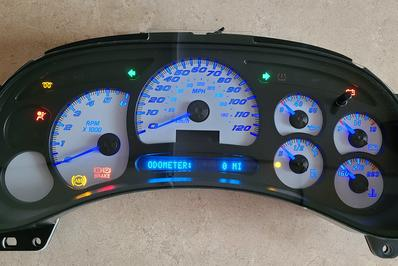
Source: Silverado Cluster
So why cling to traitional methods for custom dash clusters when AM now removes tooling barriers and accelerates iteration?
Traditional Manufacturing vs. AM – Why Change?
In conventional production, custom dash clusters are made using CNC machining for metal housings, injection molding for plastic bezels, and manual assembly for integrating gauges and mounts.
While effective in large-scale manufacturing, these methods reveal critical limitations in small-batch or personalized applications.
● High Tooling Cost & Slow Innovation
Injection molding requires expensive tooling, directly causing long lead times and prohibitive costs for low-volume or one-off dash cluster projects.
● Limited Geometry → Restricted Design
FlexibilityCNC and molding cannot achieve complex contours or integrated layouts, directly preventing ergonomic shapes and unique gauge arrangements in custom clusters.
● Sub-Assembly Complexity → Increased Failure Points
Producing bezels, brackets, and reinforcements separately and assembling them later increases labor demand and introduces more potential failure points under vibration.
● Material Constraints → Reduced Durability
Conventional plastics like ABS degrade under heat and UV exposure, directly leading to warping, discoloration, and shorter service life inside vehicle cabins.
These challenges highlight the need for a new manufacturing approach—one that eliminates tooling barriers, unlocks design freedom, and delivers durable, reliable results.
AM Value
Additive manufacturing directly resolves each of these pain points by converting technological capabilities into tangible performance and commercial value for custom dash clusters.
Rapid Iteration Through Tool-less Manufacturing
3D printing eliminates the need for molds, meaning designs can be adjusted and produced directly from CAD files. For dash clusters, this transforms tooling-related cost and time into rapid prototyping and small-batch production, enabling quick adaptation to customer requests and shortening project timelines.
Expanded Design Flexibility Through Complex Geometries
AM allows the creation of complex, organic, and ergonomic shapes that CNC or molding cannot replicate. Applied to clusters, this means bezels can seamlessly integrate additional gauges, follow unique dashboard contours, or embed non-standard interfaces—delivering superior ergonomics and personalization.
Reliability Through Part Consolidation
Additive processes can integrate multiple functions—mounts, ribs, and connectors—into a single solid print. This directly reduces the need for separate sub-assemblies, lowering labor time and minimizing failure risks, ultimately yielding dash clusters that are more robust in vibration-heavy automotive environments.
Long-Term Performance Through Advanced Materials
With high-performance polymers such as ASA, nylon (PA12), and carbon-fiber-reinforced composites, AM delivers components that resist heat above 70°C and UV degradation. For custom dash clusters, this ensures sustained appearance and structural stability, overcoming the durability issues of traditional ABS parts.
By mapping directly to the shortcomings of traditional processes, additive manufacturing proves itself as not only a technical enabler but also a commercial accelerator for custom dash cluster applications.
Materials & Process Selection
Selecting the correct process–material combination is critical for balancing cost, performance, and reliability in custom dash cluster projects.
The best choice depends on the intended use: whether the part is only a visual prototype, a small-batch production run, or a premium build requiring maximum performance.
1. SLA 3D Printing with Photopolymer Resin – For Prototyping and Display
Process: SLA (Stereolithography) builds parts layer by layer using a UV laser that cures liquid resin into a solid shape.
Material: Standard or high-detail photopolymer resin.
Why it’s suitable:
Exceptional accuracy and smooth surface finish, ideal for design validation and aesthetic mockups.
Fast turnaround for prototypes, supporting quick iterations and client approval.
2. Silicone Vacuum Casting – For Cost-Effective Small-Batch Production
Process: A high-resolution SLA master model is first printed, then used to make a silicone mold. The mold is filled with polyurethane or epoxy-based casting resins to replicate parts in batches.
Material Options:
ABS-like Casting Resin (recommended): Balanced toughness, machinability, and cost efficiency; most suitable for dash cluster bezels and housings.
Transparent Casting Resin: For optical or backlit features, though less durable.
High-Temp Casting Resin: For slightly higher heat tolerance, but at a higher cost.
Why it’s suitable:
Perfect for runs of 10–100 units, delivering near-injection-molding quality without the cost of hard tooling.
Flexible material choices allow balance between cost, durability, and appearance.
Limitations:
Each silicone mold typically lasts for 20–25 shots, requiring remolding for larger volumes.
Performance is good for interiors but still below engineering-grade thermoplastics in extreme conditions.
3. 3D Printing Nylon (MJF / SLS) – For Premium End-Use Performance
Process: Multi Jet Fusion (MJF) or Selective Laser Sintering (SLS) fuse fine nylon powder layer by layer using heat or laser energy.
Material: Nylon PA12 (optionally carbon-fiber reinforced).
Why it’s suitable:
High heat resistance (~120°C), ensuring stability inside hot car cabins.
Excellent UV resistance compared to ABS, preventing yellowing or brittleness.
Strong, lightweight, and durable under vibration and mechanical stress.
Material Comparison Table
Property / Material | SLA Photopolymer Resin | ABS-like Casting Resin (Vacuum Casting) | Nylon PA12 (MJF / SLS) |
|---|---|---|---|
Max Operating Temperature | ~50–60°C ★★☆☆☆ | ~90–105°C ★★★★☆ | ~120°C ★★★★★ |
UV Resistance | Poor ★★☆☆☆ (yellows, cracks) | Moderate ★★★☆☆ | Excellent ★★★★☆ |
Strength & Toughness | Brittle ★★☆☆☆ | Good ★★★★☆ (similar to ABS) | High ★★★★☆ |
Surface Finish | Very Smooth ★★★★★ | Smooth with mold polish ★★★★☆ | Rough as-printed ★★☆☆☆ (requires post-processing) |
Relative Cost | Low ($) | Medium ($$) | High ($$$$) |
Post-Processing Requirements | UV curing, minimal sanding | Mold finishing, optional painting | Sanding, sealing, dyeing, painting |
Best Suited Technology | SLA (for prototype/demo only) | SLA + Silicone Casting (small batches) | SLS or MJF (premium builds) |
Typical Use Case | Design validation, display models | Cost-effective low-volume production of clusters | High-performance custom builds with budget flexibility |
Summary & Recommendations
For design validation or showroom display, SLA resin printing is the most practical solution, offering speed and aesthetics but not functional reliability.
For small-batch, cost-effective production, the SLA + silicone casting route with ABS-like resin is the optimal choice, providing durability and appearance at a fraction of tooling costs.
For premium end-use performance with no budget constraints, MJF/SLS Nylon PA12 is the go-to option, delivering superior heat and UV resistance, though it requires significant post-finishing to achieve OEM-level aesthetics.
Choosing the right solution depends on your balance of budget, performance, and visual quality. Unionfab offers all three options—prototyping, vacuum casting, and industrial nylon printing—ensuring that your custom dash cluster project is delivered with the right process at the right cost.
Contact Unionfab today to receive a tailored recommendation for your specific needs.
Cost of 3D Printing
When evaluating a custom dash cluster project, understanding the full cost breakdown is essential for making informed decisions. At Unionfab, we provide full transparency by following a clear formula:
Total Cost = Printing Cost (material price × part weight) + Post-Processing Cost + Packaging Fees + Shipping Fees + Customs Duty
Printing Cost
The printing cost is the foundation of every project, and it is determined by two key variables:
Material Price: The raw material cost, typically calculated per gram. Different polymers or composites have different price points based on their performance properties.
Part Weight: This is calculated as model volume × material density. The volume can be directly obtained from CAD software, while density values are specific to each material type.
Calculation Example
Material: Nylon PA12 (commonly used for end-use custom dash clusters due to its heat resistance and durability).
Example Price: $0.25 per gram.
Example Weight: 200 g (derived from CAD volume × PA12 density).
Printing Cost: $0.25 × 200 g = $50.00
With Unionfab’s automated online quoting system, customers can upload their CAD files, instantly calculate weight and material usage, and receive an estimated cost within seconds.
Note: This example price is for demonstration purposes only; please contact our sales team for a formal quotation tailored to your project.
For larger batch orders, our team can offer volume-based discounts and negotiated pricing to ensure maximum cost-efficiency.
Other Costs
Beyond the printing cost, several additional factors contribute to the total project cost:
Post-Processing Cost: Every order includes a complimentary default finishing service (support removal and sandblasting). For enhanced requirements such as polishing, heat treatment, plating, or leather/Alcantara wrapping, additional charges apply depending on the complexity and material type.
Packaging Fees: Standard protective packaging is included; specialized or export-grade packaging may incur extra charges.
Shipping Fees: Rates depend on destination, weight, and delivery speed. Express shipping options are available for urgent projects.
Customs Duty: International orders may be subject to local import duties and taxes, which vary by region.
For clients seeking a deeper dive into these variables and how they interact, we have prepared a comprehensive resource: see our full pricing guide here.
Design-for-AM Tips
Designing a custom dash cluster for additive manufacturing (AM) requires more than just uploading a CAD model. By applying design-for-AM (DfAM) principles, customers can optimize parts for both aesthetics and functionality, ensuring that the final product meets expectations for appearance, durability, and cost efficiency. The optimal design approach depends on the intended use case.
a. Prototyping and Display with SLA Photopolymer Resin
When using SLA resin for prototypes or display units, the design focus should be on achieving smooth surfaces and fine detail accuracy:
Wall Thickness Control: Maintain a minimum wall thickness of 1.5–2 mm to prevent warping or cracking during curing.
Support Orientation: Design parts with flat surfaces oriented downward and delicate features angled upward to minimize support marks on visible areas.
Detail Emphasis: Include small design features such as engraved logos, backlit symbols, or button outlines, since SLA can reproduce intricate details at high resolution.
Finish-Ready Surfaces: Anticipate areas that may require painting or coating, and keep those faces as flat or gently curved as possible for easier finishing.
b. Small-Batch End-Use Production
Option 1: Silicone Casting with ABS-like Resin
For cost-effective small-batch clusters, models should be optimized to extend mold life and ensure consistent replication:
Draft Angles: Add 1–2° draft to vertical walls to simplify demolding and reduce wear on silicone molds.
Uniform Wall Thickness: Keep wall thicknesses consistent (2–3 mm) to prevent sink marks or warpage during casting.
Integration of Features: Where possible, integrate bosses or mounting points into the master design, reducing the need for secondary machining.
Surface Preparation: Smooth the SLA master model (used to make molds) thoroughly, since every surface imperfection will transfer into cast parts.
Option 2: Direct 3D Printing in Nylon (MJF / SLS)
For high-performance builds using PA12 or reinforced nylon, designs should accommodate the unique nature of powder-based printing:
Avoid Thin Walls: Design walls no thinner than 2 mm to ensure mechanical stability and prevent breakage under vibration.
Lattice or Rib Structures: Incorporate internal ribbing or lattice patterns to increase stiffness without excessive weight.
Allow for Post-Finishing: Expect sanding, sealing, or coating, so avoid extremely tight cosmetic tolerances directly on the printed surface.
Moisture Consideration: Add design features (e.g., drainage or sealing edges) if the part may be exposed to humidity, since nylon can absorb moisture.
By tailoring the design strategy to the chosen process and material, customers can dramatically improve both visual quality and functional performance.
Our engineering team at Unionfab offers complimentary design-for-manufacturing (DFM) feedback. Upload your CAD files today to receive expert guidance on how to optimize your custom dash cluster design for the chosen AM process.
Application Scenarios of Custom Dash Cluster
When it comes to automotive customization, a custom dash cluster is one of the most impactful upgrades. From classic car restorations to racing modifications and small-batch specialty builds, 3D printing has become the go-to manufacturing solution.
By combining design flexibility with cost efficiency, Unionfab helps international customers achieve unique dashboards that traditional manufacturing methods cannot deliver.
Vintage Car and Classic Restoration
Many vintage cars—such as Holden classics, early-generation Mustangs, and BMW E-series models—face the same issue: the original instrument housings have cracked, faded, or warped over time, and OEM parts are no longer available.
With 3D printing, it is possible to:
● Reproduce discontinued dash cluster housings with precise fit and authentic look.
● Integrate modern electronic gauges into retro-style bezels while preserving the classic aesthetic.
This makes additive manufacturing the ideal solution for enthusiasts who want to restore their vehicles while enhancing functionality.
Racing and Performance Modification
In motorsports and high-performance car builds, drivers often replace mechanical gauges with lightweight digital dashboards. Traditional housings do not provide the durability, vibration resistance, or installation flexibility required for racing.
Custom dash clusters made with 3D printing offer:
● Secure mounting for digital displays and sensors.
● Optimized viewing angles and ergonomic layouts.
● Lightweight designs that reduce overall vehicle mass.
For racing teams, this means faster iteration and robust performance under extreme conditions.
Personalized Upgrades and Aesthetic Enhancement
For car owners who want a unique interior, the factory dash cluster often looks too standard or outdated. Whether for a show car, an exhibition vehicle, or a personal daily driver, customization adds value and individuality.
Through 3D printing, Unionfab can deliver:
● Redesigned housings with unique shapes, colors, or surface textures.
● Integration of premium finishes such as leather, Alcantara, or metallic coatings.
● Dash clusters that maintain original functionality while achieving a distinctive look.
This application is especially popular for display cars and aftermarket interior upgrades.
Low-Volume Specialty Vehicles
Prototype cars, research vehicles, and niche commercial builds often lack compatible off-the-shelf dash clusters. Traditional injection molding requires expensive tooling that is not feasible for small runs.
3D printing solves this challenge by:
● Enabling affordable, small-batch production of custom dash clusters.
● Providing flexible design adjustments without tooling costs.
● Allowing rapid delivery of parts for projects requiring only a few units.
This makes additive manufacturing the best fit for specialty or experimental vehicles where agility and cost-efficiency are crucial.
Summary of Custom Dash Cluster Scenarios
● Vintage Restoration: Exact-fit replacements for discontinued OEM housings.
● Racing Modification: Lightweight, durable housings for digital dashboards.
● Personalization: Stylish, unique designs tailored to individual preferences.
● Specialty Low-Volume Vehicles: Flexible, affordable solutions without tooling investment.
Each application scenario highlights the versatility of 3D printing in producing custom dash clusters. Whether you need a prototype, a show-ready display, or a functional end-use component, Unionfab provides the right combination of process, material, and finishing to match your requirements.
Upload your CAD file today to get 10% discount for your first order with us!
Unionfab’s Related Services for Custom Dash Cluster
Unionfab provides a full range of industrial 3D printing and small-batch manufacturing services designed for the unique demands of custom dash clusters.
From high-detail prototypes to rugged end-use parts, we combine advanced technologies with professional finishing to ensure your parts look and perform at an automotive-grade standard.
SLA 3D Printing – Bring Every Detail to Life
Our SLA (stereolithography) printing delivers outstanding surface smoothness and precision. Using high-quality resin materials, Unionfab can create prototypes that capture every fine detail—from subtle bezel curves to intricate gauge markings.
This makes SLA the best choice for:
● Prototype Validation: Verify ergonomics, fit, and style before committing to production.
● Display Models & Show Cars: Achieve a polished, presentation-ready appearance.
● Design Iteration: Quickly test different layouts or overlay designs without high costs.For clients developing custom dash clusters, SLA ensures that what you see in your CAD file is exactly what you hold in your hands.
SLS 3D Printing – Durable Nylon for Real Driving Conditions
When your project requires end-use performance, Unionfab’s SLS (Selective Laser Sintering) service with Nylon PA12 and reinforced materials provides unmatched durability. Our SLS dash cluster parts are:
● Heat Resistant: Withstand cabin temperatures exceeding 100°C.
● UV Stable: Maintain color and mechanical strength under direct sunlight.
● Vibration Tough: Designed to survive the stress of daily driving or motorsport environments.This makes SLS the ideal choice for aftermarket housings, racing dashboards, or specialty vehicles where reliability cannot be compromised.
MJF 3D Printing – Fast, Repeatable, and Production-Ready
For customers needing consistent quality across multiple units, Unionfab offers MJF (Multi Jet Fusion) printing. This technology combines production-level speed with excellent mechanical performance, allowing us to deliver:
● Quick Turnaround: Faster production cycles compared to other powder-bed methods.
● Batch Consistency: Reliable strength and accuracy across multiple parts.
● Scalable Volumes: Efficient for both prototypes and low-volume production.MJF is particularly valuable for custom dash cluster projects where time-to-market is critical, or when you need 20, 50, or 100 parts that all meet the same high standard.
Vacuum Casting – Affordable Small-Batch Production
For 10–100 unit runs, Unionfab’s vacuum casting (urethane casting) offers near-injection-molding quality at a fraction of the cost. The process starts with a high-precision SLA master, then silicone molds are used to replicate the design in casting resins.
Benefits include:
● ABS-like Resin Options: Tough and reliable, perfect for functional dash cluster housings.
● Flexible Finishing: Parts can be painted, coated, or textured to match OEM interiors.
● Cost Efficiency: Eliminates the need for expensive injection molds, saving thousands of dollars.This makes vacuum casting the most practical choice for aftermarket suppliers, restoration specialists, and low-volume OEM projects.
Why Partner with Unionfab
Unionfab combines all four processes under one roof, giving customers the freedom to move seamlessly from prototype to production. More importantly, we back every service with:
● Professional Finishing: Sandblasting, painting, sealing, or leather/Alcantara wrapping for premium interiors.
● Automotive Experience: Knowledge of heat, UV, and vibration requirements specific to in-car components.
● Global Reach: Fast quoting, reliable logistics, and support for international customers.
Whether you are restoring a vintage Mustang, designing a racing cockpit, or producing a limited run of specialty vehicles, Unionfab ensures your custom dash cluster meets the highest standards of both design and performance.
FAQs About Custom Dash Cluster
1. Can I change my dash cluster?
Yes, most vehicles allow the dash cluster to be replaced or upgraded. Car owners often install a custom instrument cluster for better aesthetics, digital displays, or racing functionality. With 3D printing dash cluster housings, the process is faster and more flexible compared to sourcing OEM parts.
2. How much does it cost to reprogram a dash cluster?
Reprogramming a dash cluster—mainly to sync the odometer and ECU—typically costs between $75–$150, depending on vehicle type and service provider. The hardware housing itself can be affordably produced via SLA, SLS nylon, or silicone molding, while programming is usually done by certified auto electricians.
3. How to make custom gauge faces?
Custom gauge faces can be created using overlays, decals, or full custom gauge cluster backgrounds. For a premium result, 3D printed bezels combined with digital displays offer complete customization of graphics, colors, and layouts. This method is especially popular for show cars and Chevy truck custom clusters.
4. What is a custom instrument cluster overlay?
A cluster overlay is a decorative or functional layer placed on top of the existing dash cluster. It allows owners to refresh the appearance with new colors, markings, or logos without replacing the entire unit. Unionfab can provide 3D printed overlays and housings that match OEM fit while adding personalized style.
5. Can I get a custom dash cluster for Chevy or Silverado trucks?
Yes, aftermarket custom gauge clusters for Chevy trucks and 99–02 Silverado models are popular upgrades. With 3D printing, Unionfab can replicate OEM-style housings or design new bezels that integrate modern digital instruments into older vehicles.
6. Why choose Unionfab for custom dash cluster printing?
Unionfab offers SLA resin prototyping, SLS nylon printing, and silicone molding services tailored to custom dash clusters. Whether you need a digital instrument cluster, a vintage-style gauge background, or a small-batch overlay run, Unionfab provides automotive-grade quality, fast delivery, and international support.