
Discover 3D-printed heat sink benefits, materials, technologies, costs, key design tips, and guidance on choosing a service provider.
Introduction
As electronics get smaller and more powerful, traditional cooling methods are hitting their limits—and that’s where 3D-printed heat sinks have started making a real impact. In recent years, companies have used metal additive manufacturing to create high-performance heat exchangers for everything from satellite payloads to power electronics.
For example, aerospace engineers have replaced bulky machined blocks with lightweight lattice heat sinks that improve thermal efficiency by more than 30%. Electric vehicle manufacturers are also experimenting with complex fin geometries that can only be produced through 3D printing, achieving faster heat dissipation in compact spaces. Even LED lighting designers have turned to additive manufacturing to create custom heat sinks that reduce weight while maintaining optimal thermal control.
What Is a Heat Sink?
A heat sink is a device used to manage and dissipate heat generated by electronic or mechanical components. By transferring heat away from critical parts like CPUs, GPUs, power transistors, or other high-power modules, heat sinks help prevent overheating, maintain optimal performance, and extend the lifespan of the device.
Heat sinks are typically made from high thermal conductivity metals, most commonly aluminum or copper. They are designed to maximize the surface area in contact with a surrounding fluid, usually air, but sometimes water or specialized dielectric fluids. The heat is conducted from the component into the heat sink and then transferred to the fluid through convection and, to a lesser extent, radiation.
Most heat sinks feature a flat base that sits against the heat source, combined with fins or other protrusions that increase the surface area and enhance heat transfer. Some designs include fans or pumps to improve airflow and cooling efficiency. By facilitating efficient heat removal, heat sinks are an essential part of thermal management in electronics and other high-power applications.
How Does a Heat Sink Work?
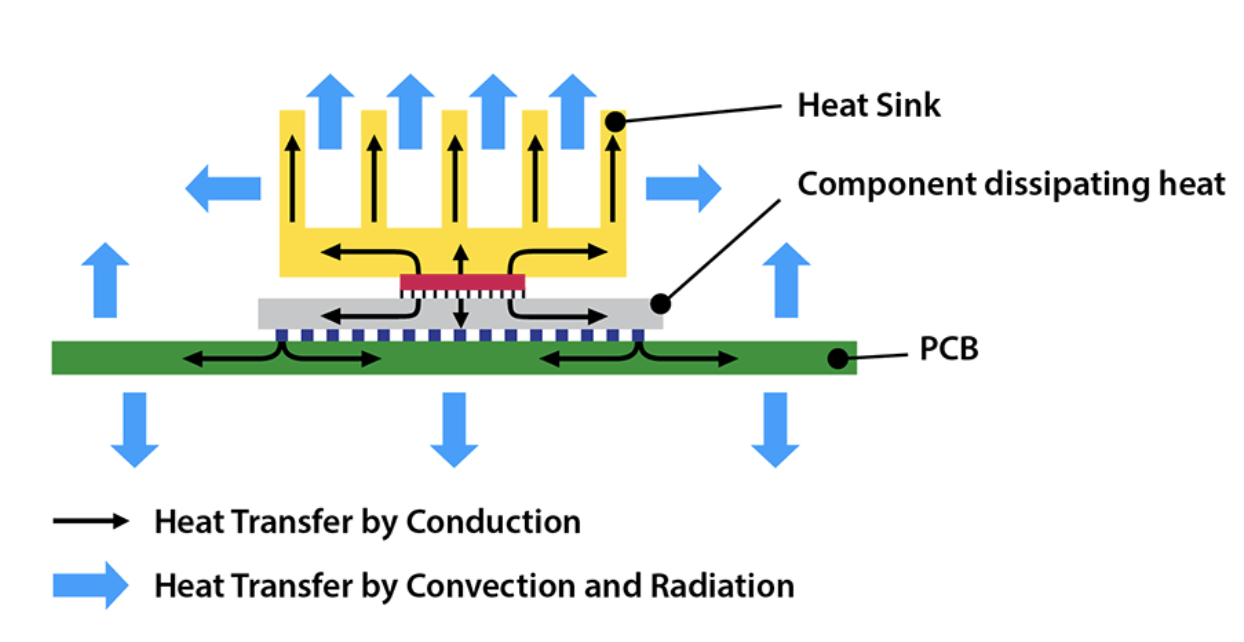
Source: semiengineering.com
A heat sink works by moving heat away from a component and transferring it into a surrounding fluid, usually air, but sometimes a liquid or specialized thermal fluid. The process relies on three main heat transfer mechanisms:
Conduction – Heat travels from the hot component (like a CPU or power transistor) into the heat sink itself. Materials with high thermal conductivity, such as aluminum or copper, are commonly used to speed up this transfer.
Convection – Heat then moves from the heat sink into the surrounding fluid. This can happen naturally (passive cooling) as warm air rises and cooler air replaces it, or it can be enhanced using a fan or liquid pump (active cooling).
Radiation – A smaller portion of heat is released from the heat sink as infrared radiation to the environment.
The efficiency of a heat sink depends on factors like surface area, fin design, material choice, and airflow. By increasing the contact area between the heat sink and the cooling medium (for example, adding fins), heat is dissipated more effectively, keeping electronic or mechanical components within safe operating temperatures.
Types of Heat Sinks
Heat sinks are broadly classified based on how they transfer heat: passive, active, and hybrid.
Passive Heat Sinks
Use natural convection to remove heat; no fans or pumps are involved.
Typically have a base and fins to increase surface area.
Quiet, reliable, and cost-effective, but less efficient for high heat loads.
Ideal for low-power electronics or situations where noise reduction is important.
Active Heat Sinks
Include a fan, blower, or liquid pump to force air or fluid across the heat sink.
More efficient than passive designs, allowing smaller, compact heat sinks to handle higher thermal loads.
Commonly used in CPUs, GPUs, LEDs, and high-performance electronics.
Hybrid Heat Sinks
Combine passive and active cooling methods.
Operate passively under low thermal loads, activating fans or pumps only when needed.
Offer a balance between energy efficiency, noise control, and high cooling performance.
Each type of heat sink has its advantages and limitations, and the choice depends on power output, space constraints, noise considerations, and thermal requirements.
Applications of Heat Sinks
Heat sinks are essential in any system where electronic or mechanical components generate enough heat to affect performance, reliability, or lifespan. By efficiently transferring heat into the surrounding air or fluid, they help maintain safe operating temperatures across a wide range of industries. Below are the major application areas.
Computers and Data Centers
Modern CPUs, GPUs, VRMs, and power supply modules produce significant heat during high-performance workloads. Heat sinks—often paired with fans or vapor chambers—prevent thermal throttling, stabilize performance, and extend hardware life in devices such as:
desktops and laptops
gaming systems
servers and cloud computing infrastructure
LED Lighting Systems
High-power LEDs convert most electrical energy into heat at the LED junction. Without proper thermal management, brightness drops and lifespan shortens. Passive aluminum heat sinks are commonly used in:
LED bulbs
street lights
industrial and architectural lighting
Power Electronics
Devices that handle power conversion or switching generate substantial heat in components such as MOSFETs, IGBTs, rectifiers, and voltage regulators. Heat sinks are widely used in:
AC/DC converters
inverters and motor drives
switching power supplies
uninterruptible power systems (UPS)
Automotive Electronics and Electric Vehicles
As vehicles become more electronic and electrified, heat sinks help manage thermal loads in:
engine control units (ECUs)
onboard chargers and DC-DC converters
motor controllers
LED headlights and infotainment systems
In electric vehicles, cooling power modules and traction inverters is especially critical for safety and efficiency.
Aerospace and Defense
Aerospace and military systems often operate under harsh environments with limited space for cooling. Heat sinks are used in:
avionics and guidance systems
satellite electronics
radar and communication equipment
Because natural convection is minimal in space, many designs rely on radiation-optimized surfaces and heat pipes to move heat toward radiative panels.
Consumer Electronics
Everyday devices integrate compact heat sinks to keep components running safely without generating noise or bulk. Examples include:
smartphones and tablets
gaming consoles
set-top boxes and routers
wearable devices (in micro-scale form factors)
Industrial and Automation Equipment
In manufacturing and process control environments, heat sinks help maintain stability in:
PLCs and industrial controllers
robotics and motion control drives
sensors and measurement equipment
Reliable thermal management ensures continuous operation in high-duty cycles.
Why Choose 3D Printing for Heat Sink Manufacturing?
Experimental work from institutions such as a study from Edith Cowan University, research from Oak Ridge National Laboratory, and research from the University of Glasgow on 3D-printed heat sinks has consistently shown that 3D-printed heat sinks can outperform traditional aluminum designs in both thermal performance and weight efficiency.
Multiple studies have demonstrated that optimized 3D-printed designs—including lattice, gyroid, and honeycomb structures—can significantly improve heat dissipation, reduce junction temperatures, and achieve higher surface area-to-volume ratios compared to conventional extruded or machined heat sinks.
Recent work, including a 2025 experimental study on honeycomb-structured 3D-printed heat sinks, further highlights that strategically designed cellular geometries enable more compact and efficient heat exchangers. This provides engineers with a practical way to enhance thermal management without increasing overall size or weight.
Traditional vs. 3D-Printed Heat Sinks
To make these advantages more concrete, the comparison table below outlines the key manufacturing and performance differences between the two approaches.
Feature | Traditional Manufacturing | 3D Printing (Additive Manufacturing) | Why It Matters |
|---|---|---|---|
Geometric Complexity | Limited to straight fins, uniform cross-sections; internal channels are difficult or impossible | Freely creates curved fins, internal cooling paths, lattices, TPMS structures | Enables higher surface area, better heat spreading, and more compact heat sinks |
Performance Optimization | Hard to modify design for simulation-driven or topology-optimized shapes | Easily produces topology-optimized, biomimetic, or conformal designs | Maximizes heat transfer efficiency per gram of material |
Material Usage | High waste (machining removes material) | Material used only where needed; unused powder can often be recycled | Reduces cost when using premium alloys like Al or Cu alloys |
Design Iteration Speed | Requires tooling, fixtures, or re-machining | Directly print updated CAD designs | Faster prototyping and refinement of cooling strategies |
Part Consolidation | Many heat sinks require multi-piece brazing or assembly | Complex features printed as a single part | Eliminates joints and leakage paths, improves reliability |
Strength-to-Weight Ratio | Often over-engineered to maintain stiffness | Lightweight lattice or thin-wall geometries without sacrificing strength | Larger cooling surface at lower overall weight |
Thermal Performance | Constrained by manufacturability; fins and channels are usually uniform | AM enables lattices, turbulators, and complex flow-shaping features | Higher heat flux capability within the same volume |
Energy & Operational Efficiency | Heavier assemblies may require larger fans/pumps | Lightweight designs lower power consumption in active cooling systems | Improves overall system efficiency |
Key Takeaways
3D printing removes traditional geometry limits, enabling curved fins, internal channels, lattices, and TPMS structures that dramatically increase surface area and improve heat flow.
Topology-optimized 3D-printed designs consistently outperform conventional aluminum heat sinks, especially in compact, high-power, or space-restricted applications.
Material usage is far more efficient with 3D printing, reducing waste and making high-performance aluminum or copper alloys more economical.
Design iteration is significantly faster, since no tooling, fixtures, or machining setup is required—ideal for R&D and rapid thermal optimization.
Part consolidation improves reliability, eliminating multi-piece assemblies, brazed joints, or fin stacks that can leak, warp, or loosen over time.
Lightweight 3D-printed lattice or thin-wall structures enhance system efficiency, reducing the load on fans, pumps, and overall cooling hardware.
3D printing enables higher heat-flux capability within the same volume, allowing engineers to achieve more cooling performance without increasing size or weight.
Materials, Technologies, and Processing for 3D-Printed Heat Sinks
Materials
Choosing the right material is crucial for the thermal performance and printability of a 3D-printed heat sink. Most high-performance designs rely on metal alloys that balance thermal conductivity, weight, cost, and ease of processing.
The most common materials include:
Aluminum Alloys (AlSi10Mg, Scalmalloy)
Lightweight, affordable, and easy to print with laser powder-bed fusion
Good thermal conductivity (≈120–180 W/m·K after heat treatment)
Ideal for general electronics cooling, automotive, robotics, and aerospace components
Copper & Copper Alloys (Cu, CuCrZr)
Highest thermal conductivity (≈300–400 W/m·K), enabling the best heat dissipation
More challenging to print due to reflectivity and heat absorption
Suited for high-heat-flux applications—EV power electronics, data-center cooling, avionics
Titanium & Nickel Alloys (Ti-6Al-4V, Inconel)
Much lower thermal conductivity but excellent strength and corrosion resistance
Used in harsh environments where durability matters more than maximum heat transfer
Stainless Steels (316L, 304L)
Good mechanical strength and corrosion resistance
Thermal conductivity is lower, making them better for structural or hybrid components rather than pure heat dissipation
In short:
Use copper alloys when thermal performance is the top priority.
Use aluminum alloys when weight, cost, and printability matter most.
Use titanium/nickel alloys or stainless steel only for niche, high-durability applications.
3D Printing Technologies
The most common method for manufacturing high-performance metal heat sinks is Powder Bed Fusion (PBF), which offers the precision needed for complex internal features like lattices and microchannels.
Technology | Full Name | Why It’s Used for Heat Sinks | Key Advantage |
|---|---|---|---|
Selective Laser Melting / Direct Metal Laser Sintering | Uses powerful lasers to melt metal powder layer-by-layer. Essential for printing the complex internal geometries (lattices, gyroids) that maximize surface area. | Geometric Complexity & High Density | |
Binds metal powder with an agent, then requires a separate sintering/infiltration step. | Suitable for larger parts and high volumes when the need for extreme complexity is slightly lower. | Speed and Cost-Efficiency (for mid-to-high volume) |
Surface Treatment
Once the heat sink is printed, the quality of its surface finish directly impacts its ability to transfer heat to the surrounding fluid or air.
As-Printed Surface: The rough texture inherent to powder-bed fusion (PBF) can sometimes slightly improve natural convection by promoting flow mixing.
Chemical/Mechanical Polishing: The flat base that contacts the chip (the mating surface) must be machined or polished to achieve a very low roughness. A perfectly flat base minimizes the thermal interface resistance, ensuring maximum heat conduction into the heat sink.
Anodizing or Blackening: Applying a dark surface coating (often a thin layer of black oxide or anodization for aluminum) can significantly increase emissivity, thereby boosting the amount of heat dissipated through radiation—critical in low-airflow environments like space or vacuum chambers.
Post-Processing
The journey isn't over when the printing stops. Several post-processing steps are vital for optimizing performance and structure.
Stress Relief & Hot Isostatic Pressing (HIP): High-energy metal 3D printing can introduce internal stresses and tiny porosities. HIP applies high pressure and temperature to eliminate internal voids and densify the material, resulting in stronger parts and improved thermal conductivity.
Removal of Support Structures: The complex internal and external support structures required for printing must be carefully removed, often using a combination of milling, abrasive blasting, and sometimes chemical processes.
Leak Testing: Crucial for liquid-cooled heat sinks and cold plates to ensure the complex internal channels are fully sealed and pressure-safe before deployment.
Not sure which materials, 3D printing technologies, or post-processing steps are best for your heat sink?
Talk to our experts for tailored guidance!
Design Guide for 3D-Printed Heat Sinks
The true value of additive manufacturing lies in its ability to realize complex, high-performance geometries that were impossible just a few years ago. Here is a guide to leveraging these unique design freedoms to create next-generation heat sinks.
Topology Optimization and Lightweighting
Use topology optimization to remove unnecessary material while maintaining structural integrity.
Focus on minimizing weight without compromising thermal performance.
Ideal for aerospace, EV, and compact electronics applications.
Lattice and TPMS Structures
Gyroid, honeycomb, and other TPMS lattices increase surface area and improve airflow.
Lightweight lattices reduce overall weight while maintaining strength.
Useful for fins, heat exchangers, and internal cooling features.
Conformal Cooling Channels
Design channels that follow the geometry of the heat source for even heat distribution.
Helps eliminate hotspots and improves overall thermal efficiency.
Only feasible with additive manufacturing; difficult or impossible with traditional machining.
Manufacturability Considerations
Keep minimum feature sizes and overhangs within the printer’s capability.
Avoid excessively thin walls that may warp or break.
Consider support structures for complex geometries to reduce post-processing.
Simulation-Driven Design
Use CFD and thermal simulations to test designs before printing.
Optimize flow paths, heat transfer, and pressure drop.
Helps reduce costly trial-and-error prototyping.
Material-Specific Design Tips
AlSi10Mg: Focus on lightweight, moderately high-thermal designs; allows fine, complex geometries.
CuCrZr: Ideal for maximum heat flux, but heavier; design for compactness to offset density.
Consider anisotropy in mechanical properties depending on build orientation.
Want to make sure your 3D-printed heat sink design is fully optimized for performance and manufacturability?
Get free DFM feedback from our experts now!
Troubleshooting 3D Printing Issues for Heat Sinks
Even with advanced Additive Manufacturing (AM) technologies, translating a complex heat sink model into a high-performance physical part involves navigating unique challenges. Here are the critical issues engineers must troubleshoot during design and production.
Warping and Distortion
Problem: Thin fins, overhangs, or large flat bases may warp during printing or cooling.
Solutions:
Add fillets or chamfers to thin walls.
Use proper support structures and optimized build orientation.
Preheat the build plate if possible to reduce thermal stress.
Surface Roughness and Stair-Stepping
Problem: Layer-by-layer printing can create rough surfaces or stair-step effects, especially on angled fins or curved channels.
Solutions:
Reduce layer height to improve smoothness.
Use post-processing like bead blasting, tumbling, or electropolishing.
Consider minor design adjustments to minimize steep overhangs.
Incomplete Fusion or Porosity
Problem: Poor layer bonding can create weak spots or tiny pores, reducing thermal conductivity.
Solutions:
Adjust laser power, scan speed, or layer thickness for optimal melting.
Ensure high-quality, dry powder feedstock.
Consider hot isostatic pressing (HIP) for critical high-performance components.
Support Removal and Accessibility
Problem: Supports inside internal channels or lattices can be hard to remove.
Solutions:
Design self-supporting geometries where possible.
Use soluble supports if the printer allows.
Orient parts to minimize support use in critical heat-transfer areas.
Material-Specific Challenges
AlSi10Mg: Generally forgiving, but watch out for anisotropic strength; heat treat if needed.
CuCrZr: Difficult to print due to high reflectivity and thermal conductivity; ensure stable melt pools and proper heat treatment.
General Tip: Always consider the trade-off between thermal performance, mechanical strength, and printability for the chosen material.
Cost Considerations for 3D-Printed Heat Sinks
While 3D printing offers incredible design freedom and performance benefits, understanding the cost implications is key for engineers and procurement managers. Here’s a breakdown of the main factors.
Material Costs
Metal powders are pricier than standard aluminum extrusions or copper sheets.
High-performance alloys like CuCrZr can increase costs, but allow smaller, more efficient heat sinks that may offset material expenses.
Aluminum alloys (AlSi10Mg) provide a cost-effective balance between thermal performance and printability.
Printing Process
Machine time: Complex designs with fine features take longer to print.
Layer height and resolution: Smaller layers improve surface finish and thermal performance but increase print time and energy use.
Support structures: More supports mean more material and post-processing, adding to overall cost.
Post-Processing
Heat treatment: Required for certain alloys to reach full thermal or mechanical properties.
Surface finishing: Polishing, anodizing, or coating may be needed for thermal efficiency or aesthetic purposes.
Part consolidation: 3D printing often reduces assembly costs since multiple components can be printed as one, saving labor.
Design Optimization
Smaller, lighter, more efficient heat sinks can reduce downstream system costs, such as smaller fans, lower pump power, or reduced housing weight.
Faster prototyping reduces R&D costs compared to tooling-based methods.
Long-term savings: Optimized 3D-printed heat sinks may cost more upfront but offer better performance per unit weight and volume, often paying off over the product lifecycle.
For a deeper dive into pricing and to estimate your own parts, check out our article: Metal 3D Printing Cost – Free Cost Calculator & Full Breakdown.
Tips for Picking a Suitable 3D Printing Service Provider for Heat Sinks
Choosing the right 3D printing partner is as important as selecting the material and optimizing the design. A capable provider ensures consistent quality, reliable delivery, and the best thermal performance for your heat sinks. Here’s what to look for:
1. Expertise in Heat Sink Applications
Thermal management knowledge: The provider should understand heat transfer, fluid flow, and cooling challenges for electronics or motors.
DfAM capabilities: Look for support in design for additive manufacturing, including topology optimization, lattice structures, and CFD/FEA validation.
Material know-how: Experience with alloys like AlSi10Mg and CuCrZr is essential, including knowledge of post-processing and heat treatments.
2. Equipment and Technology
Providers should use modern, well-maintained metal 3D printers (SLM/DMLS, or EBM for specific alloys).
Check build volume and capacity to ensure your heat sinks fit and production can scale.
Ask about precision and repeatability—critical for fine fins and complex channels.
3. Post-Processing Capabilities
Important services include stress relief, heat treatment, support removal, CNC finishing, and surface treatments (polishing, anodizing, etc.).
Integrated post-processing helps maintain quality and simplifies supply chain management.
4. Quality Assurance and Certifications
Look for providers with ISO 9001 or industry-specific certifications like AS9100.
They should offer material certificates, inspection reports, and traceability for each batch.
5. Experience and Track Record
Check if they’ve successfully printed similar heat sinks or complex thermal components.
Case studies, references, or documented projects indicate reliability.
6. Communication and Support
Clear, technical communication ensures your design requirements are understood.
Providers offering consultation, troubleshooting, and project updates help reduce risk and avoid costly mistakes.
7. Cost, Lead Time, and Overall Value
Transparent pricing covering material, machine time, labor, and post-processing is a must.
Reliable lead times and competitive pricing are important, but prioritize quality and expertise over the lowest cost.
Conclusion
The era of thermal constraints dictating design limitations is rapidly ending. By leveraging the geometric freedom of 3D Printed Heat Sinks, engineers are no longer confined to the simple straight fins of traditional manufacturing.
The ability to create complex internal lattices, topology-optimized shapes, and custom conformal cooling channels—particularly with high-conductivity materials like copper and specialized aluminum—is enabling unprecedented levels of thermal efficiency and lightweighting across critical sectors, from high-performance computing to electric vehicles.
As the technology and post-processing workflows mature, 3D printing is definitively establishing itself not just as a prototyping tool, but as the essential manufacturing process for achieving peak thermal performance in the next generation of power-dense electronics.
Ready to see what your 3D-printed heat sink might cost?
Estimate your project instantly with our free 3D printing cost calculator!
New to Unionfab? Enjoy 10% off your first order!
FAQs
Can 3D printed items withstand heat?
Yes, many 3D-printed parts can withstand high temperatures—especially those made from metal (like aluminum or copper alloys) or high-performance polymers (such as PA12, PEI/ULTEM, or PPS). The heat resistance depends on the material and printing technology. Metal-printed heat sinks, for example, perform similarly to traditionally machined metal parts.
Does a heat sink really work?
Yes. A heat sink helps move heat away from electronic components by increasing the surface area available for heat dissipation. When properly designed and paired with good airflow or cooling systems, heat sinks significantly lower operating temperatures and improve device performance and lifespan.
What are the two types of heat sinks?
The two main types are passive and active heat sinks. Passive heat sinks rely on natural convection to dissipate heat, while active heat sinks use fans or liquid pumps to enhance cooling efficiency.
Does a heat sink absorb heat?
Yes, a heat sink absorbs heat from electronic or mechanical components and then transfers it to the surrounding air, liquid, or other cooling medium to prevent overheating.
What is a heat sink also called?
A heat sink is also commonly referred to as a thermal conductor or heat exchanger, as it helps manage and move heat away from critical components.
How do I install a heat sink?
To install a heat sink, apply thermal paste or pads to ensure proper contact with the component, then secure it with clips, screws, or fans as required to maintain effective heat transfer.