
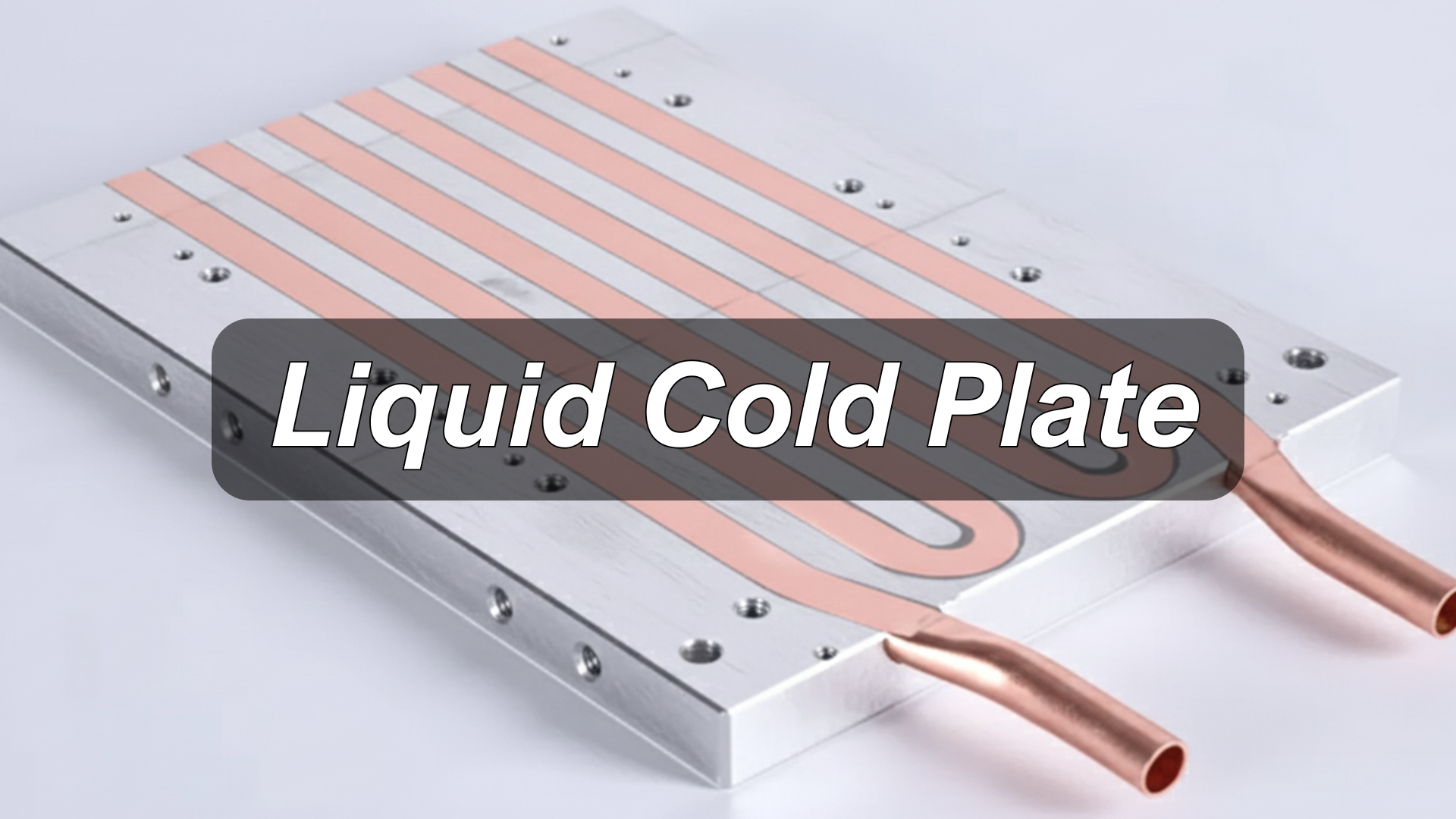
Learn about liquid cold plates: working principles, applications, materials, key designs, and custom solutions for efficient thermal management.
Introduction
As electronic devices grow more powerful and compact, managing the heat they generate has become a critical challenge. Liquid cold plates (LCPs) provide an efficient solution by directly transferring heat from high-power components to a circulating coolant. Compared to traditional air cooling, LCPs offer superior thermal performance, a smaller footprint, and quieter operation.
This guide explores the fundamentals of liquid cold plates, including their materials, internal channel designs, coolant considerations, and when to choose standard versus custom solutions.
By understanding these key aspects, engineers can optimize thermal management for applications ranging from high-performance computing to electric vehicles and aerospace systems.
What Are Liquid Cold Plates?
Liquid cold plates (LCPs) are fundamental components in advanced thermal management systems, designed to remove heat from high-power electronic devices. They consist of a metal base—usually aluminum or copper—with internal channels or machined pathways that allow coolant to flow through the plate. As the coolant passes beneath the heat-generating components, it absorbs heat and carries it away to a remote heat exchanger.
In simple terms, a liquid cold plate acts as the interface between hot electronics and the liquid cooling loop. It keeps components operating at safe temperatures, improves performance stability, and helps prevent premature device failure. As power densities continue to increase across modern systems, liquid cold plates have become one of the most effective solutions for managing concentrated heat loads.
How Liquid Cold Plates Work
At its core, a liquid cold plate performs two simultaneous thermal functions: conduction and convection.
The operation of the LCP itself is a straightforward two-step dance:
1.Absorbing Heat (Conduction)
First, the cold plate is attached directly to the heat-generating component. Because LCPs are made from metals with high conductivity, such as copper or aluminum, the heat generated by the electronic device is efficiently pulled into the metal plate. This initial transfer through direct contact is called conduction.
2.Transferring Heat (Convection)
Inside the plate, the metal has intricate channels or internal pathways. As the coolant fluid is continuously pumped through these channels, it flows across the heated inner surfaces. The heat stored in the metal is then transferred into the circulating liquid. This process of using the moving fluid to carry the heat away is known as convection.
The efficiency of this entire heat transfer process is influenced by the flow rate of the coolant, the temperature difference between the heat source and the fluid, and the specific design of the cold plate's internal channels.
Air Cooling vs Liquid Cooling
When it comes to cooling electronics, the primary choice is between air cooling (typically using a fan and a traditional air-cooled heat sink) and liquid cooling (using cold plates and a circulating fluid).
Here is a comparison highlighting why liquid cooling is often preferred for high-density applications:
Feature | Air Cooling | Liquid Cooling |
|---|---|---|
Cooling Mechanism | Fan-forced convection | Heat transport via liquid circulation |
Thermal Performance | Low to Moderate | Moderate to High |
Physical Size | Often bulky | Generally smaller |
Noise Level | Can be noisy (due to fans) | Typically quieter |
Power Consumption | Higher (for large fans) | Lower (for smaller pumps) |
Temperature Control | Lower accuracy | High accuracy |
The Bottom Line: For chips that generate a significant amount of heat (high heat flux), forced-air cooling simply cannot keep up. Liquid cold plates deliver superior thermal performance, making them the go-to solution for pushing product performance to the next level.
Advantages of Liquid Cold Plates
The shift to liquid cold plates offers several compelling benefits that optimize system design and performance:
1. Unmatched Cooling Effectiveness
Liquid coolants have a much higher thermal capacity than air, allowing them to absorb and transport heat far more efficiently. Advanced cold plate designs, which often utilize intricate mini-channels instead of simple tubing, maximize the contact surface area between the coolant and the metal, leading to peak heat transfer performance.
2. Design Flexibility and Customization
Cold plates are highly adaptable. Engineers can tailor the internal fluid paths, or "skyline" design, to perfectly match the heat source and balance the flow rate and pressure drop for optimal thermal control. This customization ensures the most efficient interface possible.
3. Smaller, Lighter Footprint
Compared to the large heat sinks and powerful fans required for high-wattage air cooling, liquid cold plate systems are typically smaller, lighter, and quieter. This is a major advantage in compact hardware, such as servers or aerospace components, where space is at a premium.
4. Reliability and Longevity
When properly manufactured and tested—often undergoing 100% in-line leak testing—cold plates provide reliable, long-term thermal management. By effectively managing the junction temperature of critical chips, they significantly extend the operational life and stability of the entire system.
How a Complete Liquid Cooling Loop Works
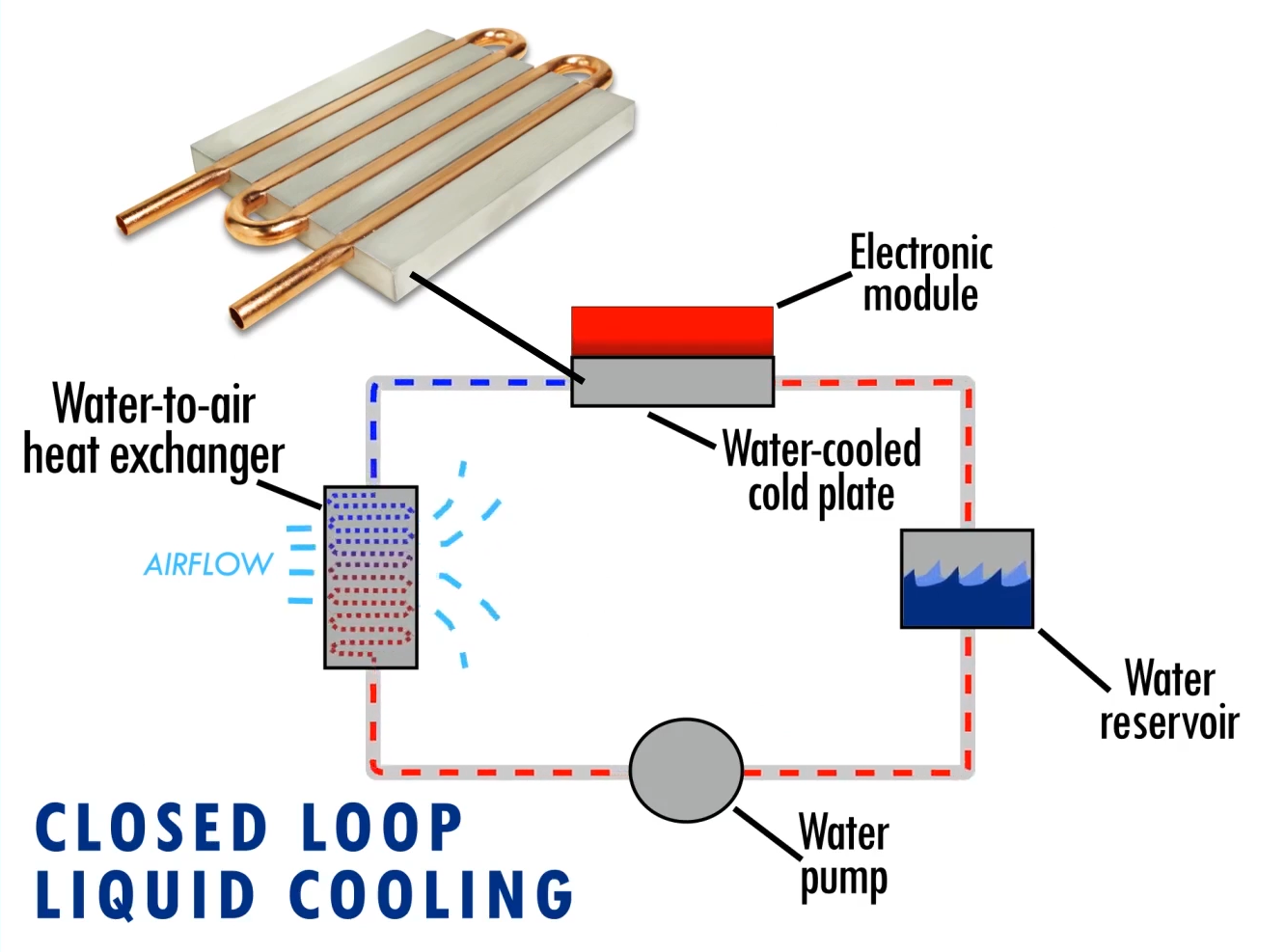
Source: ATS (Advanced Thermal Solutions, Inc.)
A liquid cold plate (LCP) is an integral part of a larger setup known as a closed-loop liquid cooling system. The LCP’s job is to efficiently absorb heat, but it relies on several other essential components to complete the cycle and dissipate that heat.
The entire cooling process can be broken down into a continuous circuit, as illustrated by your diagram:
1. The Cold Plate: The Heat Absorber
The cycle begins when the electronic module (the heat source) transfers its thermal energy directly into the cold plate.
Conduction: Heat moves from the hot component into the highly conductive metal block (aluminum or copper) of the cold plate.
Convection: The coolant fluid, which is constantly flowing through the plate’s internal channels, absorbs this heat. This is the component's role in providing localized cooling for high-power electronics.
2. The Pump & The Reservoir: Circulation and Management
Once the coolant has absorbed the heat, it must be moved out of the system.
Water Pump: The pump is the engine of the loop. It forces the coolant fluid to circulate continuously, pushing the hot fluid away from the electronic module and through the rest of the loop.
Water Reservoir: The reservoir holds the excess coolant fluid and helps manage pressure and fluid levels within the system, ensuring the pump always has enough liquid to maintain flow.
3. The Heat Exchanger: Dissipation
The final and most crucial step is to remove the absorbed heat from the coolant.
Water-to-Air Heat Exchanger: The hot coolant flows into the heat exchanger (often called a radiator). Here, the heat is transferred from the liquid to ambient air, or sometimes to another secondary liquid system.
Cooled Fluid Return: Once the heat is dissipated, the fluid’s temperature is significantly lowered. The refreshed, cool liquid then travels back to the cold plate, ready to begin the heat absorption process all over again.
This continuous, high-capacity circulation system uses liquid as the carrier to transfer heat to a remote location where it can be safely rejected, enabling superior performance compared to air cooling.
For a clearer view of how a liquid cold plate works within a complete cooling system, check out this short video demonstration:
Applications of Liquid Cold Plates
Where there is concentrated heat, there is a need for robust cooling, and this is why liquid cold plates (LCPs) have moved from specialized niches to widespread industrial use. They are the go-to solution for any application where maintaining optimal operating temperature is critical to performance and reliability.
Here are the key industries and systems relying on the power of LCPs:
1. High-Performance Computing (HPC) & Data Centers

This is perhaps the most visible application today. Modern servers, especially those housing high-density CPU and GPU clusters for AI, machine learning, and cloud computing, generate massive amounts of heat.
Servers and Racks: LCPs provide efficient, localized cooling right at the chip level, enabling higher power density within server racks than traditional air cooling could ever support.
Performance Stability: By maintaining chips within optimal temperature ranges, LCPs ensure performance stability and prevent thermal throttling, which is crucial for continuous data center operation.
2. Power Electronics & Renewable Energy

Power control devices, such as Insulated Gate Bipolar Transistors (IGBTs) and other power semiconductors, generate significant heat loads that must be managed to prevent system failure and maintain longevity.
Electric Vehicles (EVs): LCPs are essential for cooling the high-power inverters, converters, and battery packs in EVs, ensuring efficiency and safety.
Industrial Drives and Supplies: They maintain thermal control in large industrial power supplies and variable frequency drives used in manufacturing.
Renewable Energy: LCPs are used in solar inverters and wind turbine pitch control systems to dissipate heat generated during power conversion.
3. Medical, Aerospace, and Defense

In environments where reliability and small size are paramount, LCPs are often the only viable cooling solution.
Medical Devices: Equipment like MRI, CT scanners, and high-power lasers require precise temperature control for accurate and consistent operation.
Aerospace & Defense: LCPs are valued here because they are typically smaller, lighter, and quieter than fan-based systems, making them ideal for cramped cockpits, radar systems, and satellite equipment.
Photonics and Lasers: LCPs are used to cool the optical components and solid-state lasers to ensure the stability and quality of the light beam.
The necessity of LCPs continues to grow as devices become more powerful and compact. In virtually every sector, the need for effective, high-capacity cooling has made them a focal point in thermal management technology.
Materials for Liquid Cold Plates
Choosing the right material for a liquid cold plate (LCP) is critical to achieving optimal thermal performance, weight efficiency, and long-term reliability. Different materials offer unique advantages and trade-offs depending on the application.
Material Types
The vast majority of LCPs are constructed from two primary metals, both known for their exceptional ability to conduct heat:
Copper
Copper offers superior thermal performance due to its extremely high thermal conductivity. It is the material of choice when maximum heat dissipation is required in a minimal footprint. However, copper is heavier and more expensive than its counterpart.
Aluminum
Aluminum is the most common material for LCPs, striking an excellent balance between cost and performance. It is significantly more lightweight and cost-effective, making it suitable for many general and custom applications.
Comparison of Materials for Liquid Cold Plates
When selecting a material, engineers consider several key criteria:
Thermal Conductivity – Determines how efficiently heat moves from the component into the coolant.
Weight – Important for aerospace, EVs, and other weight-sensitive applications.
Corrosion Resistance – Ensures long-term reliability when exposed to various coolants.
Cost vs Performance – Balancing material cost with the required thermal performance.
The following table summarizes the properties, advantages, disadvantages, and best use for each material:
Property | Aluminum | Copper |
|---|---|---|
Thermal Conductivity | Good (~200 W/m·K) | Excellent (~400 W/m·K) |
Weight | Lightweight | Heavy |
Corrosion Resistance | Moderate | Moderate |
Pros | Low cost, lightweight, easy to machine | Superior heat transfer, high efficiency |
Cons | Lower thermal conductivity than copper | Expensive, heavy, harder to machine |
Cost vs Performance | Good Performance, Cost-Effective | High Performance, Higher Cost |
Best for | Most mainstream and weight-sensitive applications | High-heat flux applications |
Three Core Internal Channel Designs for Liquid Cold Plates
The internal flow channel is the heart of any liquid cold plate. How these channels are formed, sealed, and routed directly determines thermal resistance, pressure drop, durability, and cost.
Below we break down three fundamental internal channel design approaches commonly used across modern cold plate manufacturing.
These cover the majority of real-world use cases—from low-cost industrial cooling to ultra-high-performance aerospace applications.
Embedded Tubes
Embedded-tube cold plates use pre-formed metal tubing (usually copper or stainless steel) that is pressed into machined grooves on an aluminum base. Any remaining gaps are filled with a thermally conductive epoxy to secure the tube and improve heat transfer.
This is one of the simplest and most economical ways to build a liquid cooling path.
Key Features
Aspect | Details |
|---|---|
How It’s Made | Groove machining → Tube bending → Tube insertion → Epoxy potting/sealing |
Common Materials | Base: Aluminum; Tubes: Copper or Stainless Steel |
Advantages | - Very low tooling cost - Quick to prototype - Good durability and reliability - Effective for moderate thermal loads |
Limitations | - Higher thermal resistance than brazed/machined channels - Limited channel layout flexibility |
Ideal For | Industrial controllers, power electronics, moderate heat loads, cost-sensitive projects |
Embedded tubes are excellent when you need simple, rugged, and affordable cooling without complex flow geometry.
Vacuum-Brazed Machined Channels
This design begins with a solid plate—typically aluminum or copper—that is CNC-machined to create precise internal channels. A cover plate is then added and the entire assembly is sealed using vacuum brazing, forming a strong, leak-proof bond with excellent thermal conductivity.
This method offers the best combination of performance and design freedom.
Key Features
Aspect | Details |
|---|---|
How It’s Made | CNC milling of internal channels → Cleaning & fixturing → Vacuum brazing cap plate |
Common Materials | Aluminum, Copper |
Advantages | - Extremely low thermal resistance - Supports complex/optimized flow paths - Ideal for high power density - Good structural integrity |
Limitations | - Higher unit cost - Longer manufacturing time - Complex geometries increase CNC time |
Ideal For | CPUs/GPUs, EV power modules, aerospace systems, high-heat-flux electronics |
If thermal performance is the priority, vacuum-brazed machined channels are one of the highest-performance architectures available.
Friction Stir Welded (FSW) Channels
In this approach, internal channels are typically die-cast or machined, and a cover plate is attached using Friction Stir Welding (FSW)—a solid-state welding process where no filler material is needed.
FSW produces an exceptionally strong, uniform bond without melting the metal, resulting in excellent pressure resistance and reliability.
Key Features
Aspect | Details |
|---|---|
How It’s Made | Cast or machined channels → FSW applied to seal cover plate |
Common Materials | Aluminum (most compatible with FSW) |
Advantages | - Seamless weld with no filler - High structural strength - Low thermal resistance at the welded interface - Excellent for high-pressure cooling loops |
Limitations | - Requires specialized FSW equipment - Limited to FSW-compatible materials (mainly aluminum) - High upfront cost if die casting is used |
Ideal For | Automotive inverters, industrial power modules, applications requiring high structural integrity |
FSW cold plates are best where durability, leak resistance, and mechanical robustness are as important as thermal performance.
Coolant Selection and System Reliability
The choice of coolant and proper system maintenance are as critical as the cold plate design itself. The fluid carries the heat, but it is also the primary medium for corrosion and clogging, which can severely compromise the system's long-term reliability and performance.
Common Coolant Types
The circulating fluid must possess high thermal capacity, chemical stability, and compatibility with the materials in the loop.
Coolant Type | Primary Components | Thermal Capacity | Application Notes |
|---|---|---|---|
Water | De-ionized or Distilled Water | Highest | Best thermal performance; requires excellent corrosion inhibitors and filtration; freezes easily. |
Glycol Mixtures | Ethylene Glycol (EG) or Propylene Glycol (PG) + Water | Good | Lower freezing point (essential for systems operating below ambient); slightly lower thermal capacity than pure water. |
Dielectric Fluids | Synthetic fluids (e.g., mineral oil, fluorocarbons) | Variable | Non-conductive (safe for immersion cooling); high cost; low thermal capacity compared to water. |
The Corrosion Challenge: Galvanic Attack
Corrosion is the single biggest threat to LCP system longevity. It occurs when two different metals are electrically connected and immersed in an electrolyte (the coolant), creating an electrical current that causes the more anodic (less noble) metal to dissolve.
The Risk: A common example is a system mixing Aluminum cold plates with Copper fittings or a Copper radiator. The Aluminum will sacrificially corrode to protect the Copper, leading to leaks and system failure over time.
The Solution: Inhibitors: The primary defense is the use of corrosion inhibitors (additives) within the coolant. These chemicals form a protective layer on the metal surfaces, preventing the galvanic reaction. Systems must use the correct inhibitor formulated specifically for the metals present (e.g., inhibitors designed for mixed Aluminum/Copper systems).
Filtration and Fluid Purity
High-performance cold plates, particularly those with Precision-Milled or High-Density Fin internal structures, often feature microchannels where the flow path dimensions are extremely small.
Clogging Risk: Fine debris, sediment, or scale formation from impure or aged coolant can easily clog these microchannels, leading to increased pressure drop and catastrophic thermal failure (hot spots).
Maintenance: Maintaining fluid purity through regular coolant flushing and using appropriate in-line filters is mandatory for ensuring the designed thermal performance is sustained over the product's lifespan.
Standard vs Custom Cold Plates
Once an engineer understands the fundamental structures and materials of liquid cold plates, the next critical step is deciding between using a readily available, off-the-shelf solution or commissioning a custom-designed cold plate. This decision significantly impacts the project's budget, timeline, and final thermal performance.
When to Use Off-the-Shelf Solutions
Off-the-shelf (standard) cold plates are components that are pre-designed and mass-produced in fixed sizes and channel geometries (often Embedded Tube or Extruded designs).
Use Cases:
Low to Moderate Heat Flux: The application does not require absolute peak thermal performance.
Simple Component Footprint: The device being cooled has a common, easily matched geometric size.
Budget and Time Constraints: Project timelines are tight, and unit cost is prioritized over bespoke performance.
Proof-of-Concept: Used for early-stage thermal validation before committing to custom tooling.
When Custom Designs Are Needed
Custom cold plates are designed from the ground up to perfectly match the heat source, the thermal budget, and the available hydraulic power of the cooling loop. Structures like Precision-Milled (CNC) and High-Density Fin are typically employed here.
Use Cases:
Extreme High Heat Flux: Required for cooling powerful GPUs, CPUs, or high-power laser diodes where the thermal margin is very thin.
Complex or Irregular Footprint: The cold plate needs to cool multiple, non-uniformly spaced components on one base.
Integration Requirements: The cold plate must integrate structural mounting features, seals, or specific port locations (e.g., aerospace, defense).
Optimal Performance: When the absolute lowest thermal resistance ($R_{th}$) or the most uniform temperature across the component is mandatory.
Trade-offs: Cost, Lead Time, Performance, Integration
The choice between standard and custom design involves classic engineering trade-offs:
Criterion | Standard Cold Plates | Custom Cold Plates |
|---|---|---|
Unit Cost | Low (Tooling amortized) | High (Machining hours, specialized labor) |
Lead Time | Short (In stock, fast shipping) | Long (Design, prototyping, tooling, manufacturing) |
Thermal Performance | Moderate, non-optimized | Highest (Optimized for specific heat load) |
System Integration | Requires adapters/workarounds | Seamless (Designed for exact system fit) |
Prototyping | Usually not required | Essential (Often utilizing CNC or 3D Printing) |
Tips for Selecting the Right Cold Plate Supplier
When seeking a supplier, especially for custom designs, look for competencies that match your needs:
Advanced Manufacturing Capabilities: Suppliers offering in-house CNC machining provide the highest precision and geometric freedom, while those with 3D printing capability can offer rapid prototype turnaround for complex internal flow validation.
Thermal Simulation Expertise: The supplier should be able to perform Computational Fluid Dynamics (CFD) analysis to predict performance and pressure drop before physical prototyping.
Quality Control: Look for ISO certifications and experience with 100% in-line leak testing (e.g., using helium leak detection) to guarantee reliability.
Conclusion
Liquid cold plates (LCPs) are essential for high-power electronics, offering superior localized cooling that air systems cannot match.
Effective LCP design balances material choice (Copper for performance, Aluminum for cost), internal channel structure (Embedded Tubes to Brazed Channels), and fluid dynamics for optimal heat transfer and pressure control.
For demanding applications, custom designs with precision manufacturing ensure the cold plate meets unique thermal and mechanical requirements, delivering reliable performance and extended component lifespan.
FAQs
What is a cold plate?
A cold plate is a highly conductive metal plate, often made of aluminum or copper, designed to absorb and transfer heat away from electronic components or other heat sources.
What is a cold plate cooling system?
It's a complete liquid cooling loop that includes a cold plate, a pump, a heat exchanger (radiator), and sometimes a reservoir, used to manage high heat loads in power electronics and systems.
How does a cold plate heat exchanger work?
It uses a circulating fluid (typically water or a dielectric coolant) that runs through internal channels to efficiently carry heat away from the attached device to a remote heat sink or chiller.
What is a thermoelectric cold plate?
It is a cold plate integrated with a Peltier module (TEC) that uses the Peltier effect to actively pump heat away from the contact surface, often used for precision temperature control or below-ambient cooling.
What are the main applications of cold plates for histology?
In histology, cold plates are used to rapidly cool and maintain paraffin blocks or tissue samples at precise, low temperatures to facilitate microtome slicing and preparation.