
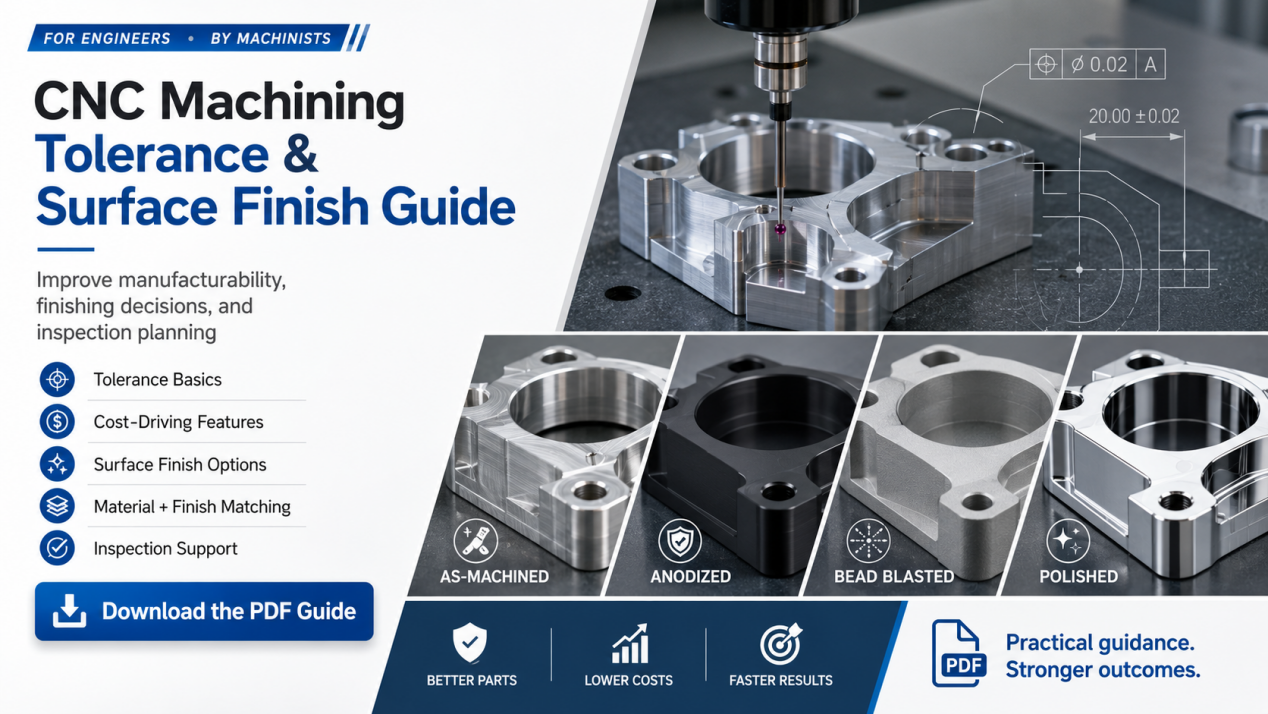
Learn how to specify CNC machining tolerances, surface roughness, and finishing requirements for better CNC parts in this practical guide for engineers, product developers, and procurement teams.
Introduction
CNC machining can deliver highly accurate, functional, and production-ready parts — but the final result depends heavily on how tolerances and surface finishes are specified.
This guide helps engineering and procurement teams understand:
How CNC tolerances affect cost, lead time, and inspection
When to use standard tolerances vs. tight tolerances
How surface roughness impacts part performance
How finishing processes may affect dimensions
What to prepare before submitting CNC projects for quotation
Designed for: Engineers, product developers, purchasing teams, hardware startups, OEMs, and industrial manufacturers.
Why Tolerance and Surface Finish Matter
In CNC machining, tolerance and surface finish are not just technical details. They directly affect whether a part fits, functions, assembles, and performs reliably in its intended application.
A part can be beautifully machined but still fail if a critical hole is out of tolerance. Likewise, a dimensionally accurate part may still underperform if the surface is too rough, too smooth, or incompatible with its final coating.
For engineers and procurement teams, the key question is not simply:
“How tight can this part be machined?”
The better question is:
“Which features truly require tight control, and which can follow standard machining tolerances?”
Over-specifying tolerances can increase machining time, inspection complexity, scrap risk, and cost. Under-specifying tolerances may create assembly problems, rework, or performance failures.
This guide provides a practical framework for choosing tolerances and surface finishes that are precise enough for function — without adding unnecessary cost or complexity.
Key Terms Engineers Should Know
Term | Definition | Importance |
|---|---|---|
Tolerance | Allowable dimensional variation | Controls fit, function, assembly, and inspection |
Standard Tolerance | Default tolerance without special requirements | Reduces drawing complexity and cost |
Tight Tolerance | Stricter control for critical features | Improves precision but may increase cost and lead time |
Surface Roughness | Surface texture, often measured as Ra | Affects friction, sealing, appearance, fatigue, and coating |
As-Machined Finish | Surface left after cutting | Common for prototypes and internal features |
Post-Processing | Secondary finishing operations | Improves appearance, corrosion resistance, or performance |
GD&T | Geometric Dimensioning and Tolerancing | Defines form, orientation, location, and runout |
CNC Machining Tolerances
Understanding CNC machining tolerances helps engineers specify the right level of precision for part function, fit, manufacturability, and cost.
Standard vs. Tight CNC Tolerances
Most CNC parts do not need every dimension to be tightly controlled. In many cases, standard machining tolerances are sufficient for non-critical features such as external profiles, clearance surfaces, covers, brackets, and visual housings.
Tight tolerances should be reserved for features that directly affect assembly, motion, sealing, alignment, or product performance.
Tolerance Type | Best Used For | Typical Impact |
|---|---|---|
Standard Tolerance | General dimensions, non-critical features, prototypes | Faster machining, lower cost, simpler inspection |
Moderate Tolerance | Functional interfaces, mounting features, controlled fits | Balanced precision and manufacturability |
Tight Tolerance | Bearing seats, precision holes, mating surfaces, sliding fits | Higher cost, longer lead time, more inspection |
Ultra-Tight Tolerance | High-precision optical, aerospace, medical, or metrology-related parts | Requires engineering review and advanced quality control |
Practical recommendation: Only apply tight tolerances to features that truly need them. Keep the rest of the part under standard tolerance whenever possible.
Common CNC Tolerance Reference
The following table provides a practical reference for CNC machining tolerance planning. Actual achievable tolerance depends on material, part geometry, feature size, machine setup, tool access, and inspection method.
Level | Range | Best For | Note |
|---|---|---|---|
General | ±0.10–0.20 mm | Non-critical parts | Fast and cost-effective |
Precision | ±0.05–0.10 mm | Functional prototypes | Common for mechanical parts |
Tight | ±0.025–0.05 mm | Holes, mating surfaces | Needs review and inspection |
Very Tight | < ±0.025 mm | Precision assemblies | Confirm case by case |
Note: Tight tolerance is not a universal requirement. It should be applied selectively based on the function of each feature.
What Drives CNC Tolerance Capability?
CNC tolerance is influenced by more than machine accuracy. The full manufacturing process must be considered.
Factor | How It Affects Tolerance |
|---|---|
Material Type | Aluminum is generally easier to machine tightly than some plastics or difficult alloys |
Part Size | Larger parts may be harder to hold to very tight tolerances across long distances |
Wall Thickness | Thin walls can deflect during machining |
Feature Depth | Deep pockets and long holes may increase tool deflection |
Tool Access | Limited access may require longer tools or special setups |
Setup Count | Multiple setups can introduce alignment variation |
Heat and Stress | Machining can release internal material stress |
Inspection Method | Tight tolerances require appropriate measurement tools and procedures |
Engineering insight: If a part has thin walls, deep cavities, long slender features, or multiple critical datums, tolerance review should happen before production begins.
Where Tight Tolerances Matter Most
Not every surface requires the same level of control. The best CNC drawings identify critical features clearly and avoid applying tight tolerances everywhere.
Feature Type | Recommended Control Level | Why It Matters |
|---|---|---|
Bearing Seats | Tight | Controls fit, rotation, and service life |
Dowel Pin Holes | Tight | Controls alignment and repeatability |
Threaded Holes | Moderate to tight | Affects fastening strength and assembly |
Mating Surfaces | Moderate to tight | Affects fit and sealing |
Cosmetic Outer Surfaces | Standard to moderate | Usually more affected by finish than dimension |
Clearance Holes | Standard | Usually allow assembly flexibility |
Internal Pockets | Standard to moderate | Depends on part function |
Thin Walls | Engineering review needed | Risk of deflection and distortion |
Best practice: Mark critical-to-function dimensions clearly on the drawing. Avoid vague notes such as “all dimensions must be high precision.”
CNC Machining Surface Finish
CNC machining surface finish affects part appearance, functional performance, and the suitability of later finishing or coating processes.
Understanding Surface Finish
Surface finish describes the texture and quality of a machined surface. In CNC machining, surface finish affects not only appearance but also mechanical performance.
Common surface finish considerations include:
Friction and wear
Sealing performance
Paint or coating adhesion
Corrosion resistance
Fatigue resistance
Sliding contact
Visual appearance
Cleanability
Surface roughness is often measured as Ra, which represents the average roughness of a surface. A lower Ra value generally means a smoother surface.
However, smoother is not always better. Some applications require a certain texture for coating adhesion, lubrication retention, or non-slip performance.
Surface Roughness Reference Table
Ra Value | Surface | Best For | Note |
|---|---|---|---|
Ra 6.3 μm | Rough | Internal, non-critical surfaces | Low cost, fast machining |
Ra 3.2 μm | Standard | General CNC parts | Common as-machined finish |
Ra 1.6 μm | Fine | Contact surfaces | Better performance |
Ra 0.8 μm | Smooth | Sliding or sealing areas | May need finishing |
Ra 0.4 μm or below | Very smooth | Precision applications | Needs process review |
Practical recommendation: Use Ra 3.2 μm or Ra 1.6 μm for many functional CNC parts unless the application requires a smoother or rougher surface.
Common CNC Surface Finish Options
Finish | Best For | Benefits | Considerations |
|---|---|---|---|
As-Machined | Functional prototypes; internal parts | Fast, cost-effective, dimensionally predictable | Tool marks may remain visible |
Bead Blasting | Aluminum parts; cosmetic surfaces | Uniform matte appearance | May slightly affect sharp edges |
Anodizing | Aluminum parts | Corrosion resistance; color options; improved durability | May slightly affect dimensions |
Hard Anodizing | Wear-resistant aluminum components | Improved hardness and durability | Thickness must be considered |
Polishing | Cosmetic or low-friction surfaces | Smooth, attractive appearance | Can alter edges or dimensions |
Brushing | Visual metal parts | Directional texture; premium appearance | Mostly cosmetic |
Electroless Nickel Plating | Steel, aluminum, copper alloys | Corrosion and wear resistance | Coating thickness affects tolerance |
Passivation | Stainless steel parts | Improves corrosion resistance | Does not significantly change appearance |
Powder Coating | Enclosures, brackets, covers | Durable protective coating | Adds noticeable thickness |
Painting | Cosmetic or branded parts | Color and visual design flexibility | Requires surface preparation |
How Finishing Affects Tolerances
A common mistake is treating machining and finishing as separate decisions. In reality, surface finishing can affect final dimensions, especially for tight-tolerance parts.
For example, anodizing, plating, powder coating, and polishing can all change surface thickness or edge condition. If a hole, slot, or mating surface requires tight control after finishing, that requirement must be clearly stated before machining begins.
Finishing Process | Possible Dimensional Impact | Engineering Note |
|---|---|---|
Anodizing | Adds oxide layer to aluminum surfaces | Critical holes may need masking or post-machining |
Hard Anodizing | Adds thicker, harder layer | Important for wear surfaces but must be planned |
Plating | Adds coating thickness | Final dimensions should account for plating buildup |
Bead Blasting | Slightly changes surface texture | Usually minor, but edges may soften |
Polishing | Removes material | Can affect flatness, sharp edges, and small features |
Powder Coating | Adds relatively thick coating | Not suitable for very tight mating features without masking |
Best practice: Specify whether dimensions apply before finishing or after finishing.
Tolerance + Finish Decision Matrix
Use this matrix during design review or supplier communication.
Application Requirement | Suggested Tolerance Approach | Suggested Finish Approach |
|---|---|---|
Early prototype for fit check | Standard tolerance | As-machined |
Visual prototype for customer review | Standard to moderate | Bead blasting, anodizing, painting |
Functional mechanical part | Moderate tolerance on critical features | As-machined or Ra 1.6–3.2 μm |
Sliding or rotating component | Tight tolerance on contact features | Smooth finish, possible polishing |
Sealing surface | Tight flatness and surface control | Ra requirement should be specified |
Outdoor aluminum component | Standard to moderate | Anodizing or powder coating |
Wear-resistant component | Feature-specific tolerance | Hard anodizing, plating, or material upgrade |
Precision assembly component | Tight feature-level tolerance | Finish must be reviewed with tolerance stack-up |
Drawing Checklist Before Requesting a CNC Quote
Before sending files for CNC machining, prepare the following information to reduce back-and-forth communication and improve quotation accuracy.
Item | Why It Matters |
|---|---|
3D CAD File | Provides complete geometry for machining review |
2D Drawing | Defines tolerances, threads, surface finish, and inspection requirements |
Material Specification | Affects machinability, strength, cost, and lead time |
Quantity | Impacts production strategy and pricing |
Critical Dimensions | Helps supplier focus inspection on important features |
Surface Finish Requirement | Determines machining strategy and post-processing |
Thread Specifications | Prevents assembly issues |
Finishing Requirements | Needed for anodizing, plating, polishing, painting, etc. |
Inspection Requirements | Defines what must be measured and documented |
Application Context | Helps engineers suggest better manufacturing options |
Recommended file package: 3D CAD file + 2D drawing + material requirement + quantity + surface finish requirement + critical-to-function notes.
Common Mistakes to Avoid
1. Applying tight tolerance to every dimension
This increases cost and inspection time without improving the part if the dimensions are not function-critical.
2. Missing 2D drawings for precision parts
A 3D model alone usually does not communicate tolerance, surface finish, thread, and inspection requirements.
3. Ignoring finish thickness
Coatings and surface treatments can affect final dimensions, especially for holes, slots, and mating features.
4. Specifying roughness without function
A very smooth Ra value may increase cost. Use it only when required for sealing, sliding, wear, or appearance.
5. Using unrealistic tolerances for difficult geometries
Thin walls, deep pockets, long features, and difficult-to-machine materials may require design review.
6. Not identifying critical features
A supplier cannot know which dimensions are most important unless they are clearly specified.
How Unionfab Supports CNC Projects
Unionfab helps engineering teams and procurement teams manufacture CNC machined parts for prototyping, functional testing, and low-volume production.
Our CNC machining support includes:
CNC milling and turning
Multi-material machining support
Aluminum, stainless steel, titanium, brass, copper, and engineering plastics
Functional prototypes and low-volume production
Surface finishing options including anodizing, polishing, bead blasting, plating, and painting
Engineering review for manufacturability
Tolerance and surface finish discussion for critical parts
Quality inspection support based on project requirements
Whether you are developing a prototype, validating a mechanical assembly, or sourcing low-volume CNC parts, Unionfab can help you move from design to production with greater confidence.
Need CNC Parts with the Right Tolerance and Finish?
Upload your CAD files and let our engineering team review your CNC machining requirements.
Talk to Unionfab experts for practical guidance on manufacturability, finishing options, and production requirements.
Unionfab supports: CNC machined prototypes, functional parts, low-volume production, precision components, and finished metal or plastic parts.
Unionfab: Fast, precise CNC machining starts here.