
Learn about custom cold plates, including material selection, manufacturing methods, design considerations, and cost factors for efficient and reliable thermal management.
Introduction
Efficient thermal management is critical in modern electronics, EV batteries, medical devices, and high-performance computing systems. Custom cold plates offer a versatile solution, allowing engineers to tailor designs for specific heat loads, space constraints, and performance requirements.
By carefully selecting materials, optimizing internal channels, and choosing the right manufacturing approach, custom cold plates can deliver reliable cooling, enhanced durability, and cost-effective solutions for even the most demanding applications.
What Is a Cold Plate?

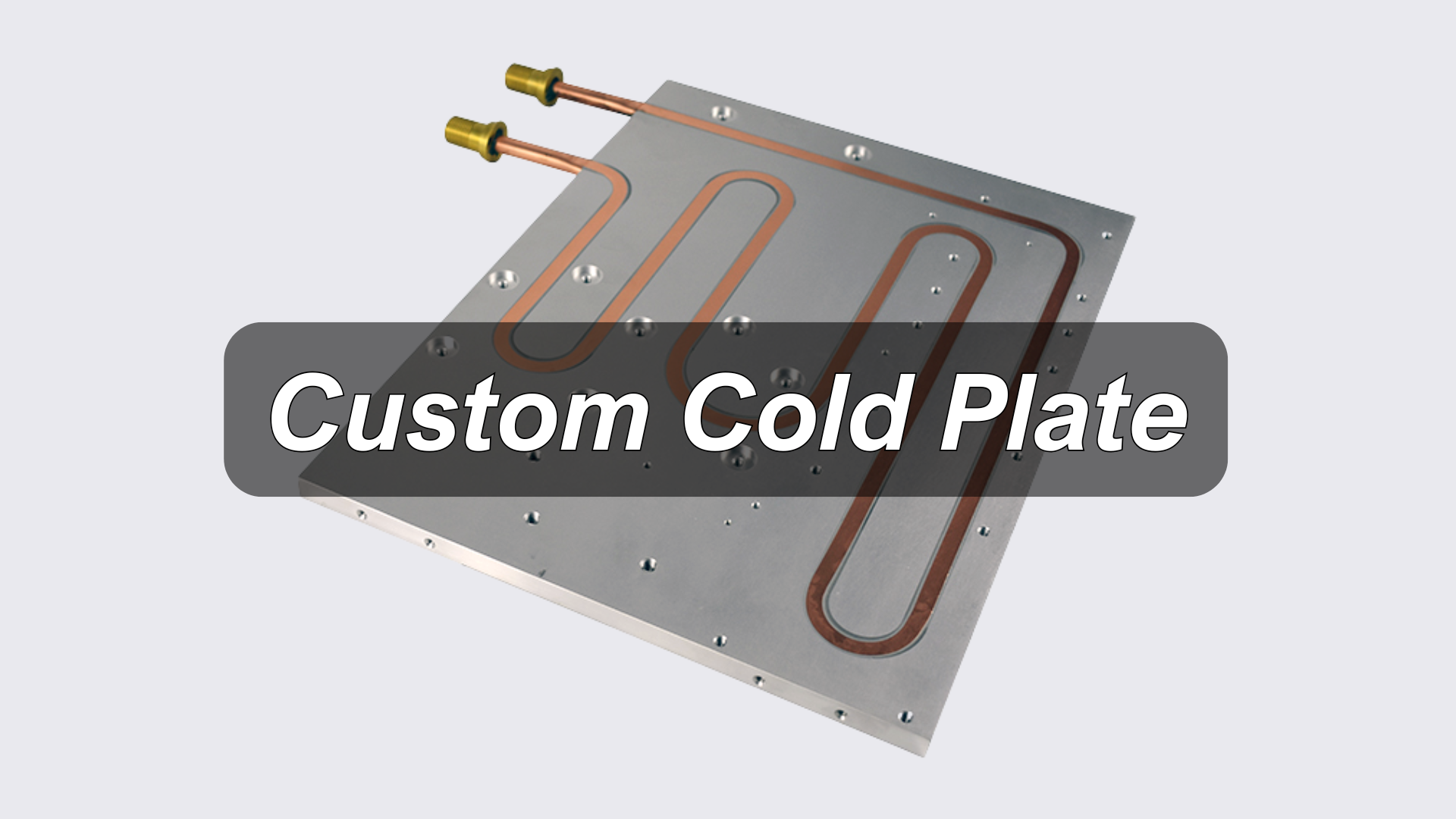
A cold plate, also known as a cooling plate or liquid cold plate, is a high-performance thermal management component designed to extract heat from devices via direct surface contact. By transferring thermal energy into a circulating coolant, cold plates provide a precision-engineered solution for managing the extreme heat densities generated by modern electronics.
Below is a simplified overview of what defines a typical cold plate and how it is used.
Aspect | Description |
|---|---|
Purpose | transfers heat from high-power components into a circulating liquid loop to maintain optimal, stable operating temperatures |
Key Components | a precision-machined base plate, internal flow channels (or embedded tubes), and a sealed cover with integrated fluid ports |
Common Materials | primarily Aluminum and Copper, selected for their specific balance of thermal conductivity, weight, and environmental resistance |
Typical Applications | power electronics, semiconductor cooling, high-density data centers, laser systems, and EV battery cooling |
How It Works
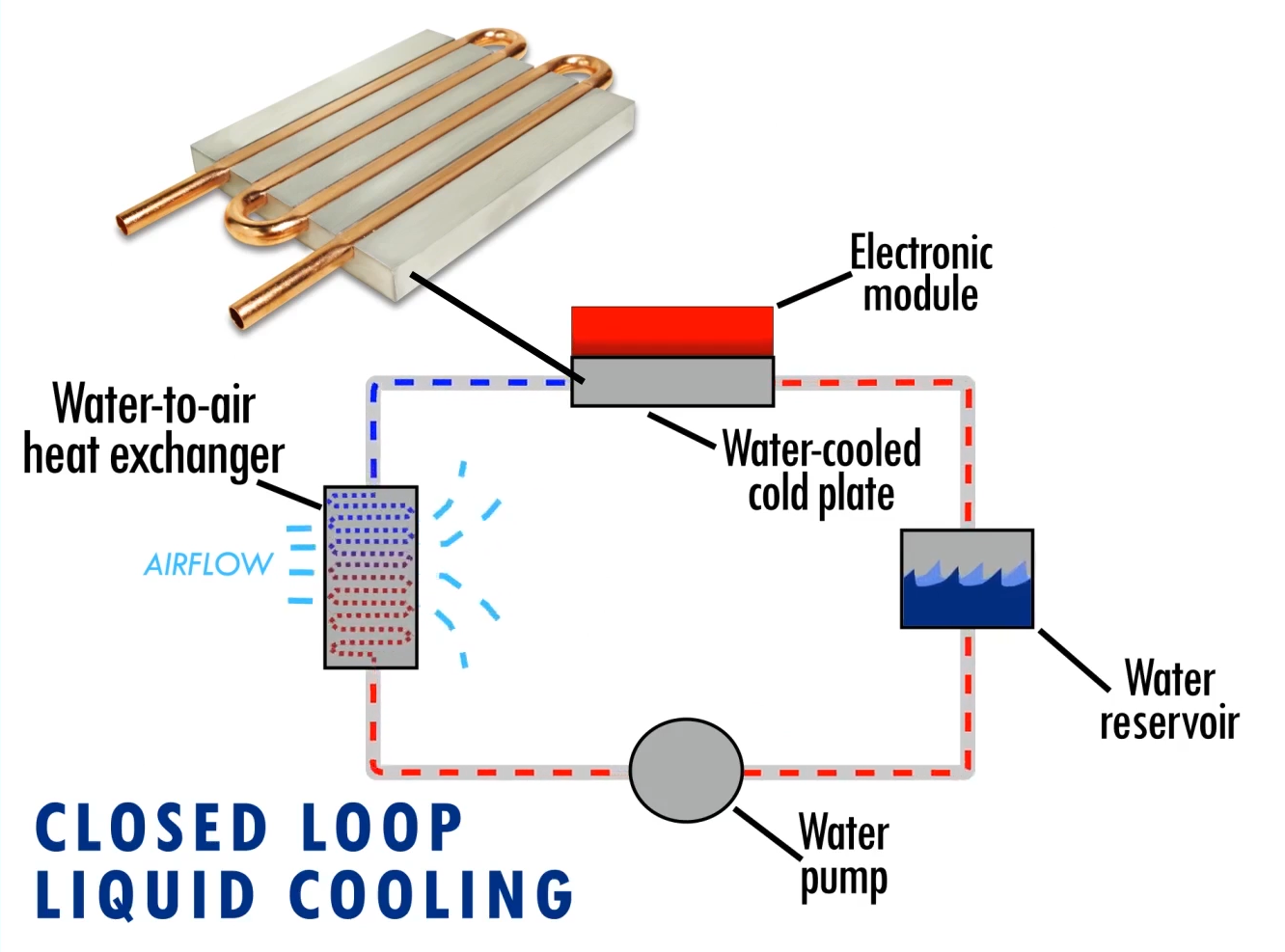
Source: ATS (Advanced Thermal Solutions, Inc.)
The operation of a cold plate follows a precise thermodynamic process to manage heat. Here is a step-by-step breakdown of how it works within a liquid cooling system:
Thermal Contact and Conduction: The heat-generating component (such as a CPU, IGBT, or battery cell) is mounted directly onto the surface of the cold plate. A Thermal Interface Material (TIM) is applied to eliminate air gaps, ensuring efficient heat conduction into the metal body.
Heat Transfer to Internal Channels: Once inside, the heat conducts toward internal flow channels. In custom designs, these channels are optimized using serpentine, parallel, or manifold configurations to maximize surface area and ensure uniform cooling across the entire plate.
Convective Cooling: A liquid coolant is pumped through these channels. As the fluid flows over internal fins or micro-channels, it absorbs thermal energy via convection.
Heat Transport & Rejection: The heated fluid is carried to an external heat exchanger (like a radiator or chiller), where the heat is released into the ambient environment before the cooled liquid cycles back.
To learn more, check out this video:
Cold Plate vs. Heat Sink
Although both cold plates and heat sinks serve the same fundamental purpose—removing heat from critical components—they operate in very different ways and suit different thermal demands.
Aspect | Heat Sink | Cold Plate |
|---|---|---|
Cooling Method | Passive or forced air cooling | Active liquid cooling |
Heat Transfer Medium | Air | Liquid coolant |
Thermal Performance | Moderate | High |
Temperature Control | Limited by airflow and ambient air | Precise and highly controllable |
System Complexity | Low | Higher (pump, tubing, coolant required) |
Volume & Weight | Large and bulky for high power | Significant reduction in size and weight |
Typical Use Cases | Low-to-medium power applications | High heat flux and space-constrained systems |
Heat sinks dissipate heat by spreading it across fins and releasing it into the surrounding air through natural or forced convection. Their performance depends heavily on airflow, fin geometry, and ambient conditions.
Cold plates, on the other hand, place a liquid coolant directly beneath the heat source. Because liquids have significantly higher heat capacity than air, cold plates can remove heat more efficiently and respond faster to temperature changes. This makes them ideal for applications where air cooling cannot meet thermal requirements.
Why Choose Custom Cold Plates Over Standard Ones?
Standard cold plates are suitable for general applications, but they often fall short in more demanding systems. With increasing power density and compact designs, thermal management can no longer rely on one-size-fits-all solutions.
Custom cold plates are engineered to match specific system requirements. They provide precise control over temperature distribution, coolant flow paths, and internal geometry.
Custom vs. Standard Cold Plates
Feature | Standard Cold Plates | Custom Cold Plates |
|---|---|---|
Thermal Optimization | General-purpose designs | Tailored to specific heat flux and hot spot locations |
Geometry & Mounting | Fixed dimensions and hole patterns | Contoured shapes designed to fit tight or irregular spaces |
Temperature Uniformity | Limited control over gradients | Precision-engineered to ensure near-isothermal surfaces |
Pressure Drop | Fixed channel resistance | Optimized to match pump curves and minimize energy costs |
System Integration | Generic fittings and ports | Integrated features (e.g., manifolding, specialized connectors) |
Material Choice | Limited | Selection based on specific coolant chemistry & environment |
In short, standard cold plates are suitable for basic cooling needs, but custom cold plates provide precision and flexibility. When systems require tight temperature control, complex integration, or uninterrupted operation, custom designs become an essential part of the thermal management strategy.
Manufacturing Methods for Custom Cold Plates
Once you’ve determined that a custom cold plate is needed, the next crucial step is selecting the manufacturing method. Different techniques influence thermal performance, cost, durability, and compatibility with your system.
1. Tubed Cold Plates
Tubed cold plates are a straightforward and reliable method that circulates coolant through embedded tubes, typically made of copper or stainless steel. They are a popular choice for general industrial applications where cost is a primary concern.
Manufacturing Principle: Metal tubes are bent to shape and either mechanically pressed into grooves or epoxy-bonded into a base plate to ensure a thermal connection.
Pros: Most cost-effective; excellent leak prevention (the tube is a single continuous piece); compatible with various aggressive coolants.
Considerations: Lower heat transfer efficiency compared to internal fin designs; performance is limited by the contact surface area between the tube and the plate.
Best for: Industrial power supplies, motor drives, and LED cooling.
2. CNC Machined (Deep Hole Drilled or Milled) Cold Plates
CNC machining is used to create internal flow paths directly within a solid metal block. This is the most common method for creating precise, custom-shaped cold plates with moderate complexity.
Manufacturing Principle: Internal channels are created either by deep-hole drilling through a solid block (gun drilling) or by milling open channels that are subsequently sealed with a cover plate using gaskets, O-rings, or specialized sealants.
Pros: High precision and dimensional accuracy; fast turnaround for prototyping; highly flexible external mounting options.
Considerations: Material waste during machining; potential leak points at sealing interfaces if gaskets or O-rings are used.
Best for: Laboratory equipment, semiconductor testing, and low-volume custom electronics.
3. Skived Fin Cold Plates
Skived cold plates utilize a specialized "skiving" process to create high-density fins directly from the base material, significantly increasing the internal surface area for heat transfer.
Manufacturing Principle: A sharp tool slices thin layers of the base metal (usually copper or aluminum) and bends them upright to form integrated fins. A cover is then added to create a closed cooling chamber.
Pros: Extremely high surface area for superior heat dissipation; no thermal resistance between the fins and the base (one-piece construction).
Considerations: Higher pressure drop due to dense fin structures; limited to certain flow path geometries.
Best for: High heat flux applications like CPUs, GPUs, and high-performance power modules.
4. Friction Stir Welded (FSW) Cold Plates
FSW cold plates join a machined base and a cover using solid-state welding. This produces a seamless, high-strength bond that is ideal for demanding environments.
Manufacturing Principle: A rotating tool creates frictional heat to "stir" two metal parts together, creating a forged-strength bond without melting the material.
Pros: Exceptional structural integrity and leak-proof reliability; high pressure resistance; no filler metals or sparks involved.
Considerations: Mostly limited to aluminum; requires specialized, high-force machinery and flat joining surfaces.
Best for: EV battery trays, high-power automotive inverters, and rail transport.
5. Vacuum Brazed Cold Plates
Vacuum brazing allows for the most intricate internal channel layouts, such as complex lattices or micro-fins, creating a monolithic part with aerospace-grade reliability.
Manufacturing Principle: Multiple layers of metal and filler foil are heated in a vacuum furnace. The filler melts and wicks into the joints, fusing the layers into a single, seamless component.
Pros: Highest thermal performance; supports extremely intricate "maze-like" internal structures; allows for multi-layer cooling paths.
Considerations: High upfront cost; long lead times; requires extremely strict cleanliness controls during assembly.
Best for: Aerospace, AI data centers (HPC), semiconductor cooling, and high-power laser systems.
6. 3D Printed (Additive Manufacturing) Cold Plates
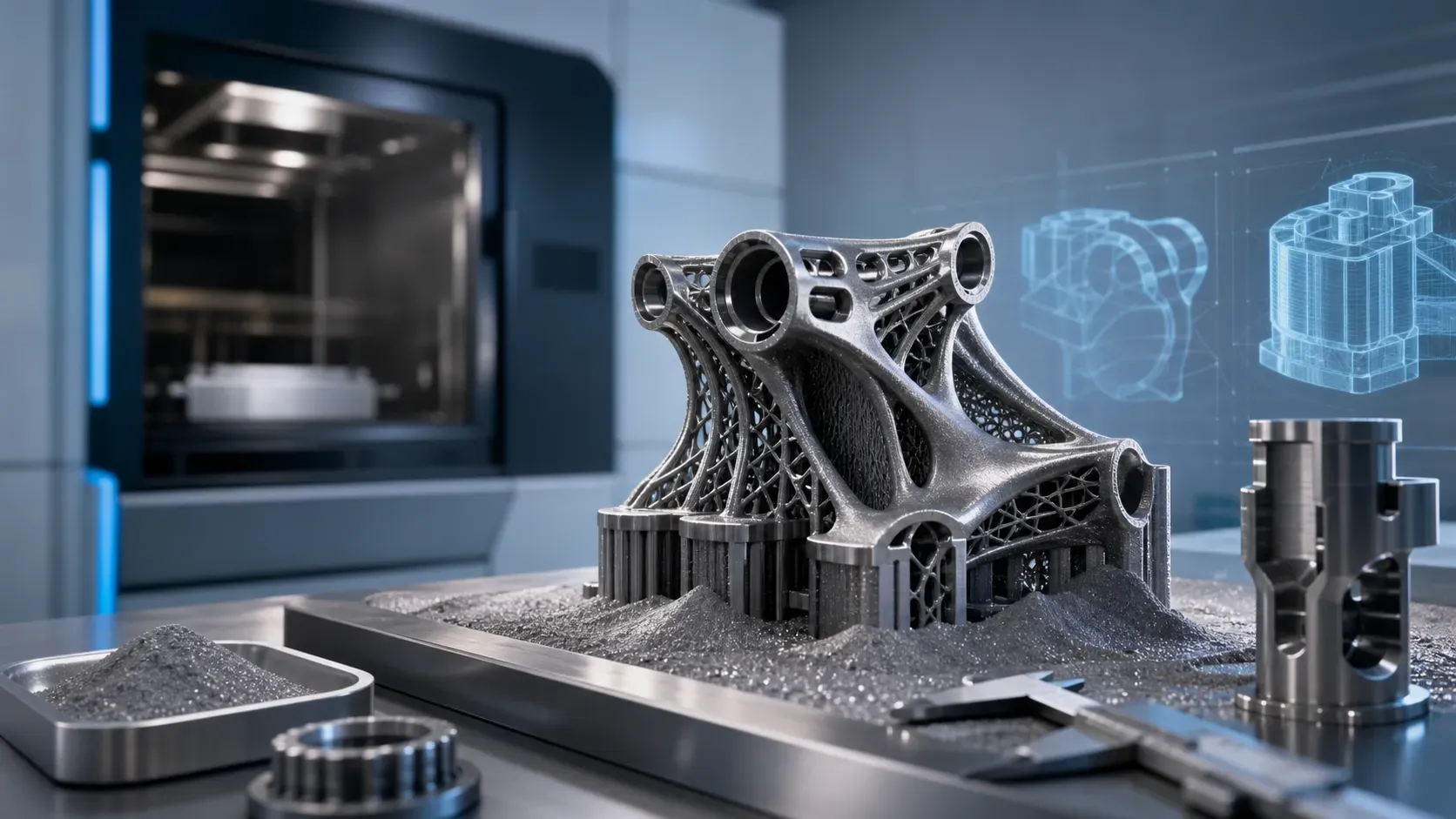
Metal 3D printing (DMLS/SLM) allows for "impossible" geometries that traditional machining cannot achieve, such as bio-mimetic flow paths that follow the exact contours of a heat source.
Manufacturing Principle: Metal powder is selectively melted layer by layer by a laser to form the plate and its internal channels as a single piece.
Pros: Extremely high design flexibility; massive weight reduction; enables the consolidation of multiple parts into one; ideal for rapid prototyping of complex parts.
Considerations: Very high cost for mass production; surface finish may require post-processing; size limitations based on the printer bed.
Best for: Specialized aerospace components, high-end motorsports, and rapid prototyping of complex cooling geometries.
Comparison of Manufacturing Methods
Method | Thermal Performance | Design Flexibility | Cost Efficiency | Typical Application |
|---|---|---|---|---|
Tubed | ★★☆☆☆ | ★★☆☆☆ | ★★★★★ | General Industrial & HVAC |
CNC Machined | ★★★☆☆ | ★★★☆☆ | ★★★★☆ | Lab Equipment & Test Fixtures |
Skived Fin | ★★★★☆ | ★★★☆☆ | ★★★☆☆ | High Heat Flux Electronics |
Friction Stir (FSW) | ★★★★☆ | ★★★☆☆ | ★★★☆☆ | EV Batteries & Automotive |
Vacuum Brazed | ★★★★★ | ★★★★☆ | ★★☆☆☆ | Aerospace & AI Data Centers |
3D Printed | ★★★★☆ | ★★★★★ | ★☆☆☆☆ | Prototyping & Space Exploration |
Summary: Which to Choose?
For Budget & Simplicity: Choose Tubed or CNC Machined.
For High Power Density: Choose Skived Fin or Vacuum Brazed.
For Large-Scale Automotive/EV: Choose Friction Stir Welded (FSW).
For Absolute Design Freedom: Choose 3D Printed.
Material Selection for Custom Cold Plates
Material choice plays a critical role in cold plate performance and longevity. Beyond thermal conductivity, engineers must also consider weight, cost, and, most importantly, chemical compatibility across the entire cooling loop.
Galvanic Corrosion Considerations
Galvanic corrosion is a leading cause of failure in liquid cooling systems. It occurs when dissimilar metals such as aluminum and copper are electrically connected through the coolant, forming a galvanic cell that rapidly corrodes the less noble metal, typically aluminum.
To prevent this, aluminum cold plates should never share a cooling loop with copper components unless high-quality corrosion inhibitors are used. Even then, best practice is to use compatible metals across all wetted surfaces.
Comparison of Cold Plate Materials
In practice, Aluminum and Copper are the industry standards, while Stainless Steel is used for specialty environments. Composites are reserved for advanced aerospace or power electronics where Coefficient of Thermal Expansion (CTE) matching is required.
Aspect | Aluminum | Copper | Stainless Steel | Composites |
|---|---|---|---|---|
Key Benefits | Lightweight; Highly cost-effective | Superior thermal conductivity | Exceptional corrosion resistance; High strength | Tailored properties |
Thermal Conductivity | Excellent (~205 W/m·K) | Superior (~400 W/m·K) | Poor (~15–20 W/m·K) | Varies |
Weight | Very light | Heavy | Heavier than Aluminum | Light to Moderate |
Corrosion Risk | Moderate | Low | Very Low | Low |
Coolant Compatibility | Antifreeze with strict corrosion inhibitors; Dielectric fluids | Pure water (deionized); Water/Glycol; Industrial water | Compatible with almost all fluids (inc. corrosive chemicals) | Specialized fluids; Water/Glycol |
Best for | EV batteries, Aerospace, Cost-sensitive consumer electronics | HPC (CPUs/GPUs), High-power lasers, Semiconductors | Medical devices, Marine, Food/Chemical processing | High-reliability power modules (IGBTs), Satellites |
Key Takeaways
Aluminum: The go-to for weight-sensitive and cost-constrained projects. While inherently prone to corrosion, this risk is managed by using specialized "inhibited" coolants. It is the standard for EV battery cooling trays.
Copper: The "gold standard" for peak thermal performance. If your application has a high heat flux (e.g., a high-end AI processor), copper is almost always required. However, be mindful of its weight and the risk it poses to any aluminum components in the same system.
Stainless Steel: While it is a poor thermal conductor, it is incredibly rugged. In many custom cold plates, stainless steel tubes are embedded into an aluminum base. This "tubed" design allows the coolant to touch only the steel (preventing aluminum corrosion) while the aluminum base spreads the heat.
Composite Materials: Often used when the cold plate must "move" (expand/contract) at the same rate as the electronic chip it is cooling. This prevents mechanical stress on solder joints in high-reliability aerospace and military hardware.
Design Tips for Custom Cold Plates
Designing an efficient custom cold plate requires a balance of fluid dynamics, material science, and mechanical engineering. Here are key strategies to optimize your design:
1. Optimize Fluid Flow and Turbulence
Disrupt the Boundary Layer: Incorporate internal features like fins, pins, or staggered pedestals. These create turbulence, which breaks up the stagnant fluid boundary layer and significantly increases the heat transfer coefficient.
Ensure Flow Uniformity: In multi-channel or parallel designs, ensure the coolant is distributed evenly. Fluid will naturally follow the "path of least resistance," which can lead to hot spots if the manifold is not balanced.
Manage Pressure Drop: High turbulence increases cooling but also increases the work required by the pump. Design your channels to stay within the pump’s optimal operating curve to prevent system fatigue.
2. Strengthen Material Compatibility (Corrosion Prevention)
The Golden Rule of Liquid Cooling: Avoid mixing dissimilar metals. Never use aluminum cold plates in a loop with copper piping or heat exchangers without specialized, high-concentration corrosion inhibitors.
Coolant Pairing:
Aluminum: Use inhibited water-glycol mixtures;
Copper: Use deionized (DI) water or treated water-glycol;
Stainless Steel: The best choice for aggressive chemicals or high-purity DI water that would otherwise leach ions from copper.
3. Maximize Thermal Interface Efficiency
Surface Flatness and Roughness: Specify tight tolerances for flatness (typically <0.05mm) and low surface roughness. Even microscopic air gaps act as insulators.
Mounting Pressure: Thermal Interface Materials (TIMs) like grease or pads require consistent clamping force to perform correctly. Ensure your design includes enough mounting points to apply even pressure across the contact area.
4. Design for Manufacturability (DFM)
Inlet/Outlet Placement: Position fluid ports to prevent air pockets from being trapped inside the plate, which can drastically reduce cooling performance.
Choose the Right Sealing:
O-Rings: Best for easy maintenance and prototyping.
Vacuum Brazing / FSW: Best for high-pressure, high-reliability, and leak-proof monolithic structures where gaskets are a liability.
Wall Thickness: Maintain sufficient wall thickness to handle the internal fluid pressure (including potential pressure spikes) without deforming.
5. Simulate Before You Build
CFD Analysis: Use Computational Fluid Dynamics (CFD) to visualize flow velocity and temperature gradients. This helps identify "dead zones" (stagnant fluid) where heat can build up before you invest in expensive prototypes.
To learn more, check out this video:
Cost Considerations for Custom Cold Plate Projects
When planning a custom cold plate project, understanding the main cost drivers early can help you make informed design decisions and avoid unexpected expenses.
Here is a breakdown of how material, technology, and design choices influence the final price.
1. Material Choice
Material selection has a major influence on both performance and cost. Although copper offers superior thermal conductivity, it is significantly more expensive and harder to machine than aluminum. Aluminum remains the most commonly used metal for cold plates because it strikes a balance between performance, weight, cost, and manufacturability.
Aluminum — Widely cost‑effective and easier to process.
Copper — Higher performance but higher machining cost and longer run times.
Stainless Steel & Composites — Cost varies depending on design complexity and manufacturing method.
2. Manufacturing Technology vs. Volume
The "best" technology depends on your Production Volume. You must balance Unit Cost (the price per piece) with NRE (Non-Recurring Engineering/tooling costs).
Method | NRE / Setup Cost | Unit Cost | Volume Strategy |
|---|---|---|---|
3D Printed | Very Low | Very High | Best for 1–5 prototypes with "impossible" geometries. |
CNC Machined | Low | Medium | Best for low-volume (10–100) or high-precision testing. |
Tubed | Medium | Low | High ROI for medium-to-high volumes where basic cooling is enough. |
Skived Fin | Medium | Medium | Cost-efficient for high-heat-density chips in medium volumes. |
FSW | High | Very Low | Best for high-volume (1,000+) automotive or EV projects. |
Vacuum Brazed | Very High | High | Reserved for high-performance aerospace or AI data centers. |
Low Volume (<50 units): Stick to CNC Machining or 3D Printing. The high unit price is offset by the fact that you don't have to pay for expensive molds or vacuum furnace setups.
High Volume (>1,000 units): Technologies like Friction Stir Welding (FSW) or specialized Extrusions become much cheaper because the initial "tooling" cost is spread across thousands of parts, drastically reducing the labor time per piece.
3. Surface Specifications: Roughness vs. Flatness
Over-specifying surface finish is a common way to waste money.
Roughness : A "mirror finish" looks great but rarely improves cooling. Most microscopic gaps are filled by your Thermal Interface Material (TIM). A standard finish of 32–64 µin is usually sufficient. Requesting a smoother finish requires slower machining passes and increases the price.
Flatness: This is far more important than roughness. However, to save money, only specify tight flatness for the "contact zones" where the components sit, rather than the entire plate.
4. Mounting Features and Holes
The "Fluid Path" Conflict: Placing holes near internal channels requires complex "islands" or specialized tube bending, which adds significant machining time.
Threaded Holes: Tapped holes are more expensive than simple through-holes. If you require Helicoils (stainless steel inserts), expect the cost to rise due to the manual installation required.
Tolerances: Avoid tolerances tighter than ±0.005 in across large distances. Extreme precision requires climate-controlled rooms and specialized sensors, which can double the machining cost.
5. Connections and Finishing
Standard vs. Custom Ports: Using standard SAE O-ring ports or NPT fittings is cheap. Custom manifolds or welded-on specialized connectors require manual labor and extra pressure testing.
Surface Treatments: Unless the environment is highly corrosive, an "as-machined" finish is the cheapest. Anodizing or Nickel Plating adds cost and may require "masking" (covering areas that need to remain conductive), which is a high-labor manual process.
Conclusion
Custom cold plates are key to achieving efficient, reliable, and application-specific cooling. Thoughtful choices in manufacturing methods, materials, and internal design not only optimize thermal performance but also help control costs and enhance longevity.
Contact us today to discuss your cooling requirements and receive a solution tailored to your application!
FAQs
What is the purpose of a cold plate?
The goal of a cold plate is to provide precise temperature control for high-power devices. By utilizing the superior heat capacity of liquids, cold plates efficiently stabilize temperatures in high-density environments where maintaining a specific thermal profile is critical for performance and longevity.
What does a cold plate consist of?
A cold plate typically consists of a high-conductivity metal body (such as copper or aluminum) featuring internal flow channels. It includes a precision-machined mounting surface for the heat source and specialized inlet/outlet ports to integrate into a wider fluid circulation loop.