
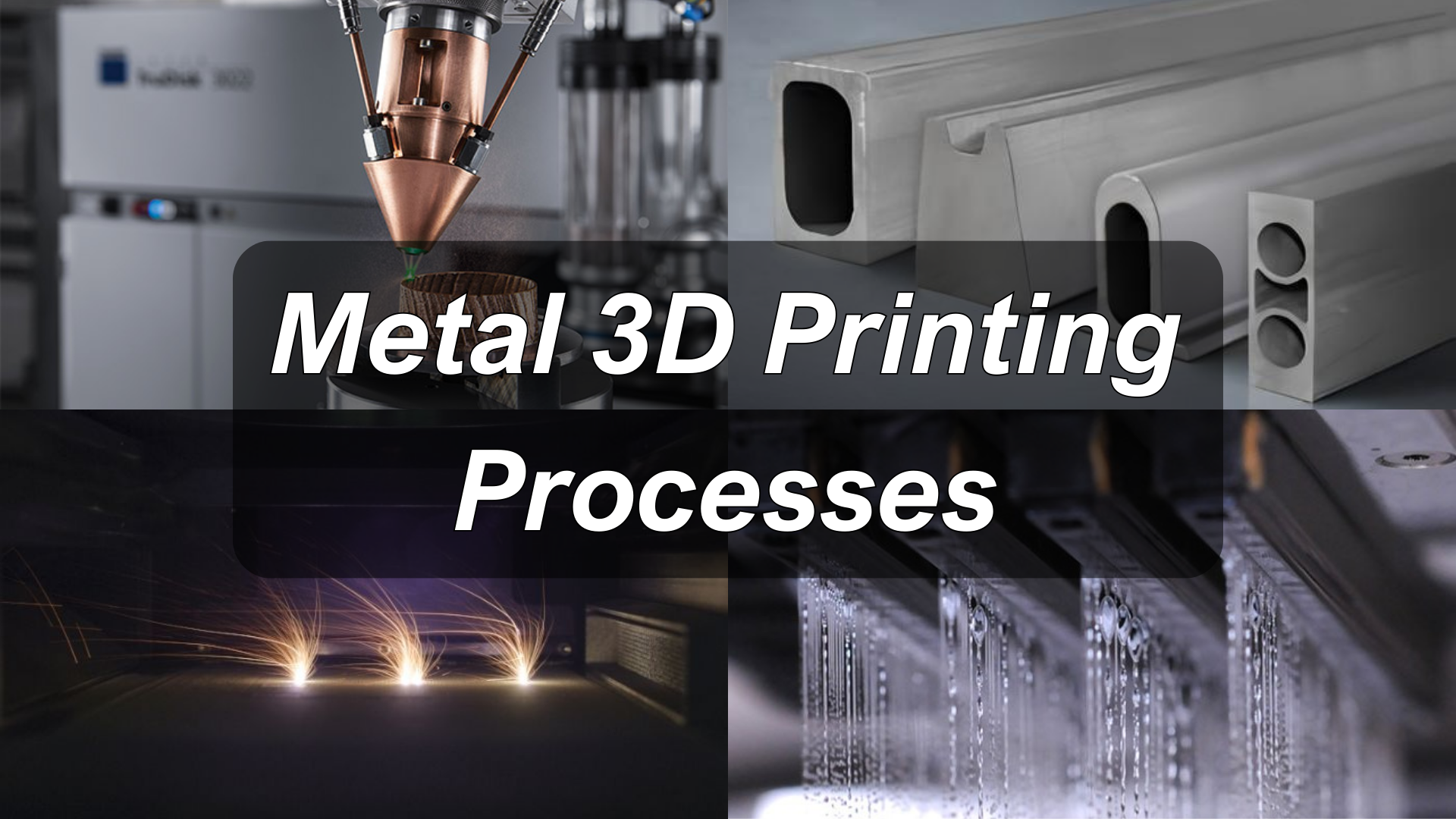
Explore the 4 main metal 3D printing processes: PBF, DED, Binder Jetting, and MEX. Compare how they work and their key advantages to choose the right process for your project.
Introduction
3D printing, also known as additive manufacturing (AM), has advanced rapidly over the past decade, evolving from a niche prototyping method into a viable industrial production technology.
Metal additive manufacturing, in particular, introduces a wide range of technical terms—such as PBF, SLM, EBM, Binder Jetting, and DED—that you are likely to encounter frequently. But what do these processes actually mean? How are they related to one another? How do they work, and what advantages or limitations should you expect in practical applications?
This guide aims to clarify these questions by focusing on the four main process categories of metal 3D printing: Powder Bed Fusion (PBF), Directed Energy Deposition (DED), Binder Jetting (BJ), and Material Extrusion (MEX).
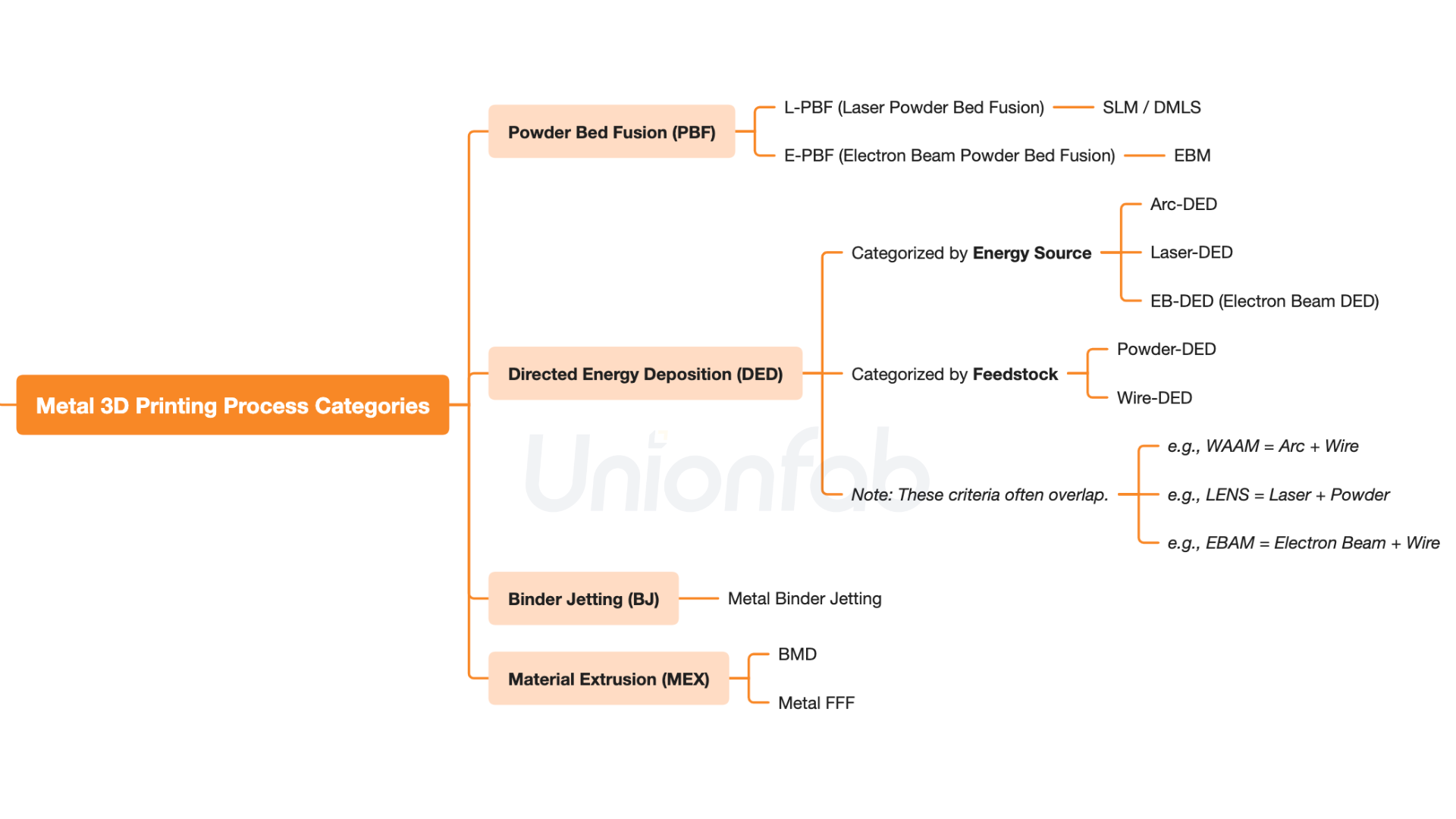
The mind map above provides a structured overview of how the major metal 3D printing process categories and their common subtypes are organized. From this map, you can observe several key relationships:
Widely used terms such as SLM, DMLS, and EBM are not separate categories but specific technologies nested within Powder Bed Fusion (PBF).
Directed Energy Deposition (DED) can be classified by both energy source and feedstock, and these classifications often overlap in real-world systems (e.g., WAAM or LENS).
Binder Jetting and Material Extrusion follow unique paths involving binder-assisted shaping and bound-metal extrusion, respectively.
1. Powder Bed Fusion (PBF)
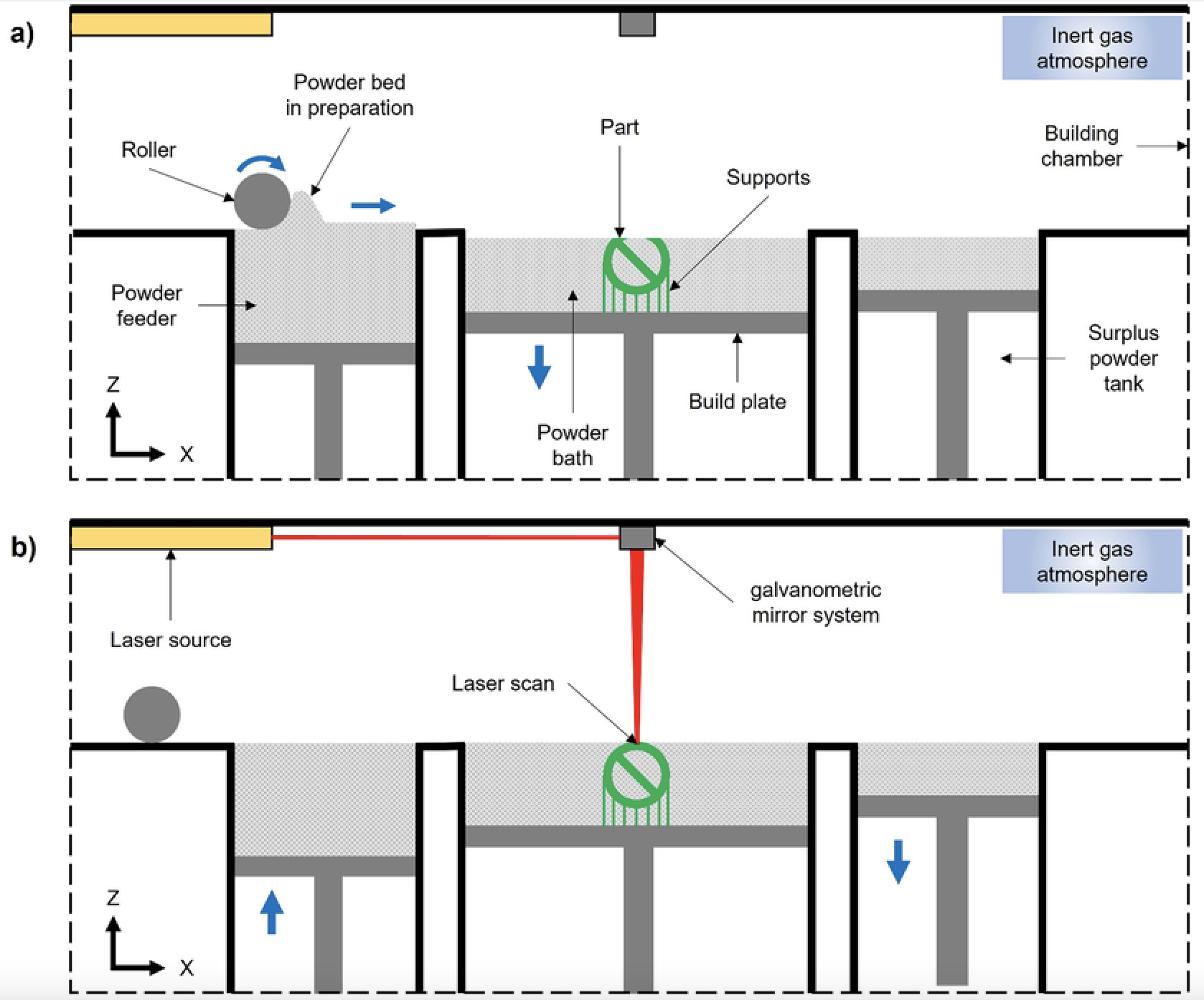
Source: researchgate.net
In a PBF system, a recoater blade or roller spreads a micro-thin layer of fine metal powder across a build platform. A high-powered thermal energy source—either a laser (L-PBF) or an electron beam (E-PBF)—selectively melts and fuses the powder particles according to the cross-section of the CAD model. Once a layer is complete, the build platform descends slightly, a new layer of powder is spread, and the process repeats.
Pros:
Unmatched Complexity: Capable of printing intricate designs, such as conformal cooling channels and lattice structures, that are impossible with traditional machining.
High Resolution: Yields exceptional dimensional accuracy and fine feature details.
Excellent Material Properties: Produces highly dense parts (often > 99.5%) with mechanical properties rivaling or exceeding cast metals.
Cons:
Support Structures are Mandatory (Especially for Laser Systems): Contrary to some misconceptions, laser-based PBF requires robust support structures to anchor the part to the build plate and dissipate intense thermal stresses, preventing warping.
Slow Build Rates: The precise, point-by-point melting process makes it slower than other categories.
High Costs: The machines, high-quality metal powders, and required inert gas environments demand a significant capital investment.
To explore individual technologies in more detail, check out our SLM and EBM guides, or read The Complete Guide to Metal 3D Printing Technologies for a full industry overview.
2. Directed Energy Deposition (DED)
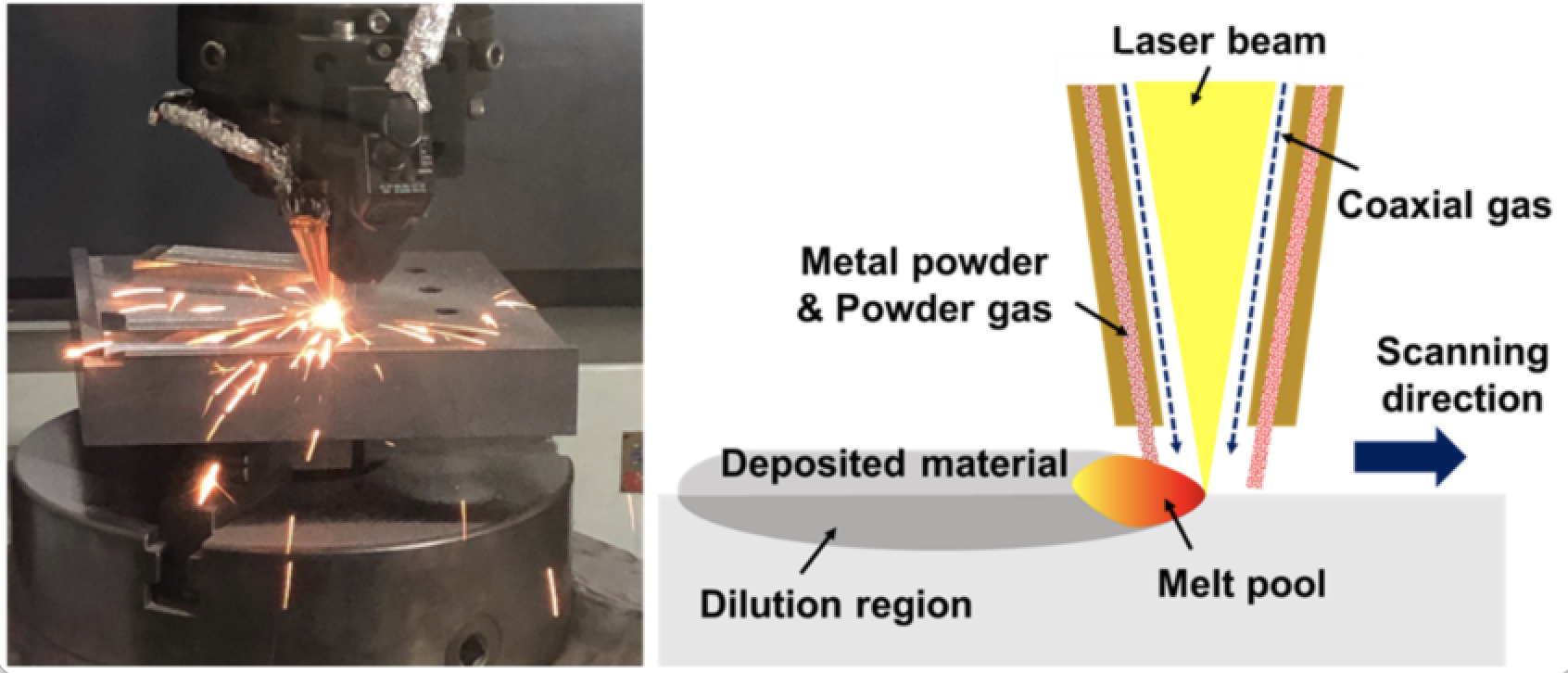
Source: researchgate.net
DED involves a multi-axis robotic arm or a CNC-style gantry system equipped with a specialized nozzle. This nozzle simultaneously feeds material, either metal powder or metal wire, into a focused energy source (laser, electron beam, or plasma arc). The material is instantly melted as it is deposited onto the build surface.
Pros:
Exceptional Speed: DED boasts some of the highest deposition rates in metal AM.
Massive Build Volumes: Unconstrained by a powder bed chamber, DED can build parts several meters long.
Repair and Modification: Uniquely capable of depositing new metal onto existing components, making it invaluable for repairing high-value parts like turbine blades or large dies.
Multi-Material Capabilities: Can switch feedstock mid-print to create custom alloys or functionally graded materials.
Cons:
Poor Surface Finish: The rapid deposition leaves a rough, "near-net-shape" finish.
Extensive Post-Processing: DED parts almost always require secondary CNC machining to achieve critical tolerances.
Limited Complexity: Cannot produce the fine internal channels or delicate overhanging structures achievable with PBF.
3. Binder Jetting (BJ)
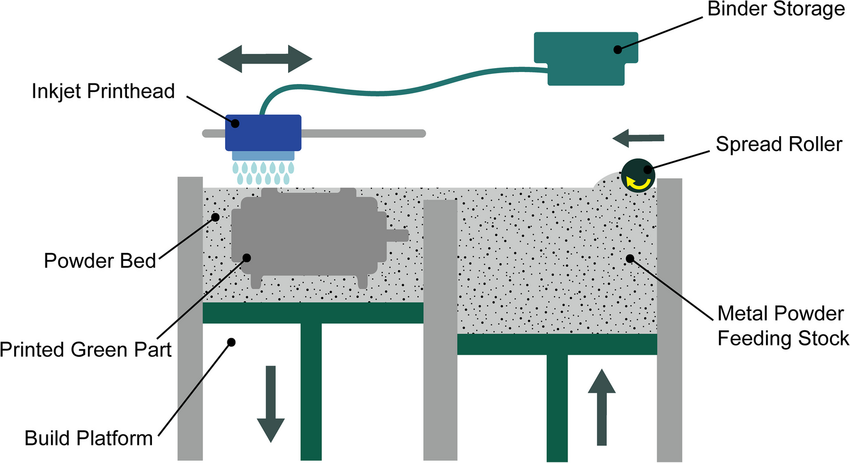
Source: researchgate.net
Unlike PBF and DED, the printing phase of Binder Jetting does not use heat. A printhead moves across a bed of metal powder, selectively jetting a liquid binding agent (essentially an industrial glue) to bond the particles together.
Once printing is finished, the part is in a fragile “green” state, meaning the metal particles are only held together by the binder. As a result, the part has low strength and does not yet possess its final material properties.
To achieve its final metal properties, the part must undergo extensive post-processing: debinding (to remove the polymer glue) and high-temperature furnace sintering (to fuse the metal particles together).
Pros:
High-Speed Batch Production: Capable of printing dozens or hundreds of parts simultaneously in a single powder bed.
No Thermal Distortion During Printing: Because there are no lasers melting metal during the print phase, parts don't suffer from immediate thermal warping.
No Print Supports Needed: The surrounding loose powder supports the part as it prints (though specialized supports may be needed later during the sintering phase).
Cost-Effective: Generally offers a lower cost-per-part for medium-to-high volume runs.
Cons:
Significant Shrinkage: Parts can shrink by up to 20% during the furnace sintering stage, requiring complex software calculations to compensate accurately.
Lower Density: While improving, sintered BJ parts are generally slightly more porous than PBF parts.
Fragile Green Parts: The unsintered parts require delicate handling.
For a deeper look at Binder Jetting workflows, materials, and applications, see our Metal Binder Jetting guide, or compare it with laser-based methods in our Metal Binder Jetting vs DMLS article.
4. Material Extrusion (MEX)
Source: Wikimedia Commons
Metal MEX uses a feedstock made of metal powder heavily bound within a thermoplastic or wax matrix (usually in the form of a filament or a rod). This material is heated and extruded through a nozzle layer by layer to form the part.
Similar to Binder Jetting, this process only creates a "green" part. The polymer binder must then be chemically or thermally removed (debinding), and the remaining metal matrix is fused in a sintering furnace.
Pros:
Highly Accessible: The equipment is significantly cheaper than laser-based systems.
Office-Friendly: Uses bound metal rather than loose, reactive powders or dangerous lasers, meaning it requires minimal safety infrastructure and no specialized inert environments.
Easy to Operate: Requires less specialized technical training to run the printers.
Cons:
Multi-Step Process: The reliance on debinding and sintering extends the total lead time.
Dimensional Accuracy Challenges: Experiences high shrinkage during sintering, making tight tolerances difficult to achieve without secondary machining.
Part Strength: Parts are generally weaker and have lower density compared to PBF or DED processes.
How to Choose the Right Metal 3D Printing Process?
Each metal 3D printing process has unique strengths. The table below compares the key differences to help you identify the most suitable technology for your project.
Comparison Aspect | Powder Bed Fusion (PBF) | Directed Energy Deposition (DED) | Binder Jetting (BJ) | Material Extrusion (MEX) |
|---|---|---|---|---|
How It Works | Lasers/E-beams selectively melt a bed of metal powder. | Energy source melts metal powder/wire as it is deposited. | Inkjet deposits liquid binder onto powder layer by layer. | Heated nozzle extrudes binder-bound metal filament. |
Common Technologies | L-PBF (SLM, DMLS), E-PBF (EBM) | WAAM, LENS, LMD, EBAM | Metal Binder Jetting (MBJ) | BMD, Metal FFF |
Best For | High-precision, complex end-use parts | Massive structural parts, high-value repairs | Batch production of small, complex parts | Accessible prototyping & custom jigs |
Strength | ★★★★★ (Near-wrought density) | ★★★★☆ (Fully dense) | ★★★☆☆ (Post-sintering) | ★★☆☆☆ (Requires HIP) |
Accuracy | ★★★★★ (Exceptional detail) | ★★☆☆☆ (Near-net shape) | ★★★★☆ (Predictable shrinkage) | ★★☆☆☆ (Prone to warping) |
Finish | ★★★★☆ (Low Ra, matte finish) | ★☆☆☆☆ (Very rough, weld-like) | ★★★☆☆ (Good, slightly porous) | ★★☆☆☆ (Visible layer lines) |
Print Speed | ★★☆☆☆ (Slow build rate) | ★★★★★ (High deposition rate) | ★★★★☆ (Fast layer binding) | ★★☆☆☆ (Slow extrusion) |
Typical Part Size | Small to Medium | Huge | Small to Medium | Small |
Key Post-Processing | Support removal, stress relief annealing | Heavy CNC machining to achieve final tolerances | Debinding & furnace sintering | Debinding & furnace sintering |
Relative Cost | $$$ | $$ | $ | $ |
Safety & Environment | Inert gas, strict powder handling required | Fume extraction, radiation shielding (for EBAM) | Minimal hazards (cold process) | Office-friendly, standard ventilation |
In summary, selecting the optimal technology depends entirely on your project's primary constraints. Use this quick decision guide to prioritize:
Precision & Complexity > Cost → Choose PBF Best for: Intricate medical implants, aerospace engine cores, and conformal cooling molds.
Size & Speed > Precision → Choose DED Best for: Large structural components, marine parts, and repairing worn high-value tooling.
Volume & Scalability > Extreme Strength → Choose Binder Jetting Best for: Cost-effective mass production of standardized small parts (e.g., automotive brackets, filters).
Accessibility & Budget > Performance → Choose MEX Best for: Office-friendly rapid prototyping, functional validation, and low-cost temporary tooling.
Conclusion
Selecting the right metal 3D printing process requires balancing precision, part size, production volume, and cost.
Powder Bed Fusion delivers exceptional detail and material performance, Directed Energy Deposition enables large-scale manufacturing and repair, Binder Jetting supports efficient batch production, and Material Extrusion offers an accessible entry point for metal fabrication.
Understanding these core technologies provides a practical foundation for making informed manufacturing decisions.
Ready to move from evaluation to production?
Use our free cost calculator to get an instant estimate for your project.
Special offer: Get 10% off your first order when you sign up as a new customer.
FAQs
What is metal 3D printing called?
Metal 3D printing is most commonly referred to as metal additive manufacturing (metal AM). It describes a group of technologies that build metal parts layer by layer from digital models rather than removing material through machining.
What are the different types of metal 3D printing technologies?
The industry categorizes metal 3D printing into several distinct processes based on how the material is joined:
Powder Bed Fusion (PBF): Includes SLM (Selective Laser Melting) and EBM (Electron Beam Melting).
Directed Energy Deposition (DED): Often used for large parts and repairs.
Binder Jetting (BJ): A high-speed, liquid-binder-based process.
Material Extrusion (MEX): Uses metal-filled filaments, similar to standard FDM printing.
What is the process of printing on metal?
The process varies by technology, but the most common method is powder-based metal additive manufacturing. It typically involves spreading a thin layer of fine metal powder and using a high-powered laser or electron beam to selectively fuse the particles. Other methods use metal wire or a combination of metal powder and a polymer binder (which is later removed in a furnace).
What is the most accurate method of metal 3D printing?
Powder Bed Fusion (PBF), specifically SLM, is widely considered the most accurate method. It offers exceptional dimensional accuracy and can produce fine feature details (down to 20-100 microns) and complex internal geometries that other methods like DED or Binder Jetting cannot match.
How much does metal 3D printing cost?
The cost depends on your chosen approach:
In-house Production: Beyond the initial equipment investment (typically $200,000 to over $1 million for industrial systems), ongoing expenses include high-quality metal powders, specialized facility requirements, maintenance, and skilled operation.
On-demand Services: Outsourcing is often more economical for most applications. Costs are primarily driven by material usage and build time. Because less material is required, complex lattice structures can sometimes cost less to produce than solid parts.
For a detailed breakdown of pricing factors and estimation methods, see our Metal 3D Printing Cost guide.