
Compare Xometry, Protolabs, and Unionfab on quoting systems, DFM feedback, pricing, lead time, and manufacturing capabilities.
Introduction
Xometry is a global manufacturing marketplace connecting customers with a network of third-party suppliers. Protolabs is an automated rapid prototyping specialist operating its own production facilities alongside an extended partner network.
Unionfab serves as the overseas manufacturing service provider of UnionTech, one of China's leading industrial 3D printer manufacturers, delivering direct-from-factory production backed by the largest self-owned industrial 3D printing infrastructure in China.
All three platforms offer on-demand manufacturing with online quoting, but their production models, pricing structures, and levels of engineering support differ significantly. This guide breaks down each provider across key decision factors to help you identify the right fit for your project.
Quick Comparison: Xometry vs Protolabs vs Unionfab
For a high-level overview, the table below highlights the core differences in how these three providers operate and where they offer the most value.
Feature | Xometry | Protolabs | Unionfab |
|---|---|---|---|
Core Value | Global sourcing & material variety | Ultra-fast prototype delivery | Factory-direct pricing & engineering support |
Production Model | 100% Marketplace (Outsourced) | Hybrid (In-house + Network) | Direct In-house Manufacturing |
Best For | Standard parts & niche materials | 24-48h rapid prototyping | Industrial small-batches & metal 3D printing |
Pricing | Dynamic (Low for economy/international) | Premium (Higher cost for extreme speed) | Competitive (70% lower than industry avg) |
DFM Feedback | Automated (AI-driven) | Automated (Interactive software) | Hybrid (AI + Manual Engineer Review) |
Capacity | Massive (Distributed network) | High (Standardized factories) | Massive (1,000+ machines, self-operated) |
Customer Support | Digital Dashboard / Support Tickets | Corporate / Standardized | Direct Engineer-to-Engineer Support |
Manufacturing Model
Although these platforms offer online quoting and on-demand manufacturing services, their underlying production models differ significantly.
Company | Manufacturing Model | Description |
|---|---|---|
Xometry | Marketplace |
|
Protolabs | Hybrid |
|
Unionfab | Direct In-House Manufacturing |
|
Manufacturing Capabilities
When evaluating a manufacturing partner, it’s crucial to know immediately if they can support your specific project requirements. Below is a direct comparison of the manufacturing methods, technologies, and materials available across Xometry, Protolabs, and Unionfab.
Manufacturing Methods
Here is a quick breakdown of the core manufacturing processes supported by each provider.
Manufacturing Method | Xometry | Protolabs | Unionfab |
|---|---|---|---|
3D Printing | ✓ | ✓ | ✓ |
CNC Machining | ✓ | ✓ | ✓ |
Vacuum Casting | ✓ | ✓ | ✓ |
Sheet Metal Fabrication | ✓ | ✓ | ✓ |
Die Casting | ✓ | ✓ | ✓ |
Investment Casting | ✓ | ✓ | ✓ |
Injection Molding | ✓ | ✓ | ✓ |
Now let's take a closer look at how Xometry, Protolabs, and Unionfab compare across the two most in-demand services: 3D Printing and CNC Machining.
3D Printing Capabilities Comparison
Feature | Xometry | Protolabs | Unionfab |
|---|---|---|---|
Technologies | SLA, SLS, FDM, DMLS, PolyJet, Multi Jet Fusion (MJF), Carbon DLS, Binder Jetting | SLA, SLS, DMLS, Multi Jet Fusion (MJF), PolyJet, FDM | Large-format SLA, SLS, SLM/DMLS, FDM, Binder Jetting, DLP, Multi Jet Fusion (MJF), Polyjet |
Metal Materials | Aluminum, Stainless Steel 17-4, Stainless Steel 316/L | Aluminum, Cobalt Chrome, Inconel 718, Stainless Steel 17-4PH, Stainless Steel 316L, Titanium | Aluminum, Titanium, 316L Stainless Steel, 17-4PH Stainless Steel, Maraging Steel, CuCrZr, Inconel 625, Inconel 718 |
Resin Materials | Standard, Rigid, Somos Taurus, Tough, and more | Standard, Translucent, High-Temp, and more | Standard, Rigid, High-Temp, Somos Ledo, Somos Taurus, Transparent Clear, High Detail, Tough, Translucent, and Nylon-like resins |
Plastic Materials | Nylon, ABS, ASA, ULTEM, Polycarbonate, Polypropylene, TPU, PLA, PETG, PAEK, and PEKK | Nylon, ABS, ASA, Polypropylene, PLA, PETG, TPU, ULTEM | ABS, PETG, PC, ASA, Nylon 12 Carbon-filled, PC-FR(UL94-V0), PET-GF, PA6-GF, PA6-CF, Stratasys ULTEM 9085 |
Best For | Sourcing highly niche technologies (like Carbon DLS) or exotic materials through a vast network | Ultra-fast turnaround times for standard rapid prototyping iterations | Large-format printing, complex castable resins, and cost-effective scaling to production |
CNC Machining Capabilities Comparison
Feature | Xometry | Protolabs | Unionfab |
|---|---|---|---|
Technologies | CNC Milling, CNC Turning, and CNC Routing | CNC Milling and CNC Turning | CNC Milling, CNC Turning, CNC Routing, CNC Grinding, CNC Drilling, EDM, and Wire EDM |
Metal Materials | Aluminum, Copper, Bronze, Brass, Stainless Steel, Steel, Titanium, and Zinc | Aluminum, Brass, Copper, Stainless Steel, Steel Alloy, Steel Mild Low Carbon, and Titanium | Aluminum, Copper, Bronze, Brass, Stainless Steel, Steel, and Titanium |
Plastic Materials | HDPE, Acetal (Delrin), Polypropylene, UHMW-PE, Nylon 6/6, Acrylic, ABS, Polycarbonate, PEEK, PTFE-Teflon, Garolite, PVC, and ULTEM | ABS, Acetal, CPVC, Delrin, HDPE, LDPE, Nylon, PEEK, PEI, PET, PMMA (Acrylic), Polycarbonate, Polypropylene, Polystyrene, PPSU, PSU, PTFE, and PVC | PVC, PE, UHMWPE, POM, Delrin, PMMA, PC, PP, PS, ABS, PA6, PA66, PA-MC, PTFE, PET, PBT, PEEK, PEI, PI, Delrin AF, ESD225, ESD420, ESD520, and MC501CDR6 |
Best For | Finding highly obscure materials or specialized machining | Lightning-fast turnarounds on standard materials | Comprehensive machining techniques and highly specialized/ESD-safe engineering plastics for both prototyping and production |
*Disclaimer: The data presented in the three tables above is compiled directly from the official websites of Xometry, Protolabs, and Unionfab as of March 16, 2026. Offerings may change over time or vary by region and project scope. This comparison is for reference only.
Quoting Systems and DFM Feedback
In the digital manufacturing era, instant quoting has become a baseline expectation. What truly differentiates platforms is the quality of their Design for Manufacturability (DFM) feedback, which helps identify potential manufacturing issues early and reduce costly production risks.
To better understand how leading platforms approach this process, we uploaded the same test model to Xometry, Protolabs, and Unionfab and compared the feedback generated during the instant quoting stage.
Instant DFM Check Comparison
To ensure a fair comparison, the same model was uploaded to all three platforms using identical manufacturing parameters.
Test Model: L-Bracket
Dimensions: 41 mm × 35 mm × 52 mm
Volume: 14,213.98 mm³
Process: 3D Printing
Technology: SLM / DMLS
Material: Aluminum AlSi10Mg
After uploading the CAD model, each platform generated automated manufacturability feedback during the quoting process.
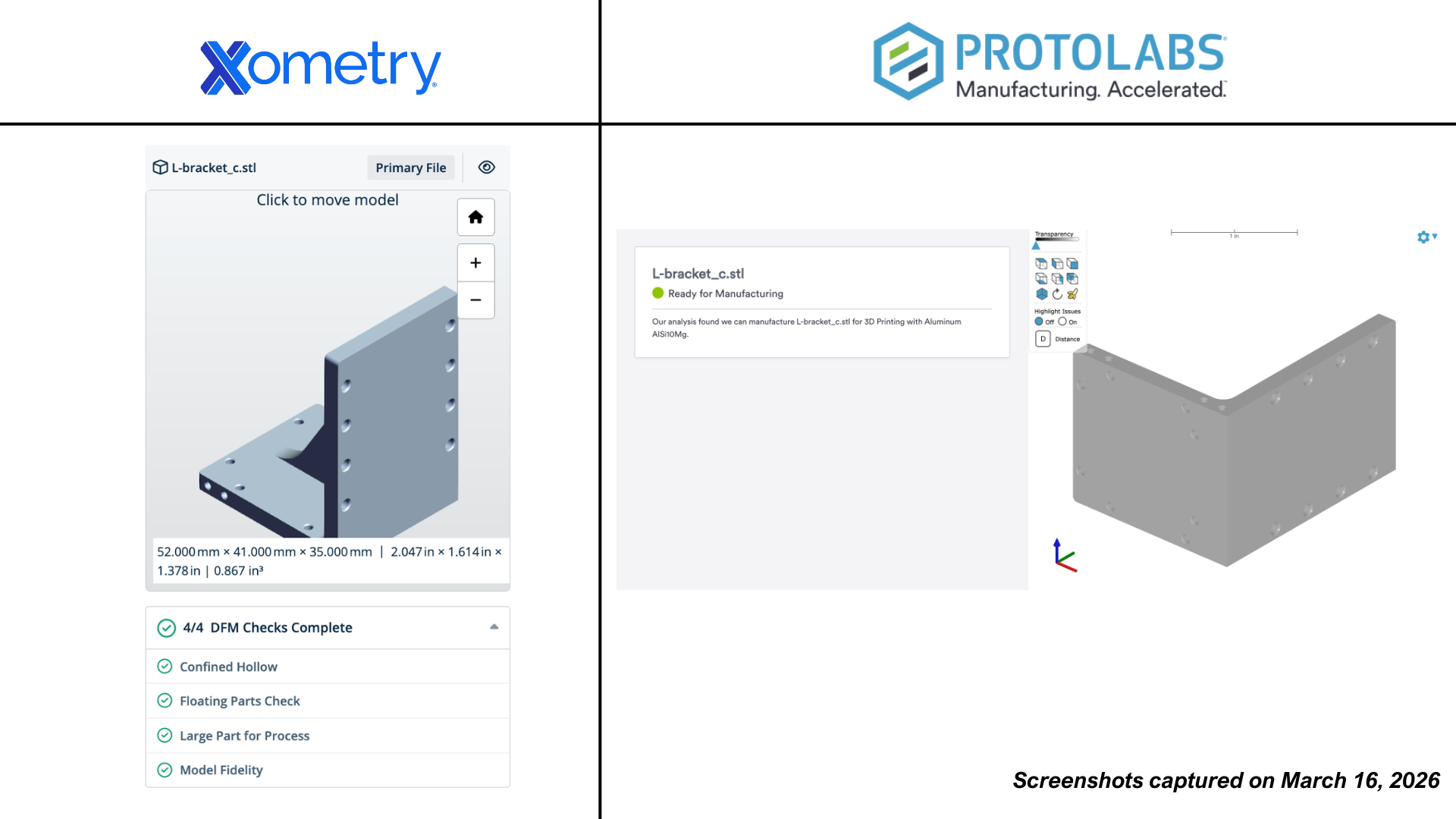
As seen in the figure above, the level of automated feedback varies among platforms. For this specific model, Protolabs provides a straightforward "Ready for Manufacturing" confirmation. Xometry offers a slightly more detailed 4-point checklist, covering basic model fidelity and size constraints (such as confined hollows and floating parts).
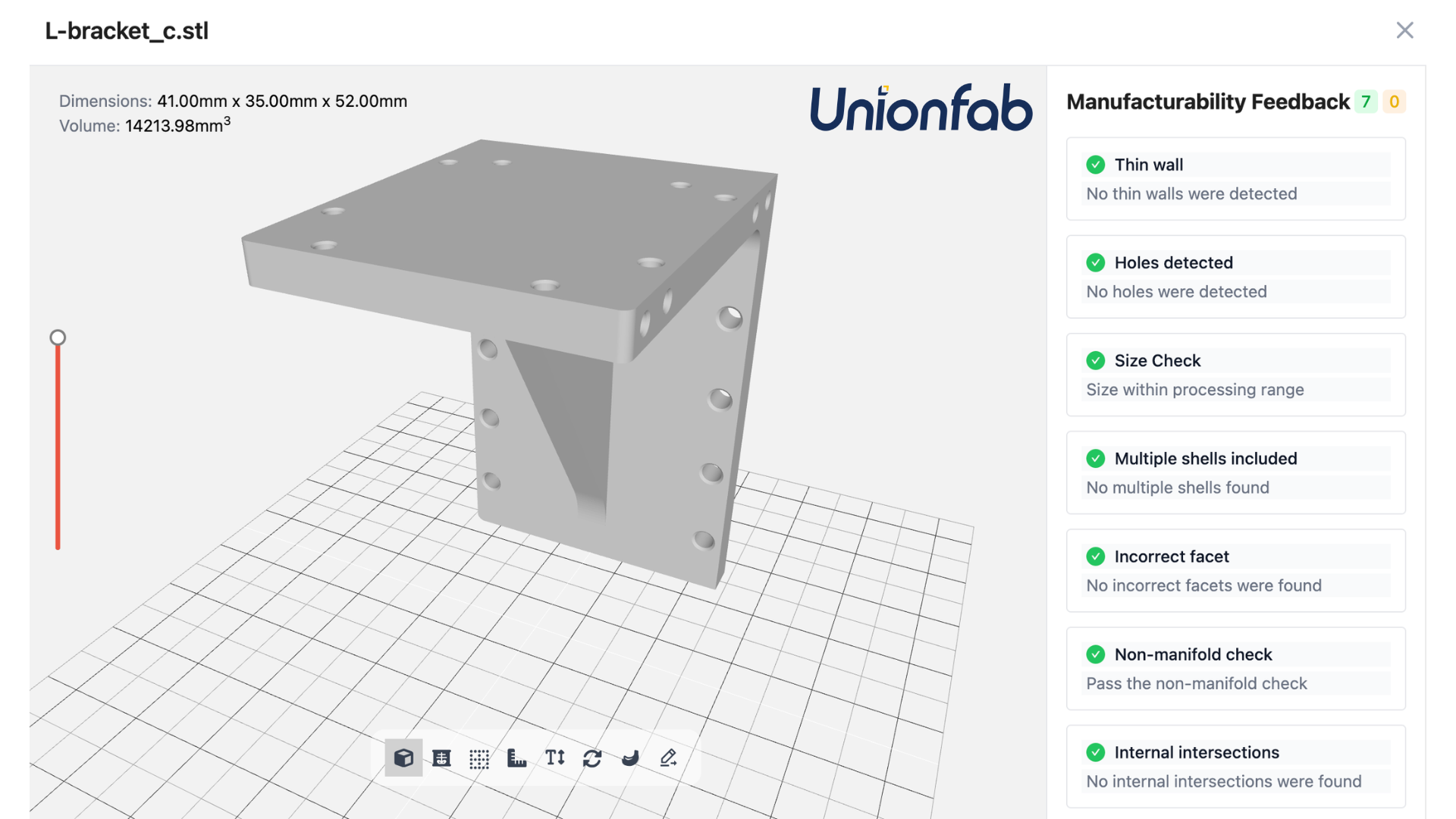
In contrast, Unionfab's quoting system provides a more comprehensive, 7-point breakdown of manufacturability diagnostics. The system actively scans for specific geometric risks, explicitly checking for thin walls, internal intersections, multiple shells, and incorrect facets, giving users a much clearer picture of their model's structural integrity.
Unionfab's Engineer-Led DFM Review
While human engineering support is a standard safety net across top-tier manufacturing platforms and is often triggered when automated algorithms flag an unprintable file, Unionfab takes a highly proactive and consultative approach right from the start.
Beyond automated algorithms, Unionfab integrates an engineer-led review directly into the quoting phase, before any order is finalized or manufacturing begins.
This proactive validation supports two common user scenarios:
1. A Safety Net for Experienced Engineers
Even experienced engineers occasionally encounter small but costly issues, such as tolerance mismatches, incorrect material selections, or overlooked geometric details.
For engineers who already understand their design requirements, this review functions as a final technical verification step. The engineering team confirms that the design strictly aligns with production specifications, helping prevent minor errors from turning into expensive manufacturing problems.
2. Technical Guidance for Designers Exploring New Processes
For R&D teams or designers who are less familiar with a specific manufacturing technology, Unionfab's engineering team can also provide practical manufacturability guidance.
Rather than simply confirming whether a part is manufacturable, our engineers may proactively suggest improvements, such as:
Selecting a more suitable manufacturing process
Optimizing wall thickness or support structures
Adjusting tolerances to improve cost efficiency
Recommending alternative materials based on performance requirements
In some cases, this guidance can help customers evaluate different production approaches—for example, determining whether SLM metal 3D printing or CNC machining would provide a better balance between cost, strength, and lead time for their specific application.
Ready to check the manufacturability of your design?
Pricing Comparison
The cost of 3D printing and CNC machining services depends on several factors, including the provider's pricing model, service structure, production volume, material selection, and lead time requirements.
The following table summarizes how Xometry, Protolabs, and Unionfab approach pricing.
Cost Criteria | Xometry | Protolabs | Unionfab |
|---|---|---|---|
Pricing Model | Dynamic AI-driven quoting based on supplier capacity and location | Premium pricing with automated in-house production and partner network | Hybrid quoting combining automated pricing with engineer-reviewed solutions |
Service Structure | Multiple tiers from Economy to expedited production | Standardized service tiers with relatively small price variation | Customized quoting based on project requirements rather than fixed tiers |
Volume Scalability | Competitive for large batches using global suppliers | Suitable for prototypes and small-batch production | Best suited for prototypes and industrial small-batch production |
Cost Optimization | Algorithm-based pricing with limited manual optimization | Automated DFM feedback for manufacturability | Engineers review project requirements and recommend cost-efficient manufacturing strategies |
In general:
Xometry can offer variable pricing when customers are flexible on production location and lead time.
Protolabs is typically positioned as a premium option for rapid prototyping.
Unionfab focuses on providing tailored quotations and engineering support to match both prototype and industrial small-batch production needs.
For a more detailed breakdown of cost calculation and pricing factors, refer to these related articles:
Want to know how much your part will cost to manufacture?
Upload your CAD file to the Unionfab Instant Quote System and get your price in seconds.
Lead Time Comparison
Speed is one of the main reasons engineers choose digital manufacturing. However, lead times can change significantly when scaling from prototypes to larger production runs.
The table below compares typical lead time performance.
Lead Time Factor | Xometry | Protolabs | Unionfab |
|---|---|---|---|
Prototype Speed | Fast. Simple parts often ship in 3–5 days. | Industry-leading. Some parts ship in as little as 24 hours. | Competitive. Typical prototype lead time is 3–5 days. |
Small & Medium Batches | Variable. Offshore economy options may take 17–20 days. | Slower at scale. 500-part batches may take 18–30 business days. | Optimized for small-batch production, typically 10–15 days. |
Predictability | Moderate. Delivery depends on partner shop availability. | High for in-house production, moderate for network orders. | High. Production planning and engineering review improve schedule stability. |
Final Verdict: Choosing the Right Provider
Selecting the ideal manufacturing partner is a strategic decision that depends on whether your project requires raw speed, the lowest possible market bid, or a reliable, engineer-managed production transition.
Choose Xometry if:
Your design is highly standardized: Xometry’s marketplace is most effective for "set and forget" parts that follow industry-standard geometries and don't require deep technical consultation.
You prefer an automated, "hands-off" experience: Best for users who want to manage everything through a digital dashboard and are comfortable with their project being routed through a distributed network of third-party shops.
You have significant lead time flexibility: Their model is a great fit for non-urgent components where you can afford the logistical timelines associated with global marketplace routing.
Choose Protolabs if:
You need a prototype urgently: Protolabs remains the specialized choice for ultra-fast, 24-hour turnarounds on simple geometries where budget is not a constraint.
You are in early-stage R&D: Their automated software is excellent for quick, low-volume "proof of concept" iterations before moving into more complex engineering phases.
Choose Unionfab if:
You want direct-from-factory pricing without the marketplace markup: Unlike marketplaces that add service fees to third-party quotes, Unionfab offers 70% lower costs by leveraging our own massive industrial infrastructure. You get the price advantage of a China-based factory with the professional service of a global partner.
You are moving from prototype to industrial small-batch production: While networks often struggle with consistency and lead times at scale, Unionfab specializes in the 100–1,000+ part range, providing stable schedules and engineering-backed quality.
Your project requires technical accountability: If your part has tight tolerances or complex features, you shouldn't rely on an algorithm. Unionfab provides a dedicated engineering safety net, ensuring your parts are optimized for manufacturing before the first machine starts, preventing costly delays and re-works.
New to Unionfab? First-time customers enjoy 10% off their first order.