
Discover custom exhaust manifolds: why they’re needed, manufacturing and material choices, design tips, and cost drivers.
Introduction
When you push an engine beyond its factory limits, off-the-shelf components often become the biggest bottleneck.
Whether you are performing a complex engine swap that leaves zero room for stock plumbing, or you need to manage the intense heat and pressure of a high-boost turbo setup, standard headers simply won’t cut it.
Going custom allows you to break free from these constraints. It’s about more than just aesthetics; it’s about engineering a system that perfectly matches your vehicle’s specific geometry and performance goals.
What Is a Custom Exhaust Manifold?
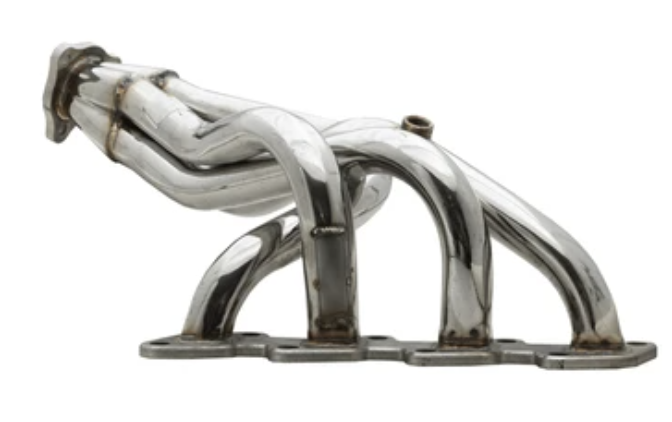
Source: shutterstock.com
To understand what a custom exhaust manifold is—and when it is truly necessary—it helps to look at exhaust components through an engineering hierarchy. The differences are not just in naming, but in the design intent behind each solution.
At a high level, exhaust manifolds evolve through three stages: from basic function, to performance optimization, and finally to requirement-driven engineering.
1. The Baseline: Standard Exhaust Manifold
Design goal: Cost efficiency, durability, and compact packaging.
Most production vehicles are equipped with a standard exhaust manifold, typically made from cast iron and built in a compact “log-style” shape. Its primary function is straightforward: collect exhaust gases from all cylinders and direct them toward the catalytic converter or turbocharger.
Key limitation: While durable and quiet, this design creates turbulent airflow and high back pressure. The engine must expend extra energy pushing exhaust gases out, which limits efficiency and peak performance.
2. The Upgrade: Exhaust Header
Design goal: Performance improvement through better airflow and scavenging.
An exhaust header represents the performance-oriented evolution of the standard manifold. Instead of a shared chamber, headers use individual runners for each cylinder, often tuned for length and curvature to improve exhaust pulse timing.
As explained in our Exhaust Header Guide, this layout reduces back pressure and takes advantage of the scavenging effect, where one exhaust pulse helps pull the next pulse out of the cylinder.
Key limitation: Once the vehicle deviates from that standard configuration—such as through an engine swap, major chassis modification, or large turbocharger installation—even a high-quality header may no longer fit or function correctly.
For a clearer understanding of what an exhaust manifold is and how it differs from a header, check out our article: Exhaust Manifold vs. Headers.
3. The Solution: Custom Exhaust Manifold
Design goal: Requirement-driven engineering and extreme adaptability.
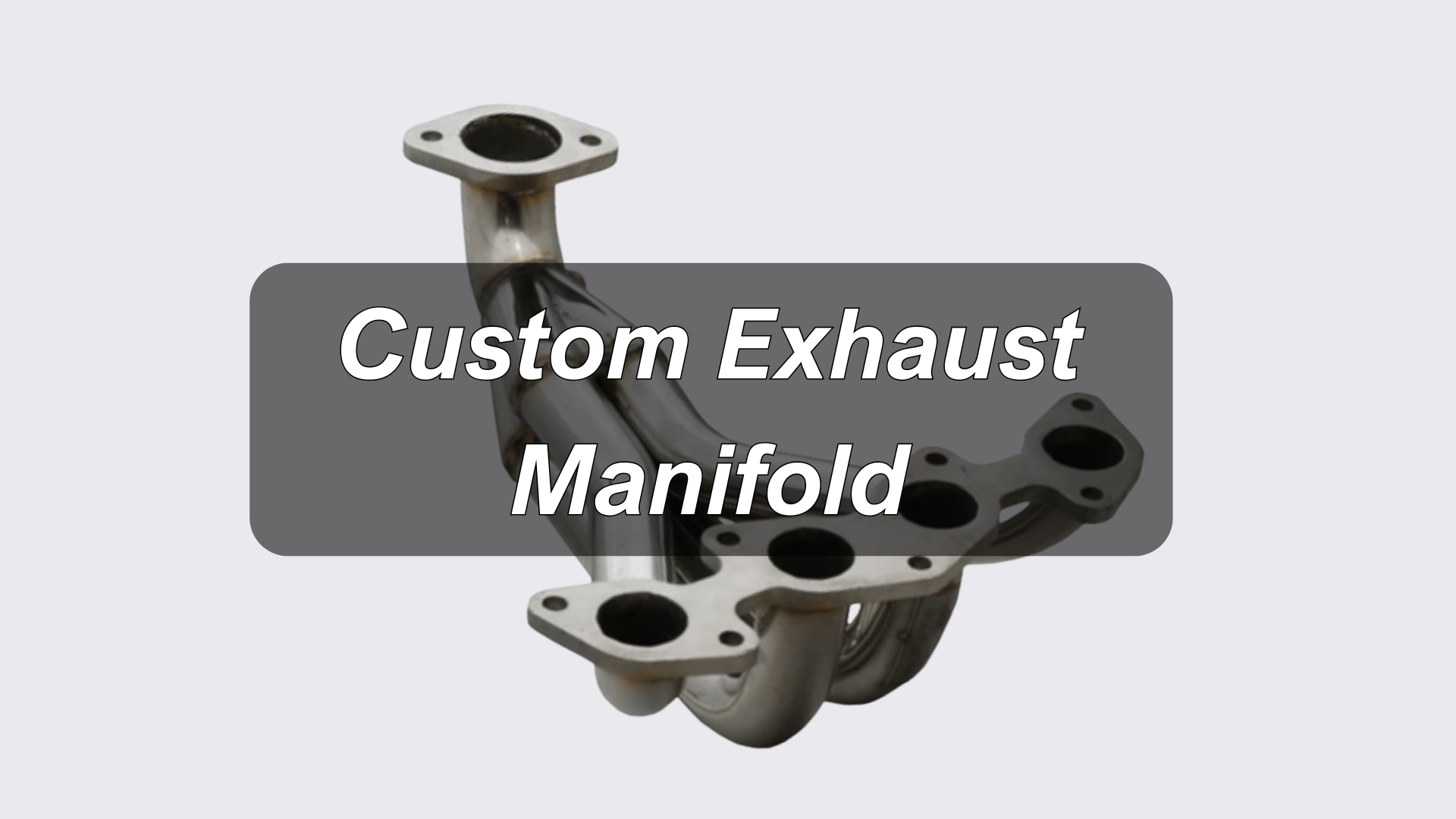
A custom exhaust manifold is not defined by a catalog part number or a fixed geometry. It is a bespoke component engineered specifically when off-the-shelf solutions—standard manifolds or performance headers—cannot meet the project’s physical, thermal, or airflow requirements.
Unlike a typical header, which follows a known performance template, a custom manifold is designed around the constraints of the build itself.
Why Choose a Custom Exhaust Manifold?
A bolt-on header is ideal for mild performance upgrades. A custom exhaust manifold becomes necessary when a project pushes beyond standard assumptions. Custom fabrication allows engineers to precisely control factors that mass-produced headers cannot.
1. Packaging Constraints (Fitment Challenges)
In complex engine swaps or professional motorsport applications, space is often the primary limitation.
The problem: Steering shafts, suspension components, subframes, and tight engine bays can physically block standard header layouts.
The custom solution: Manifolds can be designed to route runners around obstacles with millimeter-level precision, often using digital scanning, CAD modeling, and CNC-formed components to ensure reliable fitment.
2. Thermal Management for Forced Induction
Turbocharged applications are the most common reason custom exhaust manifolds are required.
The problem: Turbo manifolds are exposed to extreme temperatures—often exceeding 1,000°C—combined with constant thermal cycling. Thin-wall stainless steel headers may crack or deform under sustained load.
The custom solution: A purpose-built turbo manifold allows for optimized wall thickness, improved stress distribution, and the use of high-temperature materials such as Inconel alloys. Custom design also enables precise turbo placement based on airflow, heat management, and weight distribution rather than factory constraints.
3. Flow Dynamics Optimization
In top-tier racing environments (such as F1, WEC, or Time Attack), even small airflow inefficiencies matter.
The problem: Traditional bending and welding methods limit internal geometry, especially in collectors where multiple runners merge.
The custom solution: Advanced manufacturing methods, including metal additive manufacturing, make it possible to create smooth, organically optimized runner transitions and collectors that minimize turbulence beyond what conventional fabrication can achieve.
Manufacturing Methods for Custom Exhaust Manifolds
Choosing the right manufacturing method is a balancing act between budget, volume, material requirements, and performance goals. While mass production relies heavily on basic casting, custom fabrication utilizes distinct processes to achieve specific engineering outcomes.
Here are the primary methods used in custom manifold production, ranked from industry standards to specialized high-tech solutions.
1. Mandrel-Bent Fabrication with CNC Components
This is the standard for the vast majority of high-performance headers. Fabricators use mandrel benders to insert a solid rod into the tube while bending it, ensuring the pipe maintains a constant internal diameter. High-end builds now almost exclusively integrate CNC-machined flanges and billet collectors for superior fitment.
Best for: One-off custom builds, prototyping, and most aftermarket performance headers.
Pros:
Flow Consistency: Maintains uniform cross-sectional area throughout the bend.
Sealing Integrity: Using CNC-machined flanges ensures a perfectly flat surface, eliminating exhaust leaks common with laser-cut plates.
Strength: CNC billet collectors provide structural reinforcement at the critical merge point.
Cons:
Bend Radius Limits: Machines have physical limits; extremely tight bends often require cutting and welding (see Pie-Cut).
Design Constraints: Cannot create complex organic shapes or variable-diameter runners easily.
2. Pie-Cut / Segmented Fabrication
Before mandrel benders were widely accessible, or when a bend radius is too tight for a machine, fabricators use "pie-cuts." This involves cutting straight tubes into small, angled wedges and welding them together to form a curve.
Best for: Extremely tight engine bays where standard bends won't fit, or for unique aesthetic requirements (the "lobster tail" look).
Pros:
Infinite Flexibility: Fabricators can create any radius or shape, no matter how tight the turn.
Accessibility: Requires only a saw and a TIG welder, making it accessible for any shop.
Cons:
High Failure Risk: Introduces meters of welding seams, significantly increasing the risk of heat stress cracking.
Internal Turbulence: Unless carefully back-purged and smoothed, the internal weld beads can disrupt airflow.
Labor Intensive: Extremely time-consuming to cut, fit, and weld.
3. Investment Casting (Precision Casting)
Unlike the rough sand casting used for standard OEM manifolds, investment casting (or lost-wax casting) allows for high surface detail and smooth internal runners. This is the go-to method when a custom design moves to small-scale production.
Best for: Small-batch production runs (e.g., 20-50+ units) for specific aftermarket kits.
Pros:
Repeatability: Every unit is identical with perfect consistency.
Durability: Thick walls and lack of weld seams offer excellent reliability.
Cost: Becomes the most cost-effective method per unit once volume increases.
Cons:
Tooling Cost: High upfront investment for molds makes it prohibitively expensive for single "one-off" projects.
Inflexibility: Once the mold is made, the design cannot be changed without significant expense.
4. Metal 3D Printing (Additive Manufacturing)
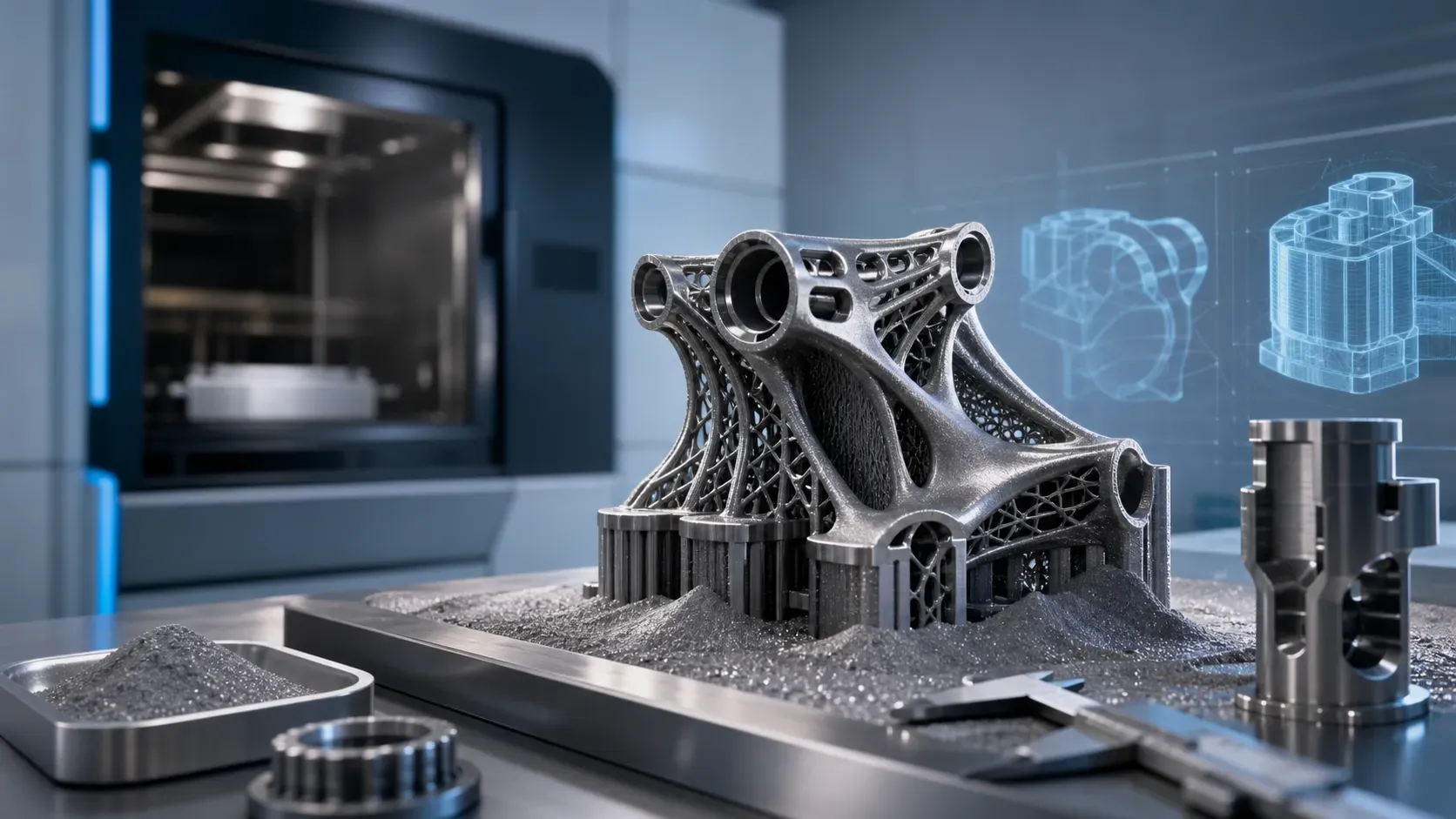
This represents the cutting edge of exhaust engineering. Manufacturers use processes like Laser Powder Bed Fusion (LPBF) to produce 3D printed exhaust manifolds directly from a CAD file.
Best for: Extreme performance applications, complex turbo packaging, and using superalloys like Inconel.
Pros:
Design Freedom: Enables organic, flow-optimized geometries and internal features impossible to manufacture with tubes or casting.
Monolithic Structure: Prints the flange, runners, and collector as one piece, eliminating weak weld points.
Material Capability: Ideal for processing
Inconel 625/718, which offers superior heat resistance with thinner, lighter walls.
Cons:
Unit Cost: Higher cost per part compared to bent tubing.
Build Size: Limited by the build volume of the printer (though large-format printers are becoming common).
5. Hydroforming & Stamped Sheet Metal
Common in OEM manufacturing, hydroforming uses high-pressure fluid to expand a tube into a mold. In custom racing (like F1 or 2-stroke bikes), a similar effect is achieved by welding two stamped halves of thin sheet metal together.
Best for: Extremely lightweight applications or space-critical designs where traditional tubes are too bulky.
Pros:
Weight Reduction: Allows for extremely thin wall thicknesses throughout the entire component.
Complex Cross-Sections: Can transition from round to oval shapes smoothly.
Cons:
Tooling Requirements: Requires expensive dies and presses.
Durability: Thin walls are more susceptible to impact damage and fatigue compared to cast or tubular manifolds.
Whether you need precise CNC-machined components (like flanges and billet collectors) to complete your fabrication, or a fully metal 3D printed manifold for complex geometries, you can verify manufacturability and estimate costs instantly using our online platform.
Comparison of Manufacturing Methods
The following table compares these methods to help align your engineering requirements with manufacturing realities.
Method | Flow Performance | Design Freedom | Cost Effectiveness | Best for |
|---|---|---|---|---|
Mandrel-Bent | ★★★★☆ | ★★★☆☆ | ★★★★☆ | One-off builds, Prototyping. |
Pie-Cut | ★★☆☆☆ | ★★★★★ | ★★☆☆☆ | Tight engine bays, Aesthetic builds. |
Investment Casting | ★★★★☆ | ★★★★☆ | ★★★☆☆ | Small-batch production (20+ units). |
3D Printing | ★★★★★ | ★★★★★ | ★★☆☆☆ | Complex geometries, Inconel parts. |
Hydroforming | ★★★☆☆ | ★★★☆☆ | ★☆☆☆☆ | Ultra-lightweight racing, OEM. |
Summary: Which to Choose?
Choose the method based on your production volume, flow requirements, packaging constraints, and budget.
For Standard Custom Builds & Prototyping: Choose Mandrel-Bent Fabrication.
For Extremely Tight Spaces or "Show" Aesthetics: Choose Pie-Cut Fabrication.
For Small Production Runs (Batch Manufacturing): Choose Investment Casting.
For Maximum Performance & Complex Geometries: Choose Metal 3D Printing.
For Extreme Weight Reduction: Choose Hydroforming or Stamped Sheet Metal.
Material Selection for Custom Exhaust Manifolds
Selecting the right material is a crucial step in achieving the desired performance, durability, and efficiency of a custom exhaust manifold.
Overview of Custom Exhaust Manifolds Materials
Unlike factory cars that often rely on heavy Cast Iron or basic Ferritic Stainless, custom fabrication utilizes alloys tailored to specific heat cycles. To simplify material selection, we can group these materials into five functional tiers:
1. Economy & Legacy Materials
Examples: Mild Steel, Cast Iron, 409 Ferritic Stainless, 439 Ferritic Stainless, Aluminized Steel
Focused on low cost and manufacturability.
These are the standards for OEM replacements or budget-friendly fabrication but lack the thermal resilience required for high-performance applications.
2. Standard Performance Steel
Examples: 304 Stainless Steel
The baseline for the aftermarket.
It offers a significant upgrade in corrosion resistance and aesthetics over economy steels, making it the go-to choice for naturally aspirated street cars.
3. High-Heat & Turbo Alloys
Examples: 321 Stainless Steel, 347 Stainless Steel
Stabilized stainless steels engineered for sustained high temperatures.
These grades feature Titanium (321) or Niobium (347) additives to resist the thermal fatigue and creep common in turbo setups.
Check out Stainless Steel vs Titanium Exhaust: Which Is Better? to see how these high-heat alloys compare.
4. Lightweight Specialty Materials
Examples: Titanium (Ti-6Al-4V)
Chosen strictly for weight reduction in niche racing or "cold-side" piping.
Note that Titanium is generally unsuitable for turbo manifolds due to rapid embrittlement at high temperatures.
Read Titanium Exhaust Explained: Why It’s Worth It? to learn why titanium is ideal for lightweight piping.
5. Motorsport Superalloys
Examples: Inconel 625, Inconel 718
Nickel-based superalloys designed for the most extreme conditions.
Reserved for top-tier motorsports, these offer the ultimate combination of strength and heat resistance for anti-lag systems.
Comparison of Custom Exhaust Manifolds Materials
Choosing the right material is a balancing act between heat tolerance, durability, and budget. To help you navigate these options, we have broken down the comparison into three key sections: thermal limits, overall performance comparison, and a pros, cons, and best-use summary.
1. Temperature Capabilities
The chart below ranks the Maximum Safe Operating Temperatures of these materials. This baseline helps you immediately rule out materials that cannot withstand your specific thermal requirements.
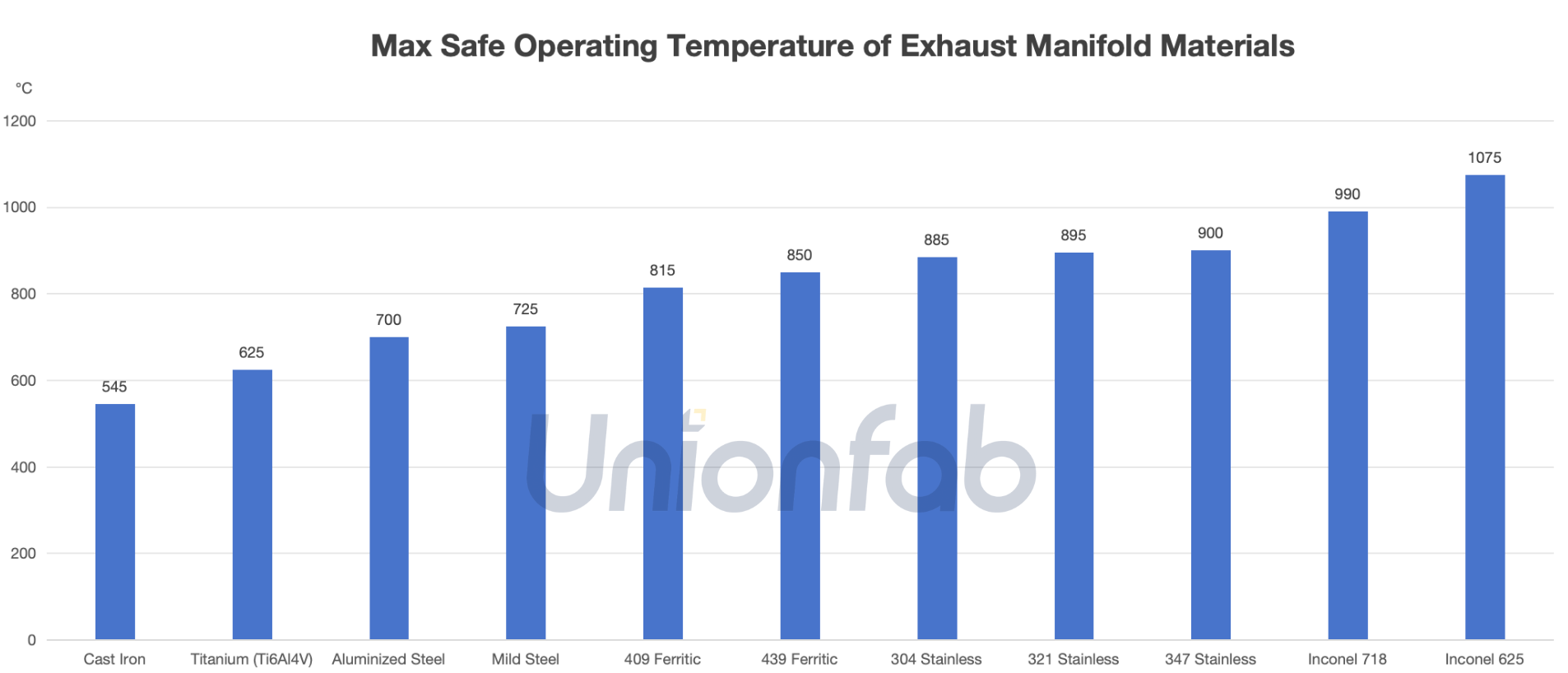
Note: The values above represent approximate maximum safe operating temperatures for each material and are provided for reference only.
2. Overall Performance Comparison
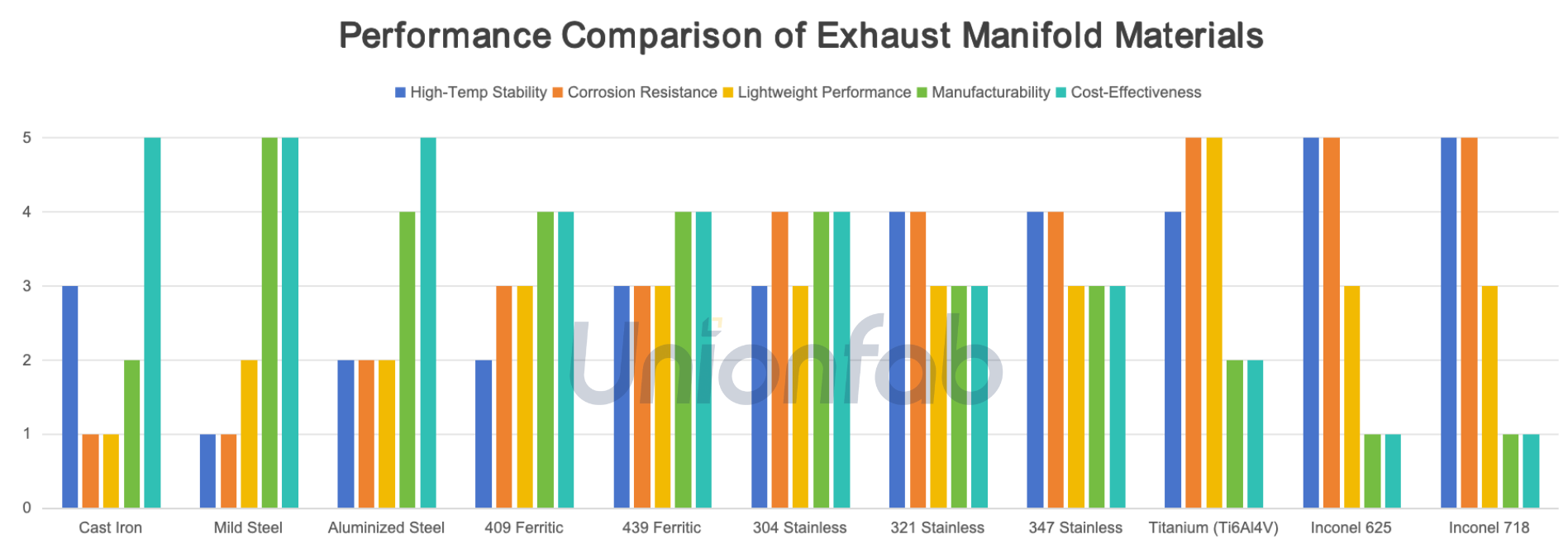
Temperature isn't the only factor. A material might withstand extreme heat but be too heavy for racing, or too expensive for a street build. You also need to consider high-temperature stability (how well it resists cracking and warping over time), manufacturability (how easy it is to weld and fabricate), and other critical aspects.
The following chart compares how these materials stack up across five critical performance metrics, giving you a holistic view of their strengths and weaknesses.
Key Takeaways from the Chart:
The "Sweet Spot" (304 & 321 SS): These materials offer the best balance. They score high enough in performance without bottoming out on cost or manufacturability. This is why 304 is the industry standard.
The "Budget" Options (Cast Iron & Mild Steel): They win on Cost-Effectiveness but fail on weight and corrosion resistance. Great for saving money, bad for performance.
The "Elite" Tier (Inconel): Inconel dominates High-Temp Stability but is the hardest to manufacture and afford. It is the ultimate choice only when budget is not a factor.
Titanium: While it scores a perfect 5 for Lightweight, remember its heat limit makes it unsuitable for manifolds (it is best for cat-backs).
3. Pros, Cons, & Best Applications
Material | Pros | Cons | Best For |
|---|---|---|---|
Cast Iron | Extremely durable in stock applications; absorbs vibration; cheap. | Heavy; brittle nature leads to cracking under thermal shock; hard to repair. | OEM Replacements & stock daily drivers. |
Mild Steel | Easiest to fabricate; very affordable; materials widely available. | Rusts rapidly without coating; poor heat retention; low strength at red-hot temps. | Budget DIY Fabrication, jigs, and mock-ups. |
Aluminized Steel | Cheap; aluminum coating offers temporary corrosion protection. | Coating burns off at manifold temps; welding ruins the protective layer. | Budget Repairs & temporary exhaust systems. |
409 Ferritic Stainless Steel | Better heat handling than mild steel; low cost. | Develops ugly surface rust; difficult to polish; lower strength than 304. | Factory Exhaust Piping & mufflers. |
439 Ferritic Stainless Steel | Higher oxidation resistance than 409; contains titanium for weldability. | Still susceptible to aesthetic corrosion; harder to source for custom work. | OEM Catalytic Converters & headers. |
304 Stainless Steel | Excellent rust resistance; polishes beautifully; Aftermarket Standard. | Prone to cracking in turbo apps (high expansion); welds can fail if not purged. | NA Street Cars, entry-level headers & styling. |
321 Stainless Steel | Titanium-stabilized to resist fatigue; withstands heat cycling well. | More expensive; harder to source; slight overkill for basic non-turbo engines. | Circuit Racing & reliable endurance upgrades. |
347 Stainless Steel | Niobium-stabilized for superior creep resistance; retains shape at heat. | Expensive; requires precise welding; availability lower than 304. | High-Performance Turbo street & track builds. |
Unmatched strength-to-weight ratio; exotic look; corrosion-proof. | Not for Manifolds: Embrittles rapidly above 600°C; expensive; hard to weld. | Cat-back Systems & niche NA weight reduction. | |
Ultimate heat stability; zero cracking; allows for ultra-thin walls. | Extremely expensive; difficult to machine and weld; requires expert skills. | F1, WRC, Anti-Lag, & top-tier motorsport headers. | |
Inconel 718 | Exceptionally high tensile strength; widely used in aerospace. | Harder to weld than 625 (prone to cracking); often requires heat treatment. | Turbine Internals & high-temp fasteners (bolts/studs). |
Design Considerations for Custom Exhaust Manifolds
Even the strongest material—Inconel included—will fail if the design is flawed. Planning a custom exhaust manifold isn’t just about connecting pipes; it’s about managing heat, flow, and stress so your engine can breathe efficiently and survive long-term use.
Below are four core design choices that have the greatest impact on both performance and durability.
1. Runner Length and Diameter
“Runners” are the individual pipes that connect the engine’s exhaust ports to the collector. Their size and layout largely determine where the engine makes power.
Tube Diameter (Speed vs. Volume)
Smaller diameters increase exhaust gas velocity. Higher velocity improves low-end torque and throttle response.
Larger diameters allow more total flow, which supports high horsepower at high RPM. However, oversized tubing slows gas speed and often makes the car feel sluggish at lower speeds.
Rule of Thumb: Use the smallest diameter that still supports your target horsepower. Oversizing is one of the most common mistakes and usually hurts street drivability.
Runner Length
Short runners favor high-RPM power.
Long runners improve mid-range torque.
Equal vs. Unequal Length
Equal-length runners keep exhaust pulses evenly spaced, improving turbo efficiency and peak power.
Unequal-length runners are easier to package and slightly less efficient, but they create the distinctive “rumble” sound (famously used on Subaru engines).
2. Collector Design
The collector is where all runners merge into a single pipe, making it one of the most critical airflow zones in the manifold.
Merge Angle
Think of the collector like a highway on-ramp. Shallow merge angles (ideally 15° or less) allow exhaust gas to combine smoothly. Sharp 90° intersections—often seen in budget “log” manifolds—create turbulence and slow down turbo spool.
Twin-Scroll vs. Single-Scroll
If your engine and turbo support it, a twin-scroll design is preferable. By separating exhaust pulses into paired cylinder groups, pulse interference is reduced, resulting in quicker response and better efficiency.
3. Flange Design
The flange is the flat plate that bolts the manifold to the engine—and it’s where many leaks and failures originate.
Thickness
For turbo applications, avoid thin flanges. Instead of the common 3/8" (9.5 mm), use 1/2" (12.7 mm) thick flanges. The added mass helps maintain flatness during welding and resists warping under extreme heat.
Expansion Slots (Relief Cuts)
As the manifold reaches red-hot temperatures, the metal expands. Relief cuts between exhaust ports allow each section of the flange to expand independently. Without them, thermal expansion can pull on studs, crack welds, or warp the flange.
Port Matching
The flange openings should closely match the engine’s exhaust ports. Any step or mismatch disrupts flow, creates turbulence, and adds unnecessary heat.
4. Heat Management
Managing heat isn’t just about protecting nearby components—it directly affects performance. Hot exhaust gas carries more energy, flows faster, and drives the turbo more efficiently.
Ceramic Coating
A high-temperature ceramic coating is the most effective option. It keeps heat inside the runners to improve flow, reduces under-hood temperatures, and protects mild steel from corrosion.
Heat Shields
Metal heat shields block radiant heat from sensitive components like wiring and alternators. Compared to wraps, they’re often safer because they don’t trap moisture.
Exhaust Wrap (Use with Caution)
On mild steel, wraps trap moisture and dramatically accelerate rust.
On stainless steel, wraps can overheat the material, leading to embrittlement.
Recommendation: Wraps should only be used on high-grade alloys such as 321 stainless or Inconel.
Not sure if your design maximizes performance and durability?
Get Free DFM Feedback from our experts before fabrication.
Cost Drivers for Custom Exhaust Manifolds
Custom fabrication is rarely cheap, but understanding where the money goes can help you make smarter budget decisions. The final price of a manifold isn't just about the metal on the invoice; it is primarily driven by the complexity of the design and the hours of skilled labor required to execute it.
Here are the three main factors that will determine the final cost of your project.
1. Material Choice & Consumables
The raw cost of the alloy is only part of the equation. As you move up the material hierarchy, the "hidden" fabrication costs increase significantly.
Raw Material: A mild steel bend is inexpensive, whereas 321 Stainless or Inconel bends cost exponentially more.
Consumables (The Hidden Cost): Welding high-grade alloys (like Stainless, Titanium, or Inconel) requires "back-purging." This involves flooding the inside of the pipe with Argon gas to prevent oxidation during welding. This process consumes large amounts of expensive gas.
Tooling Wear: Harder materials like Inconel destroy cutting blades and drill bits much faster than mild steel, adding to the shop's overhead.
2. Design Complexity
In fabrication, time is money. The more complex the shape, the more hours it takes to build.
Log vs. Tubular: A simple "log-style" manifold (a straight pipe connecting cylinders) is quick to build. A complex "equal-length" manifold—which looks like a bundle of snakes—requires precise calculations and difficult assembly.
Weld Density: A manifold made from pre-bent tubes has fewer welds. A manifold made from "pie cuts" (many small wedges welded together to form a tight curve) requires inches upon inches of welding. Each inch of high-quality TIG welding adds labor time.
3. Labor & Precision
You are paying for the fabricator’s experience, not just their time.
Fitment: Making a manifold fit inside a cramped engine bay without hitting the steering shaft or burning the alternator takes careful planning and mock-up time.
Prep Work: A high-quality manifold requires hours of non-welding labor: facing flanges to ensure they are perfectly flat, port-matching the runners, and cleaning the metal before welding. Skipping these steps saves money but leads to leaks and failures later.
Unionfab’s CNC Machining & Metal 3D Printing Services
Once your custom exhaust manifold design is finalized, having the right manufacturing partner makes all the difference.
Unionfab offers a one-stop solution combining precision CNC machining and advanced metal 3D printing—helping you move from CAD to finished parts quickly and reliably.
CNC Machining
Materials: Stainless steel, Aluminum, and high-temperature alloys
Precision: Tight tolerances and excellent flange flatness for leak-free sealing
Lead Time: Typically 7–15 days, from prototypes to low-volume production
Metal 3D Printing
Technologies: DMLS / SLM and Binder Jetting
Benefits: Internal flow paths, weight reduction, and part consolidation
Materials: Stainless steel, Titanium, and Inconel for extreme heat environments
Lead Time: Functional metal parts in as little as 3–7 business days
Metal Finishing
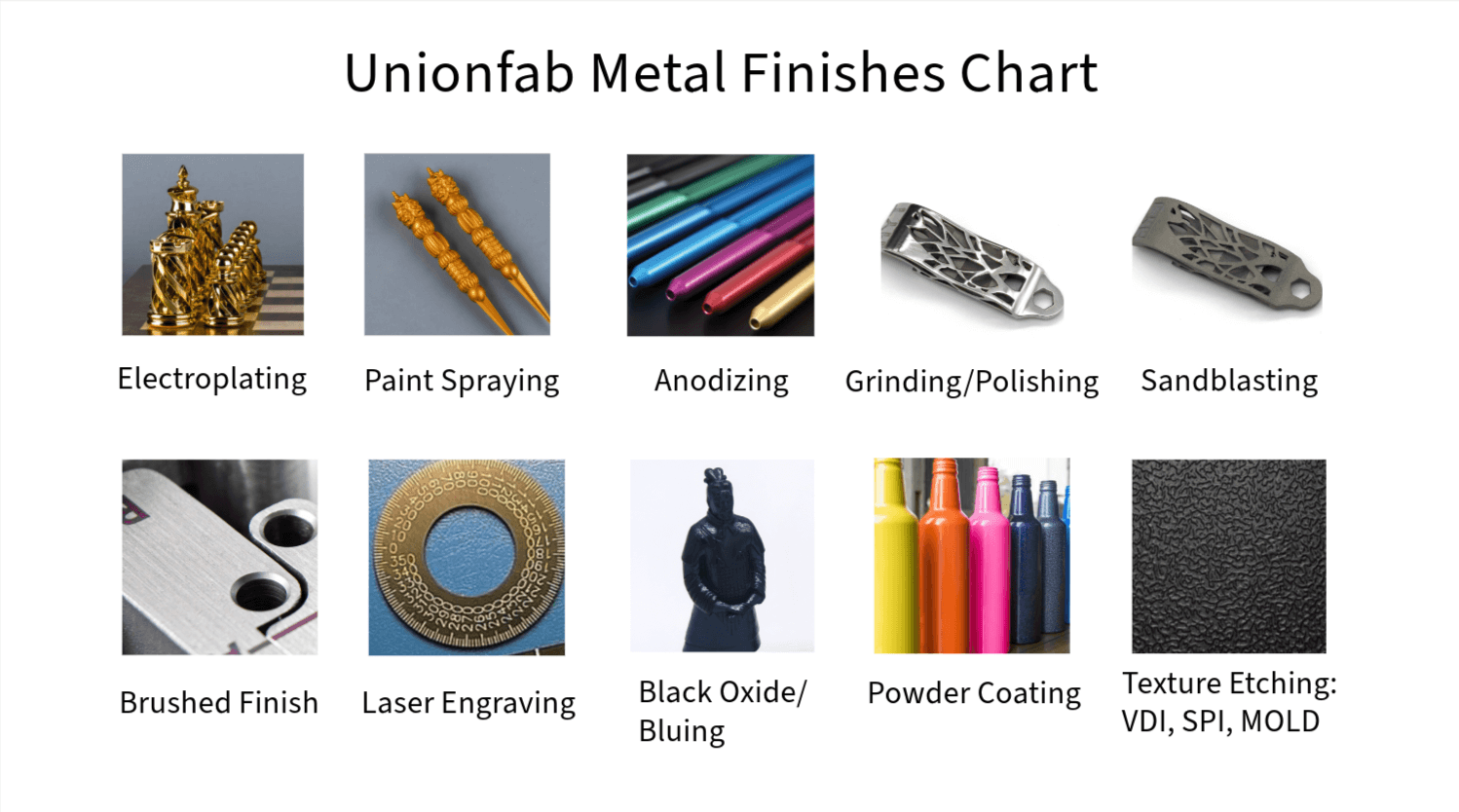
Unionfab also provides a range of metal finishing options to improve durability and appearance, including polishing, sandblasting, powder coating, black oxide, and laser engraving.
New to Unionfab?
Get a 10% discount on your first CNC machining or metal 3D printing order.
Conclusion
A custom exhaust manifold is more than just a part—it’s a performance-critical component tailored to your build. The right design, material, and manufacturing method can reduce backpressure, manage extreme heat, and fit perfectly within your engine bay.
By understanding material options, fabrication methods, design trade-offs, and installation best practices, you can make informed choices that balance cost, durability, and performance.
Whether you’re building a street car, a turbo setup, or a race-spec machine, a well-planned custom manifold delivers efficiency, reliability, and a noticeable improvement in engine response.