
Explore metal 3D printing materials, compare key alloy properties, and learn how to choose the right metal for your project.
Introduction
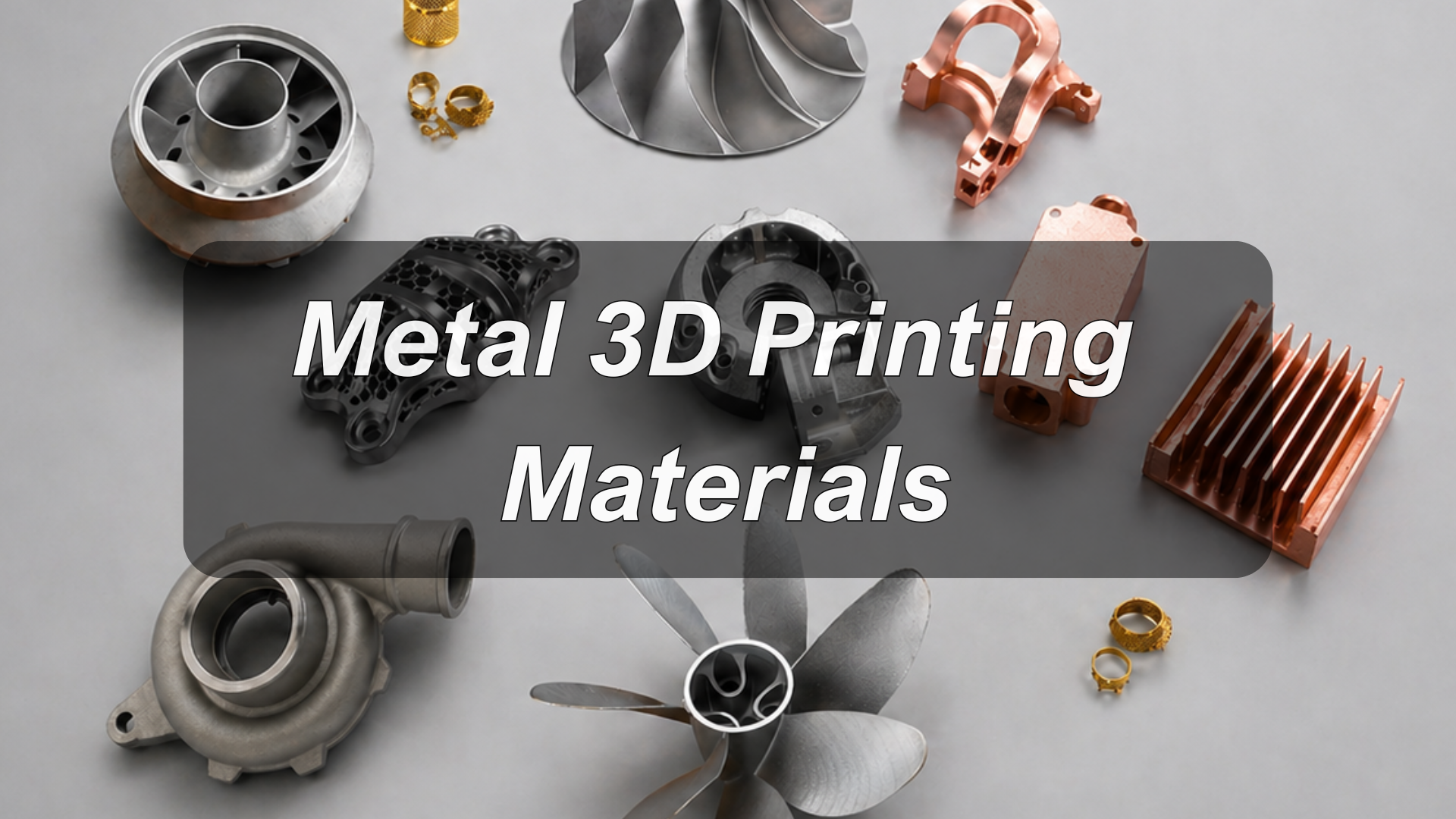
Metal 3D printing materials (also referred to as metal additive manufacturing materials) have expanded far beyond a limited set of traditional engineering alloys. Today, the technology supports a wide range of metals, from cost-effective stainless steels and lightweight aluminum alloys to high-temperature nickel superalloys and high-conductivity copper.
Each material category offers a different combination of mechanical strength, corrosion resistance, thermal stability, weight, and cost. These differences directly affect how a part performs, how it is manufactured, and what it ultimately costs.
Selecting the appropriate alloy can streamline production, optimize printability, and ensure long-term reliability. On the other hand, the wrong choice can introduce manufacturing constraints or lead to premature failure in the end-use environment.
What Are Metal 3D Printing Materials?
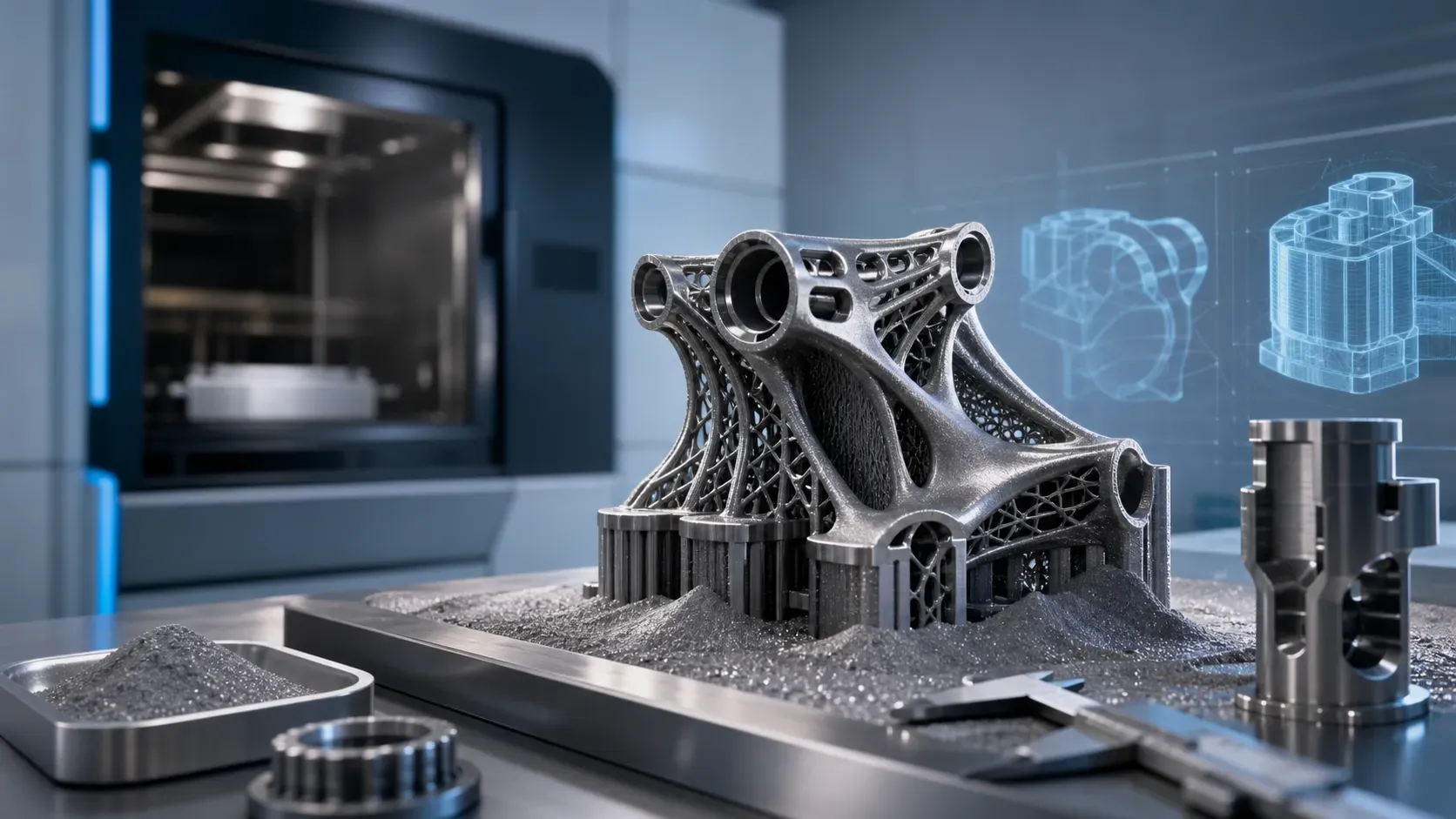
Metal 3D printing materials are the raw inputs used in additive manufacturing processes to build metal parts layer by layer. Depending on the technology, these materials can produce fully dense or near fully dense components with mechanical properties comparable to traditionally manufactured parts.
These materials are not limited to one physical form. In fact, the form of the material largely determines which printing process can be used and how the part is produced.
The most common material forms include:
1. Metal Powder
This is the most widely used feedstock in technologies such as powder bed fusion (PBF) and binder jetting (BJ).
High-quality powders are typically produced through gas atomization, resulting in spherical particles with controlled size distribution and good flowability. These characteristics are critical for achieving consistent part density and surface quality.
2. Metal Wire
Wire feedstock is primarily used in directed energy deposition (DED), including processes such as wire arc additive manufacturing (WAAM).
In these processes, the wire is continuously fed into a melt pool, making it suitable for large-scale parts and repair applications.
3. Metal Filament and Bound Feedstock
These materials are used in sinter-based workflows such as bound metal deposition (BMD).
The part is first printed in a “green” state using a metal-polymer composite, then goes through debinding and sintering to achieve its final density and mechanical properties.
For a closer look at how these processes work and how they compare, see our guide to metal 3D printing technologies.
Overview of Common Metal 3D Printing Materials
In practice, most metal additive manufacturing (AM) projects concentrate around a manageable set of proven alloy families.
Note: Most material families link to dedicated guides with more detailed properties, grades, applications, and use cases. Click through for more details.
Material Family | Common Alloys | Key Properties | Typical Applications |
|---|---|---|---|
316L, 17-4 PH | ● Corrosion resistance ● Good mechanical strength ● Broad industrial usability | ● Medical tools | |
AlSi10Mg, 6061 | ● Low density | ● Lightweight brackets | |
Ti6Al4V | ● High strength-to-weight ratio | ● Aerospace components | |
Inconel 625, Inconel 718 | ● High-temperature strength | ● Turbine-adjacent parts | |
Tool Steels | H13, Maraging Steel | ● High hardness potential | ● Molds and inserts |
Cobalt-Chrome Alloys | CoCrMo, CoCrW | ● Wear resistance | ● Dental parts |
CuCrZr | ● High thermal conductivity | ● Heat exchangers |
Use our free cost calculator to get an instant estimate for your project.
Detailed Comparison of Metal 3D Printing Materials
The following subsections compare common metal 3D printing materials across key properties. To make the data easier to navigate, the comparison is organized into three tables, each focusing on a different aspect:
Table 1: Mechanical Properties (As-Manufactured): Shows baseline mechanical performance after printing, including orientation effects.
Table 2: Mechanical Properties (After Post-Processing): Reflects typical performance in more application-ready conditions.
Table 3: Key Material Selection Properties: Covers temperature resistance, conductivity, corrosion resistance, biocompatibility, weight, and relative cost to support material selection.
Note: You can read through all three in order, or jump directly to the table most relevant to your priorities.
Mechanical Properties (As-Manufactured)
This table compares the baseline mechanical performance of common metal 3D printing materials in the as-manufactured state via the SLM / LPBF process.
It shows how different alloys behave directly after printing, including variations between vertical and horizontal build orientations.
Property | Stainless Steel (316L) | Stainless Steel (17-4 PH) | Aluminum (AlSi10Mg) | Aluminum (6061) | Titanium (Ti6Al4V) | Inconel 625 | Inconel 718 | Maraging Steel | CuCrZr |
|---|---|---|---|---|---|---|---|---|---|
Tensile Strength (MPa) | Vertical: 560 | Vertical: 1052 | Vertical: 466 | Vertical: 275 | Vertical: 1310 | Vertical: 940 | Vertical: 970 | Vertical: 1240 | Vertical: 225 |
Yield Strength (MPa) | Vertical: 480 | Vertical: 947 | Vertical: 233 | Vertical: 235 | Vertical: 1205 | Vertical: 645 | Vertical: 650 | Vertical: 1055 | Vertical: 175 |
Elongation at Break (%) | Vertical: 49 | Vertical: 15.7 | Vertical: 6.3 | Vertical: 9 | Vertical: 9 | Vertical: 44 | Vertical: 32 | Vertical: 13 | Vertical: 50 |
Mechanical Properties (After Post-Processing)
This table shows the mechanical performance of common metal 3D printing materials after typical post-processing. It reflects how these materials perform in more application-ready conditions.
Compared with the as-manufactured state, many alloys often achieve higher strength, improved ductility, or more stable performance after steps such as stress relief, aging, or annealing.
Property | Stainless Steel (316L) | Stainless Steel (17-4 PH) | Aluminum (AlSi10Mg) | Aluminum (6061) | Titanium (Ti6Al4V) | Inconel 625 | Inconel 718 | Maraging Steel | CuCrZr |
|---|---|---|---|---|---|---|---|---|---|
Tensile Strength (MPa) | 629-674 | 1335-1340 | 300-350 | 310-330 | 1075-1080 | 890-1000 | 1430-1500 | 1920-1955 | 280-340 |
Yield Strength (MPa) | 395-421 | 1235-1250 | 210-240 | 260-285 | 1000-1025 | 640-680 | 1200-1250 | 1840-1870 | 180-220 |
Elongation at Break (%) | 53-67 | 13.5-14 | 9-15 | 12-16 | 16 | 34-49 | 12-13 | 5-6 | 27-32 |
Hardness | ~150-190 HV | ~39-45 HRC | ~44-76 HRB | ~90-100 HB | ~30-36 HRC | ~145-240 HB | ~36-45 HRC | ~50-55 HRC | ~100-160 HB |
Condition | Annealed / stress relieved | Heat treated | Heat treated | Heat treated | Annealed / stress relieved | Heat treated | Heat treated | Aged | Heat treated |
Disclaimer: Data from both tables is sourced from OEM datasheets (primarily EOS, www.eos.info) and other industry sources. All values are for reference only.
Key Material Selection Properties
This table compares other key properties of common metal 3D printing materials, including temperature resistance, conductivity, corrosion behavior, weight, and cost.
It highlights how different alloys perform across these selection criteria.
Note:
★ Best-in-class: leading performer for that property
✓ Suitable: a viable option, but not the strongest for that property
blank: not a primary strength for this material
Property | Inconel 718 | ||||||||
|---|---|---|---|---|---|---|---|---|---|
Max Continuous Operating Temp (MCOT) | ~450°C | ~316°C | ~200°C | ~150°C | ~400°C | ~980°C (★) | ~650–750°C | ~300°C | ~350-500°C |
Lightweight (Low Density) | ★ | ★ | ✓ | ||||||
Strength-to-Weight Ratio | ✓ | ✓ | ★ | ||||||
Corrosion Resistance | ★ | ✓ | ★ | ★ | ✓ | ||||
Thermal Conductivity | ✓ | ✓ | ★ | ||||||
Electrical Conductivity | ✓ | ★ | |||||||
Biocompatibility | ✓ | ★ | |||||||
Relative Cost | $ | $$ | $$ | $$ | $$$ | $$$$ | $$$$ | $$$ | $$$ |
Key Takeaways
High-temperature applications: Inconel 625 leads for the highest continuous operating temperatures, while Inconel 718 offers strong elevated-temperature performance at a somewhat lower range.
Lightweight vs. Strength-to-Weight: Aluminum alloys (AlSi10Mg and 6061) offer the lowest absolute density for weight-sensitive applications, but Ti6Al4V is the better choice when structural strength and low weight must be combined.
Corrosion resistance: 316L and Ti6Al4V are both strong performers — 316L suits demanding industrial and everyday environments, Ti6Al4V excels in marine and biomedical contexts, and Inconel 625 leads where extreme chemical and high-temperature corrosion resistance is required.
High conductivity: CuCrZr is the top choice for both thermal and electrical conductivity.
Biocompatibility: Ti6Al4V is the preferred option for medical implants and biomedical applications.
New Customer Special: Sign up today and take 10% off your first order!
Further Reading
Material comparison articles:
Property reference articles:
Metal 3D printing cost:
FAQ
Can 3D printers print metal?
Yes. Metal 3D printers can produce functional parts using processes such as LPBF/SLM, EBM, DED, binder jetting, and sinter-based metal printing.
What metals are most commonly used in 3D printing?
The most common metal 3D printing materials include 316L and 17-4 PH stainless steels, AlSi10Mg aluminum, Ti6Al4V titanium, Inconel 625 and 718, maraging steel, cobalt-chrome alloys, and CuCrZr copper alloy.
What is the strongest 3D-printed metal?
Maraging steel is one of the strongest commonly 3D-printed metals when maximum tensile and yield strength are the priority, especially after aging. Inconel 718 and 17-4 PH are also strong options, while Ti6Al4V is often preferred when strength must be combined with low weight.
How do I choose the right metal for 3D printing?
Choose the material based on the part's main priority: strength, corrosion resistance, low weight, heat resistance, conductivity, biocompatibility, or cost. Then check whether the process and post-processing route can achieve the required properties in the delivered condition.
What is the difference between as-manufactured and post-processed metal AM properties?
As-manufactured properties describe the printed material before standard heat treatment or similar downstream processing. Post-processed properties describe the material after steps such as stress relief, annealing, aging, or heat treatment, and are usually more relevant for end-use parts.
What are the main metal additive manufacturing processes?
The main metal additive manufacturing processes include LPBF/SLM, EBM, DED, binder jetting, and sinter-based metal printing.