
Discover the advantages and disadvantages of 3D printing to decide whether it’s the right choice for your next project.
Introduction
3D printing has transformed product development and manufacturing by enabling rapid prototyping, complex geometries, customization, and cost-effective low-volume production. Unlike traditional manufacturing methods that often require tooling, molds, or extensive setup, 3D printing can produce parts directly from digital designs, significantly reducing lead times and increasing design flexibility.
However, 3D printing is not the ideal solution for every application. Factors such as material requirements, dimensional accuracy, surface finish, mechanical performance, and overall cost can affect whether it is the most suitable manufacturing method.
This guide explores the key advantages and disadvantages of 3D printing, when to choose 3D printing over traditional manufacturing, and the pros and cons of different 3D printing technologies. By understanding these tradeoffs, you can decide whether 3D printing is the right choice for your project.
Pros and Cons of 3D Printing: Quick Overview
To start, here’s a quick overview of the key advantages and disadvantages of 3D printing, giving you a clear snapshot of the big picture.
Pros | Cons |
|---|---|
Rapid Prototyping and Faster Design Iteration | Post-Processing Is Often Required |
Cost-Effective for Low-Volume Production | Size Limits for Single-Piece Builds |
Flexible Design and Complex Geometries | Material Options and Certified Material Data Can Be Limited |
Customization and Personalization | Part Strength Can Vary by Process and Build Orientation |
On-Demand Production and Digital Inventory | Surface Finish and Tolerance May Need Secondary Processing |
Less Material Waste Compared with Subtractive Manufacturing | Slower Cycle Times for Mass Production |
Accessible for Startups, Engineers, and Product Teams | Intellectual Property and File-Security Risks Need Control |
Key Advantages of 3D Printing
Below are the main advantages of 3D printing and the key factors that make it valuable for design iteration, complex geometries, and low-volume manufacturing.
Rapid Prototyping and Faster Design Iteration
Fast Iteration: 3D printing speeds up the product development stage by allowing engineers to move from CAD file to physical prototype without waiting for molds, or complex fixtures.
Bridge Production: It is especially useful for checking form, fit, assembly, ergonomics, and early functional performance before committing to CNC machining, casting, or molding.
Shorter Time-to-Market: A single prototype can be produced quickly, but hundreds or thousands of identical parts may take longer than a tool-based process. This makes 3D printing strongest when design iteration matters more than cycle time per part, especially in fast-moving product categories such as cosmetic packaging, consumer products, and industrial design.
Cost-Effective for Low-Volume Production
No Tooling Costs: 3D printing can be cost-effective for low-volume production because it does not require expensive molds or dedicated tooling.
No Minimum Order Quantity (MOQ): Parts can be produced as single units or in small quantities without volume commitments. It is useful for prototypes, one-off parts, engineering samples, custom fixtures, spare parts, and bridge production before the final manufacturing route is confirmed.
Economical for Small Batches: For production runs ranging from 1 to approximately 1,000 units, depending on part size and complexity, 3D printing is often more cost-effective than traditional manufacturing methods.
For a detailed breakdown of 3D printing costs, see our complete guide: How Much Does 3D Printing Cost.
Upload your CAD file to see your production price in seconds!
Flexible Design and Complex Geometries
Complex Geometries: 3D printing can produce geometries that are difficult or impossible with many traditional manufacturing methods, including internal channels, lattice structures, topology-optimized parts, organic shapes, consolidated assemblies, and lightweight designs.
Advanced Applications: This design freedom is valuable in aerospace, robotics, medical devices, automotive development, consumer product prototypes, and advanced engineering applications. It can also support application-specific designs such as snap fits, heat sinks, liquid cold plates, heat exchangers, and exhaust manifolds.
Despite its flexibility, 3D printing still follows clear design rules that affect printability and final part quality. Reviewing these early can help avoid costly redesigns.
Customization and Personalization
Easy Customization: 3D printing is well suited for customized parts because changing the design usually means updating the digital file, not building or modifying tooling.
Tailored Solutions: This makes it useful for parts designed around specific users, products, or applications, such as personalized medical devices, dental models, custom jigs and fixtures, replacement parts, and product variants. For example, 3D printing can support custom car hoods, custom dash clusters, and more.
Want to see more real-world applications?
Explore our full library of case studies and guides on our 3D Printing Blog.
On-Demand Production and Digital Inventory
On-Demand Manufacturing: 3D printing can support on-demand production for spare parts, service parts, replacement components, and low-volume product variants.
Digital Inventory: Instead of storing large physical inventories, companies can maintain digital part files and manufacture parts when needed.
Lower Inventory Risk: This can reduce inventory risk for slow-moving parts or products with uncertain demand, and it can help teams test a market before investing in tooling.
Less Material Waste Compared with Subtractive Manufacturing
Additive Material Use: 3D printing is an additive process, so material is added layer by layer instead of being cut away from a larger block.
Reduced Waste Potential: Compared with subtractive manufacturing, it can reduce material waste in some applications, especially for expensive metals, lightweight structures, and complex parts where machining would remove a large amount of material.
Material Innovation: Some materials and workflows can reduce waste, but sustainability still depends on material type, failed builds, supports, powder refresh rates, and post-processing.
Accessible for Startups, Engineers, and Product Teams
Low Barrier to Entry: 3D printing lets teams validate ideas without committing to tooling, large minimum order quantities, or long manufacturing lead times.
Broad Team Access: This makes it useful for startups, R&D teams, design agencies, universities, and internal engineering departments.
Early Risk Detection: In B2B manufacturing, a printed prototype can reveal assembly issues, ergonomic problems, interference risks, and design weaknesses before the project moves into higher-cost manufacturing.
Key Disadvantages and Limitations of 3D Printing
Below are the main disadvantages of 3D printing and the key tradeoffs to consider in different use cases.
Post-Processing Is Often Required
Additional Finishing Steps: Many 3D printed parts need post-processing, such as support removal, sanding, polishing, bead blasting, dyeing, painting, vapor smoothing, or heat treatment.
Cosmetic Requirements: For visual prototypes or customer-facing parts, post-processing may be necessary to achieve the required appearance.
Added Cost and Lead Time: This affects both cost and lead time: a part may leave the printer quickly, but the final usable part may still require finishing, quality control, and packaging.
Size Limits for Single-Piece Builds
Fixed Build Volume: Most 3D printers have a defined build volume, which limits the maximum size of a single-piece build.
Sectioned Large Parts: If a part is larger than the machine can print in one piece, it may need to be split, printed in sections, and bonded or assembled later.
Large-Format Review: Large-format 3D printing, such as SLA, may be possible for very large parts, but the process, material, and tolerance expectations must be reviewed first.
Material Options and Certified Material Data Can Be Limited
Process-Specific Materials: 3D printing materials have improved significantly, but not every engineering plastic, metal alloy, elastomer, or certified material is available for every 3D printing process.
Functional Performance Checks: For functional parts, the question is not only "Can this material be printed?" It is also "Does the printed material meet the required strength, heat resistance, chemical resistance, flame rating, biocompatibility, or certification standard?"
Standard Grade Availability: Traditional manufacturing may offer broader access to standard material grades, especially for high-volume production or regulated industries.
Part Strength Can Vary by Process and Build Orientation
Process-Dependent Strength: 3D printed parts can be strong enough for functional use, but strength depends on material, process, print orientation, layer bonding, wall thickness, infill, heat treatment, and post-processing.
Anisotropic Properties: A common limitation is anisotropy, meaning the part may be stronger in one direction than another.
Surface Finish and Tolerance May Need Secondary Processing
Process-Based Accuracy: 3D printing can produce accurate parts, but tolerances and surface finish vary by process.
Different Surface Results: SLA and DLP can produce fine detail and smooth surfaces; SLS and MJF can produce strong nylon parts with a slightly grainy surface; FDM parts often show layer lines; metal 3D printed parts usually require support removal, heat treatment, and sometimes CNC machining for critical surfaces.
Secondary Processing Needs: If a project requires tight dimensional accuracy, sealing surfaces, bearing seats, threaded holes, or cosmetic finishes, secondary machining or finishing may be required. However, this does not mean 3D printing is inaccurate. It means tolerance expectations should be matched to the process and final application.
Slower Cycle Times for Mass Production
Small-Batch Strength: 3D printing is excellent for prototypes and small batches, but it may be slower than traditional manufacturing for mass production.
High-Volume Alternatives: For thousands or hundreds of thousands of identical parts, injection molding, die casting, stamping, or automated CNC production may be more efficient.
Intellectual Property and File-Security Risks Need Control
Digital File Exposure: 3D printing depends on digital files, which creates convenience but also introduces file-security and intellectual property risks. CAD files may contain sensitive product geometry, functional designs, or proprietary engineering details.
Supplier Security Controls: Companies using 3D printing should work with suppliers that have clear file handling, confidentiality, access control, and production traceability practices.
Fast prototyping is important.
The part contains complex geometry.
Production volume is low.
Customization is required.
Tooling costs need to be avoided.
When to Choose 3D Printing Over Traditional Manufacturing
Source: precious3d.com
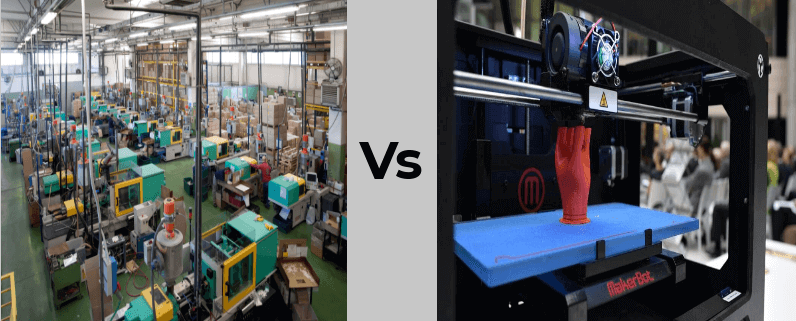
3D printing is not a replacement for every manufacturing process. The right choice depends on part geometry, production volume, tolerance, surface finish, material requirements, lead time, and total cost.
The table below compares 3D printing with common traditional manufacturing methods.
For metal parts, CNC machining, sheet metal fabrication, and casting are common alternatives. For plastic or resin-like parts, CNC machining, vacuum casting, and injection molding are often compared with 3D printing.
Manufacturing Method | Best For | Main Strengths | Main Weaknesses |
|---|---|---|---|
3D Printing | Prototypes, complex parts, low-volume production | No tooling, fast iteration, design freedom | Slower and more expensive at scale |
CNC Machining | Precision parts, engineering materials | High accuracy, excellent surface finish | Limited geometric complexity |
Sheet Metal Fabrication | Panels, brackets, enclosures | Cost-effective and scalable | Limited to sheet-based designs |
Vacuum Casting | Small production runs | Production-like appearance, low tooling cost | Limited mold life |
Injection Molding | High-volume plastic production | Lowest unit cost at scale | High upfront tooling investment |
Metal Casting | High-volume metal production | Economical for large quantities | Expensive tooling and setup |
Choose 3D Printing When
Fast prototyping is important.
The part contains complex geometry.
Production volume is low.
Customization is required.
Tooling costs need to be avoided.
Choose Traditional Manufacturing When
Production volume is high.
Tight tolerances are critical.
Surface finish requirements are demanding.
Certified production materials are required.
The design is stable enough to justify tooling.
In many projects, 3D printing complements rather than replaces traditional manufacturing.
Teams often use 3D printing for prototypes and early production before transitioning to CNC machining, casting, or injection molding for full-scale manufacturing.
Pros and Cons of Different 3D Printing Technologies
Different 3D printing technologies have different strengths and limitations.
FDM 3D Printing: Pros and Cons
FDM, or fused deposition modeling, is one of the most accessible 3D printing technologies. It uses thermoplastic filament to build parts layer by layer.
Pros:
Lower cost compared with many other 3D printing technologies
Good for simple prototypes, jigs, fixtures, and large non-cosmetic parts
Broad access to common thermoplastics
Useful for early design validation and functional concept testing
Cons:
Visible layer lines
Lower detail compared with resin printing
Strength depends heavily on print orientation and layer bonding
Not ideal for fine cosmetic surfaces or very small details
FDM is often a good choice when cost, speed, and basic functional testing matter more than fine detail or cosmetic finish.
SLA and DLP 3D Printing: Pros and Cons
SLA and DLP use light-cured resin to produce high-detail parts with smooth surfaces. These technologies are often used for visual prototypes, small detailed models, dental applications, and parts that need fine features.
Pros:
High detail and smooth surface finish
Good for visual models and fine features
Useful for small parts, appearance prototypes, and master patterns
Wide range of resin options for different visual and functional needs
Cons:
Resin handling and post-curing are required
Some resins may be brittle or UV-sensitive
Larger parts may be more limited by build volume
Functional performance depends strongly on resin type
SLA and DLP are strong options when surface detail is important, but resin material properties should be checked for functional use.
SLS and MJF 3D Printing: Pros and Cons
SLS and MJF are powder-bed processes commonly used for nylon parts. They are useful for functional prototypes, small-batch production, clips, brackets, housings, and complex plastic parts.
Pros:
No support structures are required for many geometries
Good for complex nylon parts and functional prototypes
Suitable for small batches and nested builds
Better mechanical performance than many basic prototype processes
Cons:
Surface can be grainy without post-processing
Powder handling and cleaning are required
Color and finish options may depend on post-processing
Material options are more limited than conventional plastic manufacturing
SLS and MJF are often good choices for functional plastic parts before injection molding or for low-volume nylon production.
Metal 3D Printing: Pros and Cons
Metal 3D printing is used for complex metal parts, lightweight structures, high-value prototypes, and components that are difficult to machine or cast. Common applications include aerospace, medical, energy, automotive, and advanced industrial parts.
Pros:
Complex metal geometries can be produced without traditional tooling
Lightweight structures and internal channels are possible
Useful for high-value, low-volume metal components
Can reduce material waste for expensive alloys in some applications
Cons:
Higher cost than many polymer 3D printing technologies
Support removal, heat treatment, and machining may be required
Surface finish is usually not final without post-processing
Certification and qualification can be demanding
Metal 3D printing is most valuable when complexity, performance, or material efficiency justifies the higher process cost.
Conclusion
3D printing offers major benefits, including customization, rapid prototyping, and cost efficiency for low-volume production. It also supports sustainability and makes innovation accessible to more people. However, limitations in materials, build size, production speed, and intellectual property must be considered.
In short, 3D printing is best suited for customized, low-volume, or complex parts, while traditional manufacturing is still the go-to for mass production and high-strength materials.
New to Unionfab?
Get your 10% discount and start your first project today!
FAQs
What are the pros and cons of 3D printing?
The main pros of 3D printing are rapid prototyping, design freedom, low setup cost for small batches, customization, on-demand production, and reduced material waste in some applications. The main cons are post-processing requirements, build-size limits, material limitations, surface finish limits, slower mass-production speed, and process-dependent part strength.
What are the risks of 3D printing?
3D printing has several risks, including equipment malfunction, which can cause fires if not monitored properly, and material hazards, as certain plastics or resins emit toxic fumes. Intellectual property issues can also arise since designs can be easily copied and distributed.
Additionally, poor quality control and inconsistent print outcomes may affect the final product's durability and usability.
What is the biggest problem with 3D printing?
One of the biggest challenges in 3D printing is material limitations. Many 3D printers can only work with specific materials, and even then, the strength, flexibility, and durability of these materials may not match those of traditionally manufactured products.
This can restrict the types of products that can be created and may not meet industry standards for certain applications.
Is it toxic to 3D print?
It can be, depending on the materials used. Some 3D printing filaments, like ABS, release potentially harmful fumes when heated, and certain resins used in stereolithography (SLA) printers are toxic to touch before they’re cured.
Using proper ventilation, wearing protective gear, and choosing safer materials, such as PLA, can help minimize toxicity risks.
How expensive is it to 3D print?
The cost of 3D printing varies widely based on printer type, material, and project complexity. Basic desktop printers and affordable filaments like PLA may keep costs low for hobbyists.
However, industrial-grade printers, high-quality materials, and professional services can be more costly, especially for complex or large-scale projects, with prices ranging from hundreds to thousands of dollars.
What is the most common 3D print fail?
Layer shifting and warping are two of the most common 3D printing failures. Layer shifting occurs when the printer head moves out of alignment during the printing process, leading to a distorted object.
Warping happens when the bottom layers of the print cool and shrink unevenly, causing the corners to lift off the build plate. Ensuring proper bed leveling, using adhesion aids, and controlling temperature settings can help reduce these issues.